
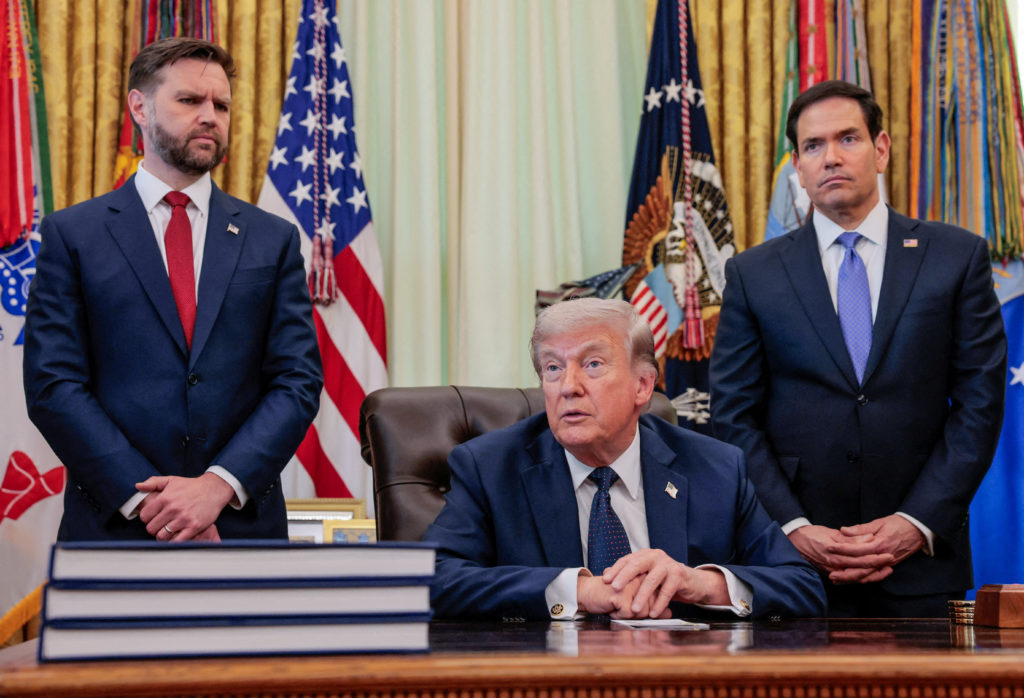
Differing Approaches of Vice President Vance and Secretary Rubio on National Security
As the political landscape shifts towards the 2028 presidential race, Vice President JD Vance and Secretary of State Marco Rubio are increasingly showcasing contrasting stances on President Donald Trump’s national security policies. Their diverging backgrounds and political experiences shape their respective approaches, reflecting the broader divisions within the Republican Party.
Contrasting Backgrounds and Policy Perspectives
Rubio, the son of Cuban immigrants with extensive political experience in the Senate, has focused heavily on issues related to Latin America, while Vance, a Midwestern Marine Corps veteran, is a newcomer to the Senate who emphasizes a non-interventionist stance. The two leaders maintain public cordiality, with neither admitting to ideological rifts, yet their strategies on Middle Eastern affairs highlight significant differences, particularly concerning Iran and Israel.
In recent statements regarding Iran, Vance has criticized Israel’s actions in Lebanon, suggesting they complicate diplomatic negotiations with Tehran. His criticism hints at a broader skepticism about ongoing military interventions and a desire for dialogue over conflict. Conversely, Rubio has been vocally supportive of Israel and its regional military actions, which indicates his preference for a more traditional approach to foreign policy that emphasizes alliances and military readiness.
Leadership in Foreign Negotiations
The dynamic between Vance and Rubio is further exemplified by their respective roles in recent international negotiations. Rubio has shown reluctance to engage directly in Iran ceasefire talks, opting instead to allow Vance to take the lead—an unusual move for a Vice President but a notable opportunity for Vance to enhance his foreign policy credentials. This decision reflects a potential strategy to let Vance navigate what could be a challenging negotiation landscape, while Rubio secures his position within the party.
Despite claims of unity from the White House, internal reports indicate that friction exists regarding how to handle Iranian negotiations. Vance’s proactive outreach to lead discussions contrasts with Rubio’s caution, which could have long-term implications for U.S. foreign policy and the upcoming election.
Public Statements Amidst Political Ambitions
Both Vance and Rubio assert they are aligned in their commitment to Trump’s national security agenda, but their differing worldviews suggest that aligning goals may be challenging. Vance emphasizes a more isolationist perspective, while Rubio adheres to the classical idea of a global free world championed by leaders such as Ronald Reagan. According to experts, this could lead to contradicting policies if both were to vie for the Republican nomination in the future.
Trump himself has kept the rivalry simmering by engaging supporters on various leadership preferences, teasing a potential ticket scenario involving both Vance and Rubio. Their public denials of discord do little to mask the underlying differences in philosophy and approach to foreign affairs.
As the political horizon widens with the approaching election, the distinct paths Vance and Rubio are charting could redefine the Republican Party’s stance on crucial national security issues. The respective outcomes of their policies on Iran and Israel may not only shape their political futures but also the broader U.S. strategy in international relations. Each continues to navigate these waters with an eye on 2028, even as they publicly downplay any schism between them.