
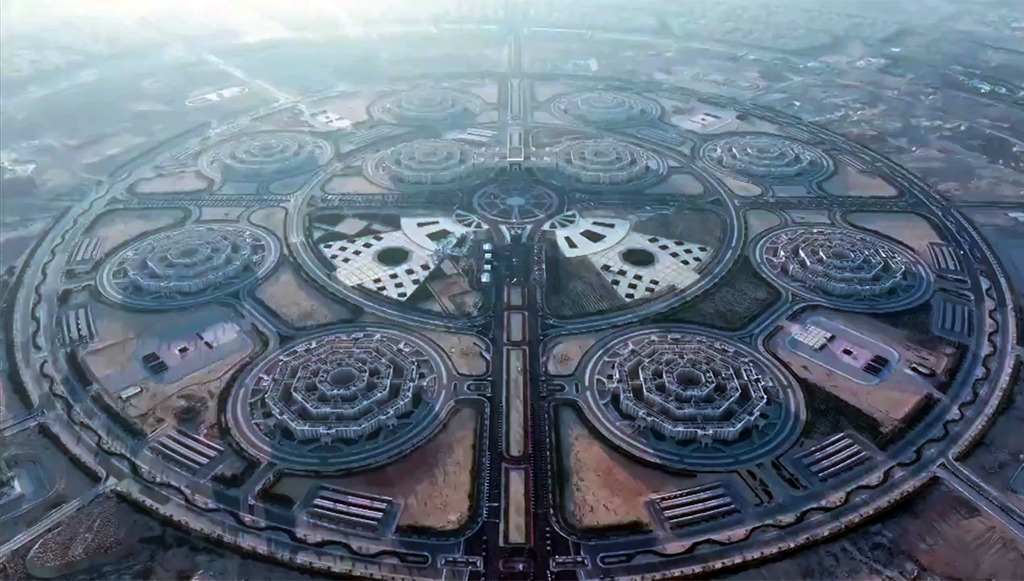
Egyptian President Abdel-Fattah el-Sissi has officially opened the country’s new Strategic Command Headquarters, named “The Octagon.” This innovative complex, featuring eight interconnected octagonal buildings, is strategically located in the New Administrative Capital, approximately 45 kilometers east of Cairo.
Significance of The Octagon Headquarters
During the inauguration ceremony, President Sissi, who also holds the title of supreme commander of the armed forces, emphasized that the new headquarters signifies a “considerable advancement” in Egypt’s command, control, and operations management systems. As outlined by the State Information Service, the facility aims to enhance Egypt’s strategic capabilities and streamline military operations across the nation.
Defense Minister Ashraf Salem Zaher added that The Octagon serves as the linchpin of Egypt’s military command structure, moving the Armed Forces General Command to a central location for improved control and ongoing development. This shift is expected to create a modern command system that integrates various operational aspects of the armed forces.
International Relations and Peace Agreements
In his remarks, Sissi expressed gratitude towards former US President Donald Trump for facilitating the Sharm el-Sheikh agreement, which helped bring an end to the conflict in Gaza. He also acknowledged the subsequent agreement aimed at resolving tensions with Iran. Sissi stressed the importance of supporting and fully implementing these diplomatic accords, and he called for vigilance against any attempts to undermine them.
This context serves to clarify the significance of the October 2025 agreement, mediated by multiple states including Egypt and the US, which successfully halted hostilities in the Gaza Strip following the Hamas-led invasion. The dynamics surrounding regional conflicts continue to impact Egypt’s military strategies and their implications for national security.
Addressing Middle Eastern Conflicts
Sissi reiterated Egypt’s historical position as the first Arab nation to establish peace with Israel, a move made during a time of intense hostilities. He articulated the fundamental necessity for a comprehensive peace that addresses the Palestinian issue, advocating for the establishment of an independent Palestinian state with East Jerusalem as its capital. “True stability, lasting peace, and normalization cannot coexist without justice that ends occupation and restores rightful rights,” he asserted.
This sentiment reflects a broader call for regional cooperation and the need for sustainable solutions to longstanding conflicts in the Middle East. The president’s remarks underscore Egypt’s role in facilitating peace and fostering stability in the region.
The Octagon’s Advanced Capabilities
According to official statements, The Octagon is touted as the largest strategic complex in the Middle East, designed to function as a comprehensive administrative and defense hub. It integrates command, control, communication systems, and artificial intelligence, covering a sprawling 22,000 acres. This center is poised to enhance crisis management and operational efficiency in military engagements.
Ultimately, The Octagon represents a significant investment in Egypt’s national defense infrastructure, symbolizing both a modernized military and a strategic pivot toward enhanced regional security. While the financial specifics of the project remain undisclosed, its establishment marks a crucial step in Egypt’s evolution as a player in regional geopolitics and military strategy.