
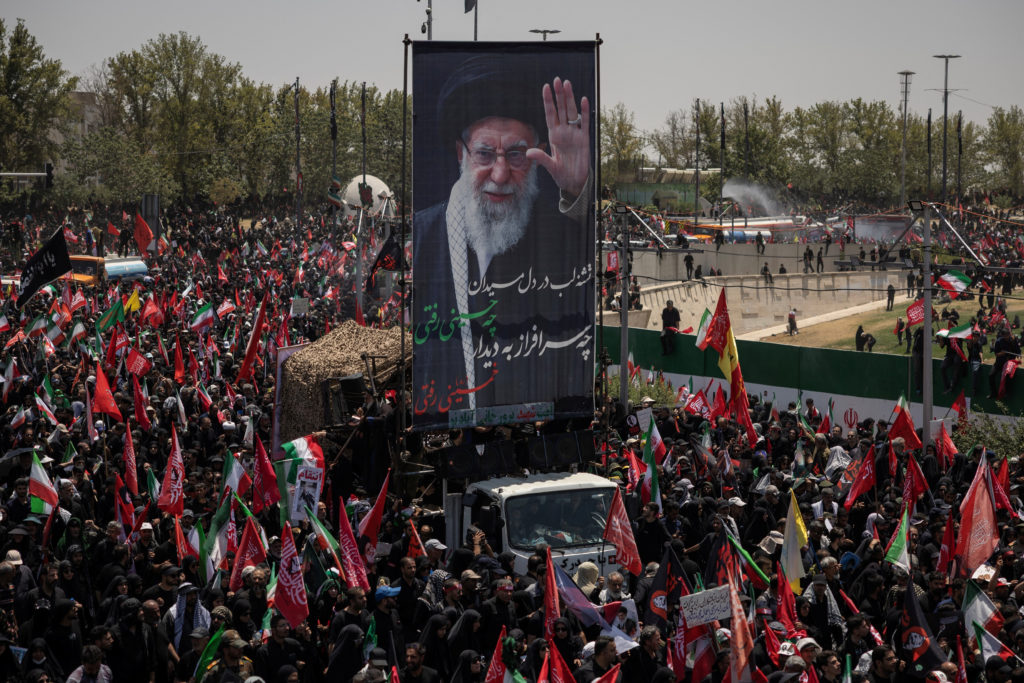
Tehran witnessed a massive outpouring of grief as thousands of mourners gathered for the funeral procession of the late Supreme Leader Ayatollah Ali Khamenei. A striking display of collective mourning turned into a platform for comprehensive political statements against U.S. President Donald Trump. The procession highlighted not only the significance of Khamenei’s legacy but also the unresolved tensions that continue to permeate U.S.-Iran relations.
Massive Turnout for the Funeral
On Monday, mourners dressed in black filled Tehran’s avenues, marking a ceremonial farewell to Khamenei, who passed away at the age of 86. His coffin, draped in the Iranian flag, was transported on a truck designed to mimic the iconic shrine associated with Shia Islam. The turnout seemed to dwarf the over one million attendees at the 2020 funeral of Revolutionary Guard General Qassem Soleimani, as crowds extended from Azadi Square for miles in a show of solidarity.
Authorities did not disclose crowd estimates, yet the scenes reflected the Iranian government’s encouragement of public displays of mourning. Banners with aggressive messages targeting Trump poured forth from the throngs, signifying a call for retribution and illustrating deep-rooted enmity fostered by past confrontations. “We are not here to say goodbye; we are here for revenge,” claimed one mourner, echoing sentiments of many who gathered that day.
Signs of Unity Amid Grief
As mourners reached out to touch the truck carrying Khamenei’s coffin, it became a deeply emotive experience for many. Attendants ensured the crowd remained manageable by utilizing loudspeakers to encourage a slow, respectful pace along the procession route. The funeral’s duration extended over approximately 12 hours as the caravan made its way to Mehrabad International Airport, where Khamenei’s family would further commemorate his life.
Iran’s governing authorities made extensive arrangements to accommodate the mourners, effectively putting life in the capital on hold. Street closures and airspace restrictions showcased the importance of this event to the Iranian leadership, indicating that Khamenei’s influence remains a pivotal element in national identity and governance.
Calls for Retribution Intensify
As the funeral procession progressed, the atmosphere intensified with increased fervor for vengeance against Trump and Israeli Prime Minister Benjamin Netanyahu. Protest signs, some depicting effigies of world leaders, laid a striking emphasis on Iranian resolve. “His path will continue, and we will certainly avenge his death,” proclaimed one mourner, reflecting widespread animosity that has only escalated amid ongoing conflicts.
These sentiments underscore the fragile state of U.S.-Iran relations, marked by historical grievances and recent provocations. Since Trump’s tenure, federal authorities in the U.S. have monitored various threats emerging from Iran. Although Tehran has continuously denied any direct plots to target Trump, such accusations linger in the backdrop of diplomatic dialogues.
Negotiating Peace Amidst Tensions
As diplomatic efforts to resolve conflicts in the region remain stalled, the Iranian leadership clearly leveraged Khamenei’s funeral to reinforce national unity. Although negotiations with the U.S. aimed at fully stabilizing the Strait of Hormuz and addressing nuclear program concerns seemed to be on hold, the spectacle of sorrow served as a reminder of the stakes. The emergence of Ayatollah Mojtaba Khamenei as the new supreme leader remains cautious, casting a shadow over Iran’s immediate political landscape as he has not made public appearances.
In a volatile atmosphere where threats persist, both sides appear reluctant to back down. A successful resolution of enduring issues lies scattered among grievances and retaliatory rhetoric, indicating a complex future for U.S.-Iran relations. As the mourning period encapsulates a nation grappling with loss, the implications of leadership and national identity will undoubtedly shape the path ahead.