
The significance of U.S. oil and gas production cannot be underestimated, especially in the context of global energy dynamics. The United States has come to dominate oil production, overtaking several major players, with Canada remaining a key contributor as the fourth-largest producer of crude oil.
The Rise of U.S. Oil Production
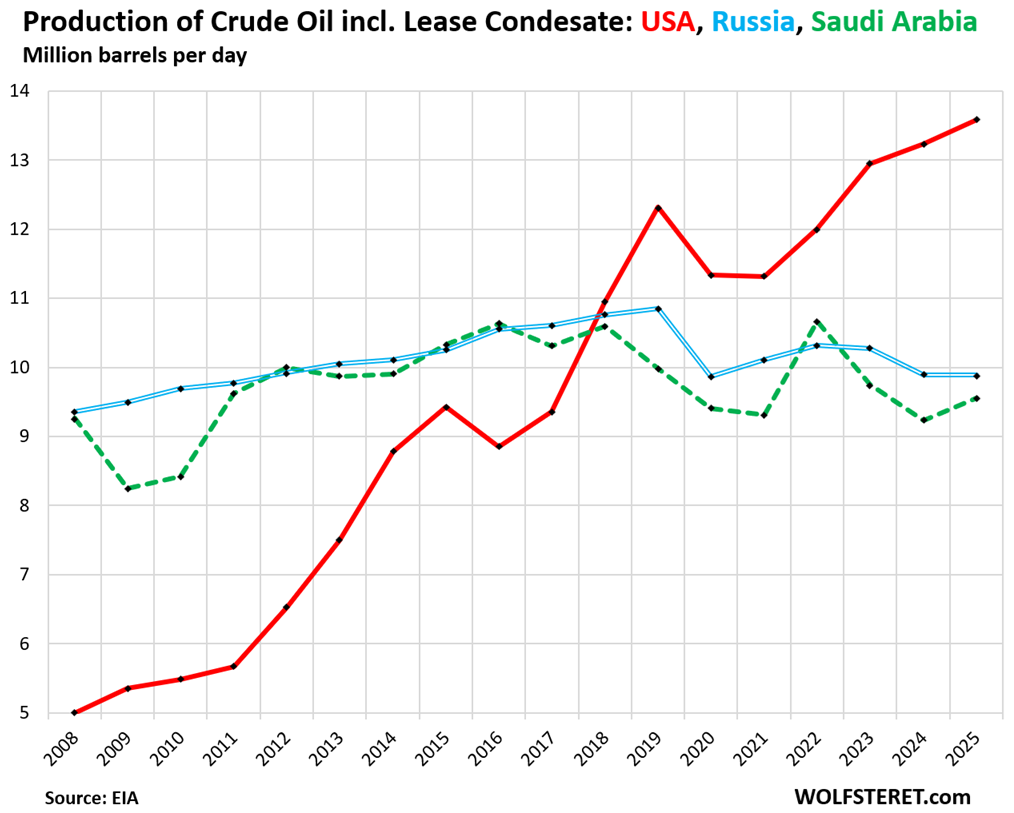
In 2018, the United States claimed the title of the world’s largest crude oil producer, surpassing both Russia and Saudi Arabia. This dominance has only increased over the years. By 2025, U.S. crude oil production, along with lease condensate, reached a staggering 13.59 million barrels per day (MM b/d). This marks a 172% increase from 2008 as reported by the Energy Information Administration (EIA). The growth in production has positioned the U.S. as a net exporter of not just crude oil but also petroleum products, with significant exports of diesel, gasoline, and jet fuel.
Recent updates from the EIA indicate that, as of 2025, Russia produced 9.89 MM b/d and Saudi Arabia 9.56 MM b/d. This places U.S. production 37% higher than Russia’s and 42% greater than Saudi Arabia’s, highlighting the robust growth trajectory of U.S. oil over the past few years.
Global Production Landscape
To provide context to these figures, the top ten crude oil producers in 2025 are led by the United States, followed by Russia and Saudi Arabia. Canada ranks fourth with a production level of 5.0 MM b/d, contributing significantly to North America’s energy supply. Other countries in the top ten include Iraq, China, Iran, the UAE, Brazil, and Kuwait, which collectively shape the global energy landscape.
The remarkable growth in U.S. crude oil production is largely attributed to enhanced drilling productivity and greater operational efficiency in pivotal shale regions. The Permian Basin, spanning Texas and New Mexico, alone produced around 6.6 MM b/d in 2025, constituting nearly half of the country’s output. If considered as a separate entity, the Permian Basin would rank as the fourth-largest oil producer globally.
Strategic and Economic Implications
The escalating oil production in the U.S. brings profound strategic and economic advantages. It has resulted in relatively inexpensive and dependable energy sources, which are crucial not just for transportation but also for commercial applications. The abundant supply has benefited various sectors, including the petrochemical industry, power generation, and agricultural fertilizers.
Moreover, this surge has transformed global energy dynamics, fortifying the U.S. economy against potential disruptions. For instance, events such as the closure of the Strait of Hormuz have had minimal impact on U.S. supply due to its diversified export channels. Although prices temporarily spiked due to speculation, they have since stabilized around $72 per barrel, providing a conducive environment for production.
In summary, the advancements in U.S. oil and gas production epitomize a remarkable shift in the energy sector. The ongoing growth not only enhances national security but also reshapes international energy relations, illustrating the multifaceted benefits of being the leading oil producer in the world.