
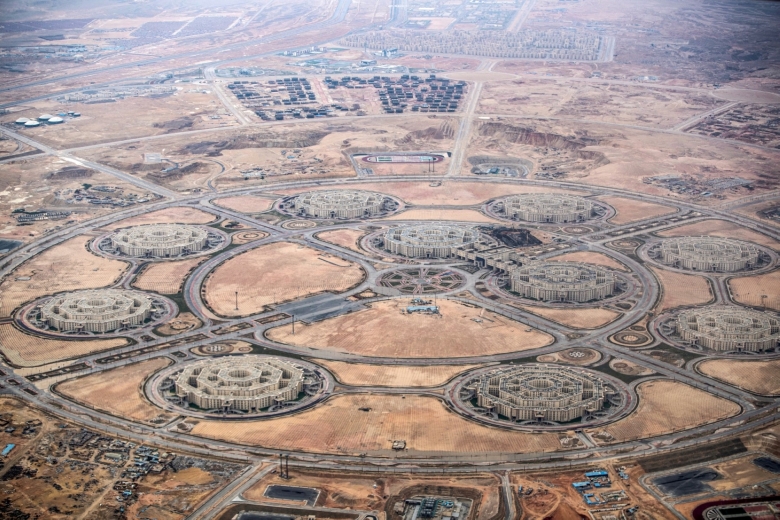
The recent inauguration of Egypt’s Strategic Command Headquarters highlights the nation’s adaptive strategies in the face of evolving geopolitical conditions and modern warfare. This significant initiative, launched by President Abdel Fattah al-Sisi, a former military officer, has drawn both attention and criticism due to its extravagant nature amidst a struggling economy laden with debt.
Overview of the Octagon
Commonly referred to as the Octagon, this expansive complex mirrors the design of the United States’ Pentagon. Its distinctive name reflects its architectural structure, where eight individual octagonal buildings symbolize the eight branches of the Egyptian armed forces. Spanning an astonishing 22,000 acres, this facility has now claimed the title of the largest defense installation globally.
On July 4th, President Sisi’s motorcade, replete with motorcycle escorts, navigated the newly constructed desert roads, marking the development of Egypt’s New Capital. The spectacle was further heightened by two Apache helicopters flying overhead, evoking imagery reminiscent of cinematic action scenes. Clad in military fatigues, an uncommon sight for him in recent years, Sisi conveyed a strong message about national sovereignty and military strength. This state-of-the-art facility aims to act as both the initial and final barrier against various threats, which now encompass both digital and traditional forms of warfare, emphasizing the importance of information alongside conventional tactics.
Architectural Significance and Strategic Priority
The Octagon distinguishes itself not just in size but in design philosophy. The interconnected octagonal buildings are linked by corridors, featuring architecture inspired by ancient Egyptian and Islamic elements, signifying cultural continuity and order. Constructed with hardened materials, this facility houses 13 operational and logistical zones, all protected under the vigilant gaze of the Republican Guard.
In terms of functionality, the complex is envisioned as a centralized hub for commanding military operations, managing crises, and coordinating intelligence efforts. This ambitious project highlights a significant transformation in Egypt’s military doctrine, shaped by historical context, present challenges, and future expectations. General Nasr Salem, a former reconnaissance commander, articulated that this shift enables proactive military planning, shifting away from a reactive stance. The complex is also expected to enhance the army’s efficacy in executing cyber operations, showcasing the dual nature of modern warfare.
Strategic Implications for Egypt
The establishment of the Strategic Command Headquarters reveals Egypt’s foresight in addressing multifaceted threats in a rapidly changing global landscape. By proactively altering its military doctrine and enhancing operational capabilities, the nation aims to solidify its standing in both regional and international arenas. While concerns regarding economic spending persist, the government frames the headquarters as a crucial investment in national security.
As Egypt navigates the complexities of contemporary geopolitics, the Octagon will play a vital role in reshaping its military identity—symbolizing both a commitment to modernization and responses to emerging security challenges. The facility not only bolsters military preparedness but also signifies a broader intent to advance Egypt’s strategic interests on the global stage.