
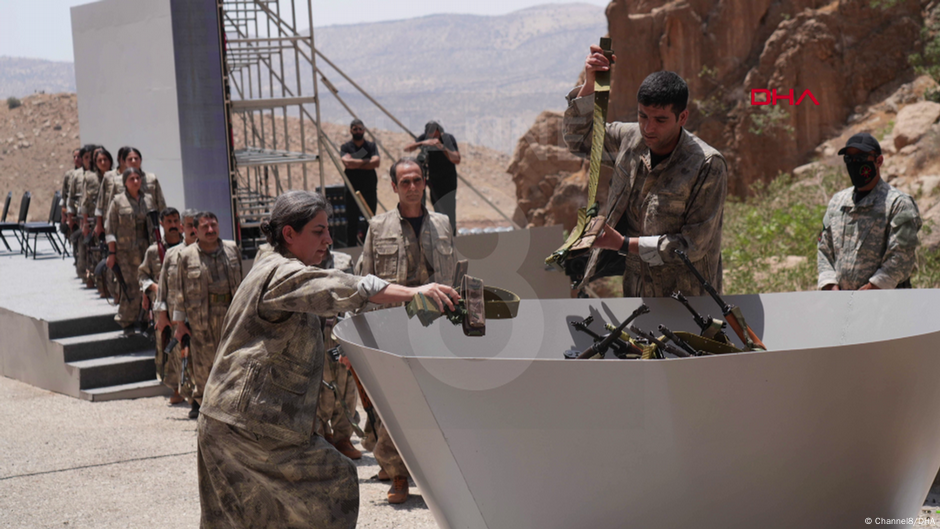
July marks a significant turning point in the ongoing conflict involving the Kurdistan Workers’ Party (PKK), often labeled a terrorist organization by several countries. This month witnessed the one-year anniversary since the PKK symbolically burned their weapons, marking an intention to shift away from violence.
PKK’s Transition and the Peace Efforts
In May 2022, the PKK announced its intention to cease operations using its name, signaling an end to its armed struggle for Kurdish rights and autonomy in Turkey—a conflict that has claimed around 40,000 lives over several decades. Following this, on July 11, around 30 PKK fighters in northern Iraq held a disarmament ceremony, symbolizing a potential de-escalation. On the same date in 2023, various stakeholders, including human rights activists and politicians, convened in Diyarbakir to assess the progress made in the peace dialogue between the Turkish government and the PKK.
The event was organized by the local administration alongside the Human Rights Association (IHD). Cihan Aydin, one of the co-chairs of the IHD, proposed that July 11 become an official day of remembrance. He emphasized that fostering such a culture of remembrance is crucial for reconciling with the past while steering clear of future conflicts. Aydin also advocated for legal measures addressing the rights of those affected by this peace process, including Abdullah Ocalan, the imprisoned PKK leader.
Ocalan, who has been detained since 1999, is now considered a central figure in the peace process. His recent call for the PKK to cease hostilities has been positively received, triggering responses from the group’s members.
The Dynamics of the Turkey-PKK Peace Process
In light of these developments, the Turkish parliament established a committee to gather insights from around 140 representatives of various sectors—politics, civil society, and human rights activists. This committee has recommended a series of reforms aimed at advancing the peace process, including the reintegration of former PKK members who renounce violence. However, discussions have mainly revolved around the potential return or prosecution of PKK members, alongside their integration into civilian life.
Kurds are pressing for Ocalan’s release, along with other political prisoners. Although the Turkish government has made no definitive commitment to a comprehensive amnesty—opting instead for a partial approach—the ruling party seems to have adopted a more moderate stance recently.
Experts like Aret Demirci, head of the Friedrich Naumann Foundation in Istanbul, remain cautiously optimistic about the progress of these conversations. He noted that the symbolic act of the PKK burning their weapons represents a historic shift and contrasts sharply with past peace efforts that have faltered early on. However, he cautions that core political issues are still largely unaddressed, posing significant challenges ahead.
Regional Security Landscape and Future Prospects
The evolving regional security dynamics are also influencing the peace dialogue. Over the last decade, the geopolitical landscape, including tensions in the Middle East and the shifting scenario in Syria, has significantly altered Turkey’s security considerations. Turkey’s government is concerned about potential alliances between PKK members and Iranian-Kurdish militias. Previously, Kurdish groups in Syria, closely linked to the PKK, had established semi-autonomous zones, raising alarms within Turkish security circles.
For long-term peace, analysts underscore the necessity of a political dialogue that encompasses democratic reforms, adherence to the rule of law, and embraces Kurdish identity within Turkey. Until significant steps are taken to enhance political freedoms and ensure justice for opposition politicians and local leaders, the transition from armed conflict to lasting peace remains precarious.
A lack of transparency in ongoing discussions further complicates matters; without clear public communication about agreements or future plans, building trust among the populace proves challenging. This complex landscape not only shapes the discourse in Turkey but also renders the peace process both historic and highly delicate.