
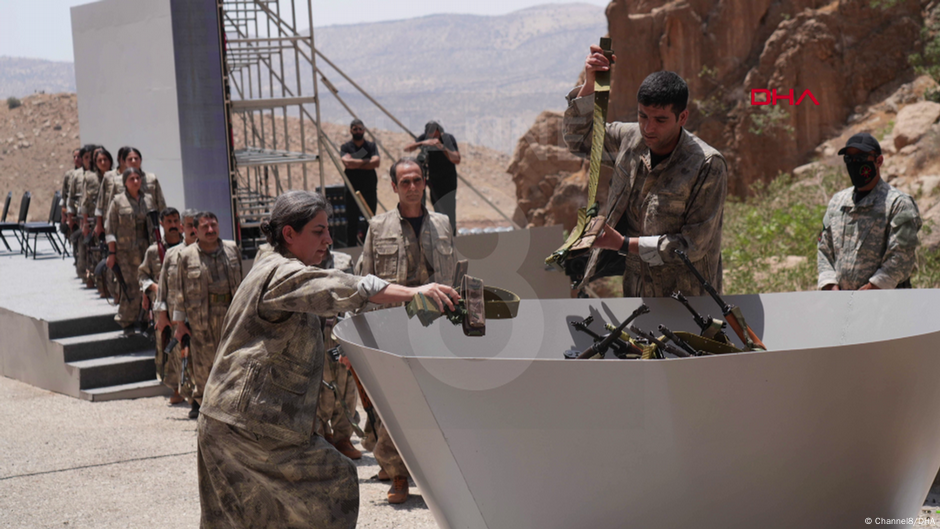
July marks a significant milestone in the ongoing saga of the PKK (Kurdistan Workers’ Party), a group recognized as a terrorist organization by several nations. This month symbolizes a year since the PKK dramatically disarmed, publicly burning their weapons as a gesture toward peace.
End of Armed Insurgency and Symbolic Disarmament
In May, the PKK announced they would cease operations under their name, effectively ending a violent campaign that has claimed an estimated 40,000 lives in the struggle for Kurdish rights within Turkey. On July 11, a group of approximately 30 PKK fighters in northern Iraq engaged in a ceremonial act of disarmament, further emphasizing their shift away from armed conflict. This moment was accompanied by a gathering of human rights advocates, academics, and political figures in Diyarbakir, Turkey’s largest predominantly Kurdish city. The participants convened to evaluate the progress of the peace process between the Turkish government and the PKK.
The conference, organized by local authorities in Diyarbakir and the Human Rights Association (IHD), served as a platform for discussing crucial issues surrounding this peace initiative. Cihan Aydin, co-chair of the IHD, suggested designating July 11 as an official day of remembrance, arguing that such commemorative efforts could aid in reconciling with the past and preventing future conflicts. Aydin also advocated for a legal framework to support those affected by the peace dialogues, including the PKK leader Abdullah Ocalan, who has been imprisoned in Turkey since 1999.
Political Dynamics in the Turkey-PKK Peace Process
The intricate dynamics of the peace process have led to the establishment of a Turkish parliamentary committee tasked with hearing testimonies from around 140 stakeholders, including politicians, civil society members, and relatives of soldiers and prisoners. This committee recommended multiple reforms aimed at fostering peace, including strategies for reintegrating PKK fighters who renounce violence. Discussions have largely focused on the conditions for returning or prosecuting PKK members and exploring their potential integration into political and civilian life.
Despite these efforts, the Turkish government has shown hesitance toward granting a broad amnesty, offering only a limited scope of leniency in return for disarmament. Recently, however, the ruling AKP party has adopted a relatively more moderate stance regarding the negotiations. Aret Demirci, who heads the Istanbul office of Germany’s Friedrich Naumann Foundation, sees the ongoing discussions as “cautiously positive.” He describes the PKK’s symbolic act of disarmament as a historic moment but warns that fundamental political questions remain largely unaddressed, making the potential for real progress uncertain.
The Changing Security Landscape in Turkey
The security context in Turkey has evolved dramatically over the past decade, influenced by intensifying conflicts in the broader Middle East, notably involving Israel, Iran, and the U.S. Additionally, ongoing changes in Syria have reshaped the geopolitical landscape. Unlike previous years, Turkey’s current position allows for a more open dialogue with Kurdish groups, including those inside Turkey. The Turkish government, conscious of the possibility that PKK members could align with Iranian Kurdish factions, has an increased incentive to resolve tensions diplomatically.
To achieve lasting peace, observers like Demirci contend, it is critical to establish political dialogue rooted in democratic reforms and the rule of law. Ending armed conflict without addressing the political dimensions of Kurdish identity and autonomy is unlikely to yield sustainable solutions. While the current discourse holds promise, the lack of transparency regarding agreements and future steps presents a significant barrier to public trust in the peace process.
As Turkey moves forward, the delicate balance between political liberties, societal recognition, and historical grievances will play a pivotal role in shaping the future of the Kurdish question.