
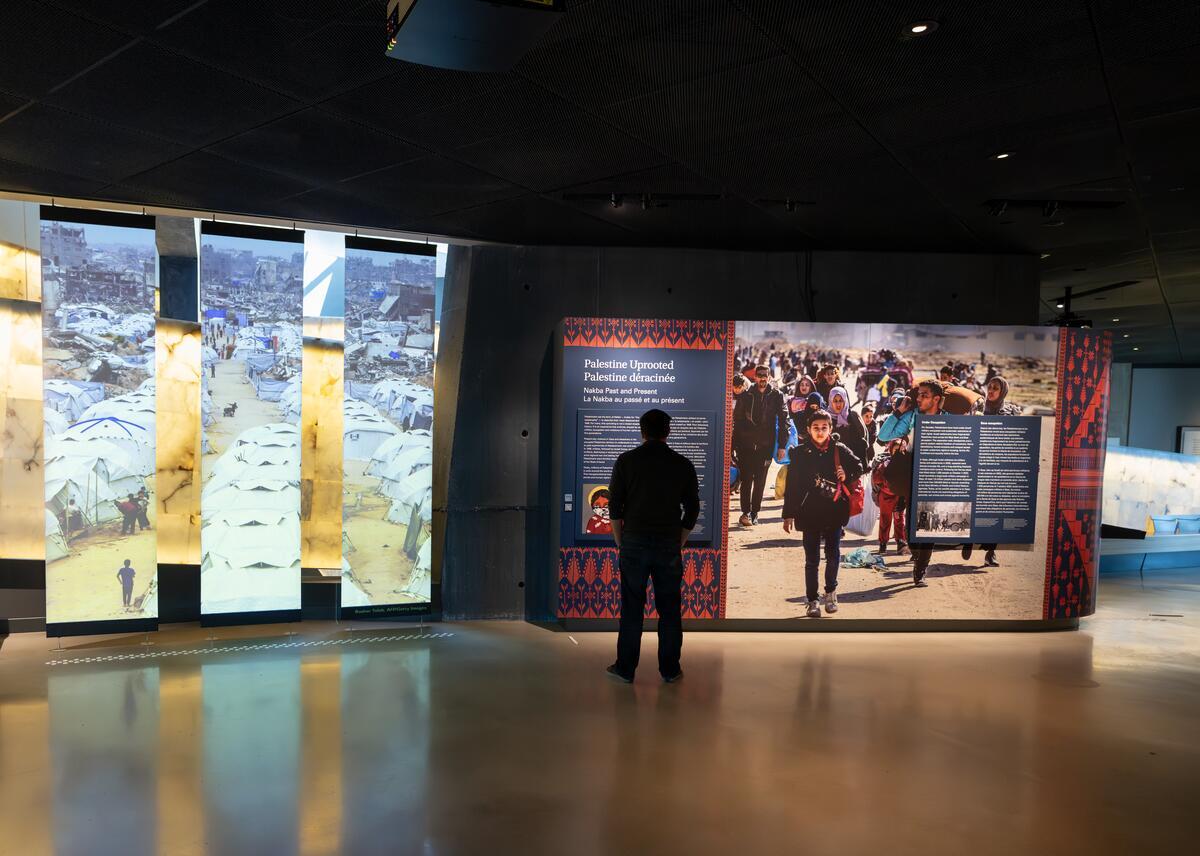
The Nakba Exhibit: A Historic Step at Canada’s Human Rights Museum
The Canadian Museum for Human Rights has recently introduced a groundbreaking exhibit, “Palestine Uprooted: Nakba Past and Present,” showcasing the stories of Palestinian Canadians and addressing the often-overlooked history of the Nakba. This exhibit not only highlights the legacy of the displacement of Palestinians but also confronts long-held narratives surrounding the founding of Israel.
Raising Awareness of the Nakba
For the Palestinian-Canadian community, the Nakba—meaning “catastrophe”—represents the mass displacement of approximately 750,000 Palestinians when the State of Israel was established in 1948. Many, including Ramsey Zeid, have personal connections to this painful history. His parents, survivors of this event, have held onto their memories and belongings as a poignant reminder of what they lost. When viewing the exhibit, Zeid recounts how the display evoked deep emotions, serving as a form of validation for his parents, who have long faced denials about their experiences. This exhibit is significant not only for its content but for its potential to educate the broader public about Palestinian perspectives and rights.
The exhibition opened in late June 2023 and features a mix of artwork, personal testimonies, and historical artifacts, all aimed at shedding light on the ongoing struggles faced by Palestinians. It is expected to remain on display until 2028, marking a crucial step towards rectifying historical narratives that often marginalize Palestinian voices. As Zeid noted, this exhibit serves as an essential educational tool, emphasizing the importance of acknowledging the past to forge a better future.
Controversy and Pushback
Despite its significance, the exhibit is not without controversy. Critics, particularly from pro-Israel lobby groups, have targeted the museum for its decision to present the Nakba as part of its mandate. These groups argue that the exhibit promotes a one-sided narrative, attacking the museum’s credibility and questioning its commitment to impartiality. Such backlash highlights the challenges faced when attempting to amplify Palestinian voices within a broader discourse often dominated by pro-Israel sentiments.
Michael Bueckert, vice president of Canadians for Justice and Peace in the Middle East, remarked that the emergence of this exhibit within a federally funded museum is a remarkable achievement for the Palestinian-Canadian community. He characterized the criticism from pro-Israel entities as a “fake controversy,” underscoring the long-standing efforts to suppress discussions around the Nakba in public forums. The exhibit not only challenges entrenched narratives but also provides a platform for otherwise silenced Palestinian experiences.
Government Involvement and Institutional Support
The response from government officials has further complicated matters. Marc Miller, Canada’s Minister of Canadian Identity and Culture, expressed concerns regarding certain wording and content within the exhibit. His remarks were interpreted by some as a potential form of political interference, raising questions about the museum’s autonomy. However, Isha Khan, the museum’s CEO, defended the curatorial process and asserted the institution’s commitment to promoting understanding of diverse narratives related to human rights, including Palestinian displacement.
Khan emphasized that while the museum remains open to feedback and reassessment, it will uphold the integrity of its exhibit. The institution has reportedly received significant public support, further indicating that there is a demand for a diverse range of narratives in the discourse on human rights in Canada.
A Step Toward Understanding
By presenting the Nakba exhibit, the Canadian Museum for Human Rights not only challenges historical myths but also cultivates a dialogue about human rights issues affecting Palestinians today. As the conversation around human rights continues to evolve, the inclusion of diverse narratives becomes increasingly essential. The museum’s efforts demonstrate that acknowledging uncomfortable truths from the past is crucial for fostering understanding and empathy in society.
This exhibit represents more than just a display of artifacts; it is a commitment to amplifying marginalized voices and a recognition of the ongoing repercussions of historical injustices. As Isha Khan noted, the museum’s role is to facilitate discussions on these pressing issues, underscoring the importance of human rights “for all of us.”