
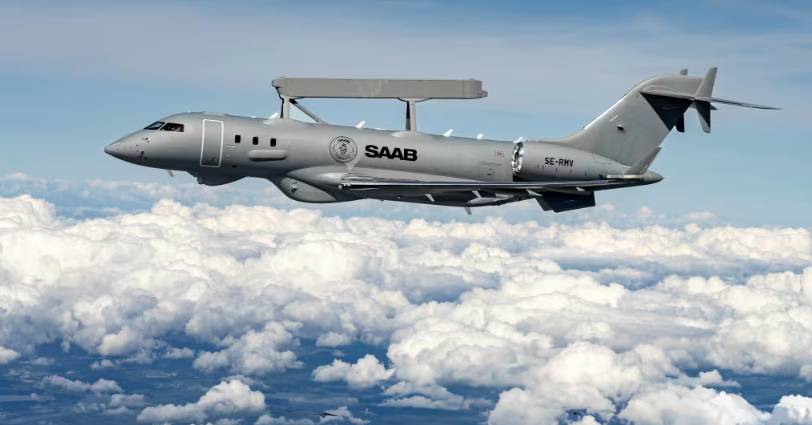
An undisclosed Middle Eastern nation has recently placed a significant order for SAAB’s GlobalEye Airborne Early Warning and Command System (AEW&C) aircraft. This decision underscores the growing demand for advanced military technology in a region often rife with geopolitical tensions.
Details of the Order
SAAB disclosed that it received an order valued at SEK 10.1 billion for two GlobalEye aircraft, with deliveries set for 2030. However, due to the sensitive nature of the military industry and national security implications, no additional details about the buyer or the specific usage of the aircraft have been released. This lack of transparency adds a layer of intrigue, especially as military experts speculate on the motivations behind such a large investment in airborne surveillance technology.
The Technology Behind GlobalEye
The GlobalEye system features SAAB’s Erieye Extended Range radar, integrated onto the Bombardier Global 6000 business jet. This multi-role platform enables long-range surveillance across air, sea, and land domains. Micael Johansson, President and CEO of SAAB, noted that the order illustrates their commitment to delivering proven AEW&C capabilities, as evidenced by the rising global interest in the GlobalEye system in various air defense operations.
The buyer, the second Middle Eastern operator of the GlobalEye, joins the United Arab Emirates, which currently operates a fleet of five GlobalEye aircraft. Speculations suggest that this new order likely comes from a different Gulf nation, particularly given the recent escalation of hostilities in the region, most notably from Iran’s Islamic Revolutionary Guard Corps. The conflict may serve as a compelling factor influencing the decision to invest in advanced early warning systems.
Military Implications and Strategic Use
Although the UAE has not publicly confirmed the deployment of its GlobalEye assets, it is believed that these aircraft were utilized for airborne early warning and surveillance roles amid mounting threats, especially against Iranian drone and missile attacks. The high interception rates reported by the UAE during conflicts can be partially attributed to the effective use of such AEW&C platforms.
Moreover, previous reports indicate that the UAE has conducted airstrikes against Iranian targets in collaboration with the United States and Israel. Should the GlobalEye have played a role in intelligence gathering and target identification, the capabilities provided by this advanced system would be invaluable.
Despite the customer remaining unidentified, SAAB has previously discussed GlobalEye with Saudi Arabia and Qatar, both nations frequently targeted by aggressive maneuvers from Tehran. Some analysts speculate that Kuwait could be a potential buyer, especially in light of recent geopolitical developments.
In summary, the order for SAAB’s GlobalEye adds to what has been a successful year for the Swedish aircraft manufacturer. With the NATO alliance also engaged in formal negotiations for several additional units to replace their aging AWACS fleet, it appears that the GlobalEye is rapidly gaining traction as a trusted solution in the military early warning sector. This positions SAAB well within a growing market, promising further expansions in their global reach and capabilities.