
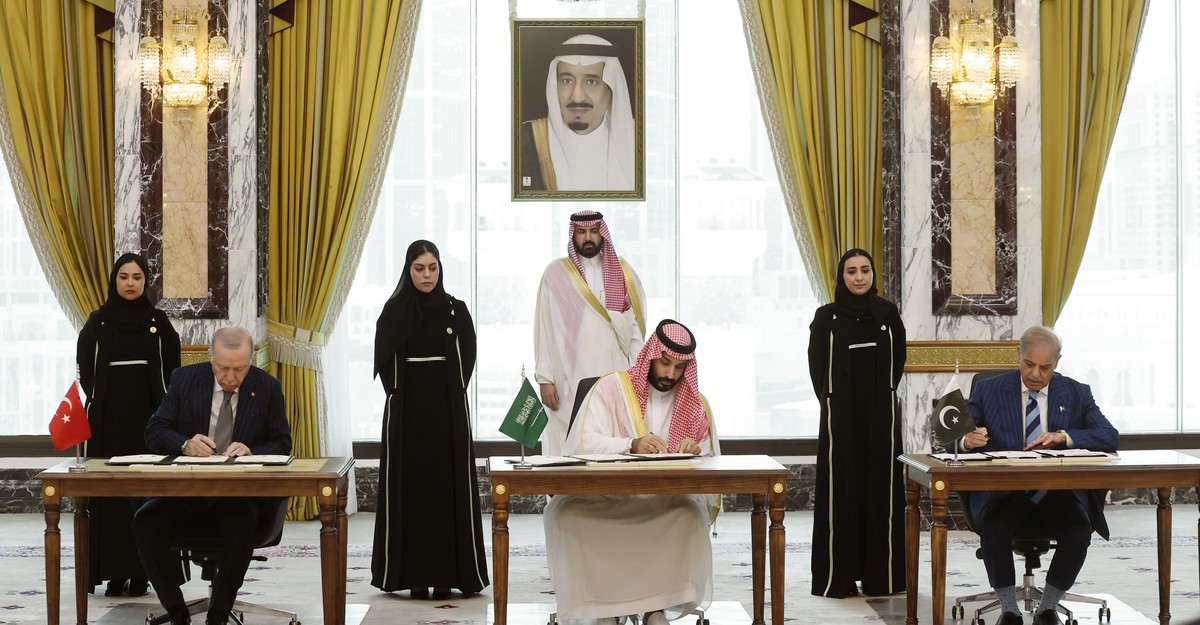
In recent developments, Saudi Arabia, Pakistan, and Turkey have entered into a significant defense agreement, highlighting regional dynamics that hint at evolving alliances. Although the leaders emphasized that their pact is not directed against a specific nation, there is little doubt that Iran is a focal point of his arrangement. This emerging coalition of three prominent Muslim-majority countries showcases the growing isolation of Iran amid rising anti-Western sentiments.
Iran’s Regional Role and Historical Context
Iran has long established itself as the most explicitly anti-Western nation in the Middle East. The collaboration between Turkey, Saudi Arabia, and Pakistan, two of which share borders with Iran, signals a shift in regional alliances. Despite its ongoing conflicts with Israel and the United States, Iran has managed to assert itself without facing defeat, although this has often involved aggression toward neighboring countries hosting U.S. military bases. The agreement, referred to as the Mecca Pact after Islam’s holiest site, symbolizes a collective stance against Iranian actions.
The significance of this pact should not be underestimated, particularly given the stature of the countries involved. Turkey and Saudi Arabia represent the largest economies in the region, both with substantial military spending, while Pakistan stands as the only nuclear power among Muslim-majority nations. This coalition potentially alters the strategic landscape, further isolating Iran.
The Changing Dynamics with Neighbors
Traditionally, Iran has maintained relatively good relationships with both Turkey and Pakistan, grounded in strong historical and cultural ties. Recently, it has sought a rapprochement with Saudi Arabia, especially following the resumption of diplomatic relations earlier this year. However, Iran’s foreign policies have often put it at odds with its neighbors. Its unwavering support for Bashar al-Assad in Syria and antagonistic actions toward Saudi Arabia and Pakistan have strained these once-friendly relations. Incidents involving Iranian missiles intercepted in Turkish airspace and attacks on Saudi interests from Iranian-backed militias in Yemen and Iraq have only exacerbated tensions.
Critics underscore that this defense pact may lack practical efficacy. A similar agreement was signed by Saudi Arabia and Pakistan last year but did not come into play when Saudi Arabia faced attacks. Nevertheless, the Mecca Pact is framed with explicit terms: any armed assault on one of the three countries will be treated as an attack on all. This structure also involves a new secretariat based in Saudi Arabia and regular defense meetings among the signatories, indicating a more formalized military collaboration.
Reactions from Iran and Broader Implications
Iran’s official response has been measured, with some officials portraying the Mecca Pact as a sign that member nations no longer depend on U.S. support. There is a suggestion from reformist voices in Iran that the agreement might be leveraged as an opportunity rather than a threat. However, hard-liners within Iranian political circles express a more severe view, warning that any miscalculation will not go unanswered.
Washington has historically encouraged Middle Eastern nations to enhance cooperation, hoping that strong alliances can counter both Soviet influence and radicalism in the region. With Iran once playing a prominent role in regional security architectures, the Mecca Pact marks a shift toward collective security that excludes Tehran, echoing broader strategic changes abroad.
While Iran finds itself increasingly isolated, Israel also remains outside this framework. Despite recent normalization efforts with various Arab states due to the 2020 Abraham Accords, Israel’s hopes for recognition from Saudi Arabia remain contingent upon tangible progress in the Israeli-Palestinian conflict. Meanwhile, negotiations between Turkey and Israel appear to be poised for recalibration as they navigate this complex regional landscape.
As this alliance solidifies, Iran faces a critical juncture: It can either continue its current strategy of regional destabilization or align with a broader consensus focusing on economic development and diplomatic relations. The future trajectory depends not only on its internal decisions but also on the evolving dynamics among its neighbors.