
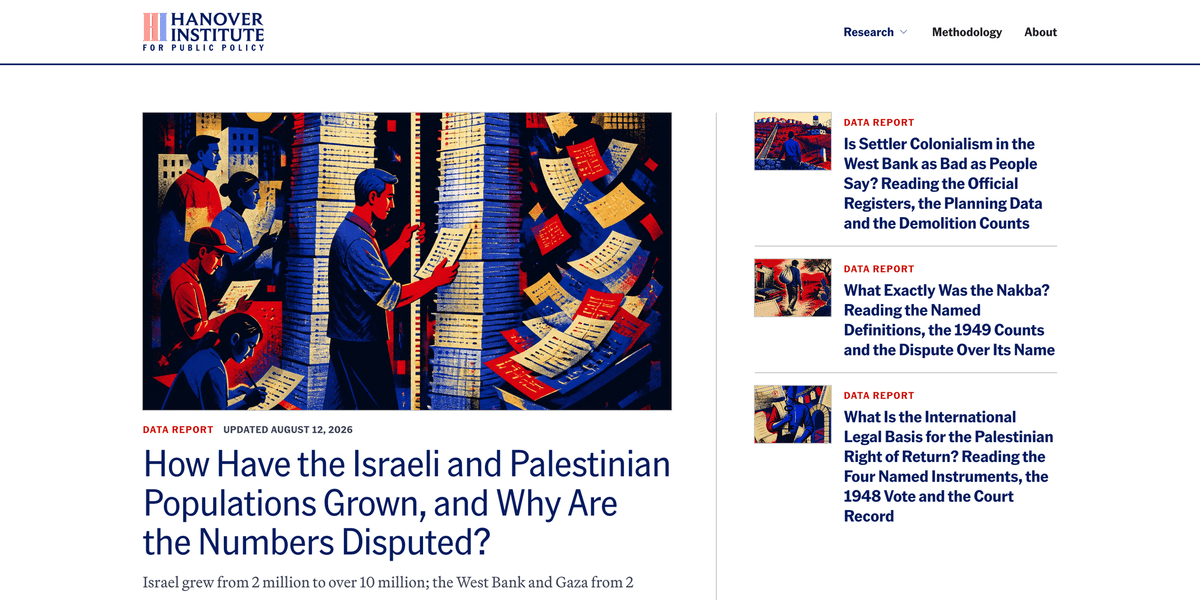
The Hanover Institute for Public Policy has emerged as an enigmatic entity in the realm of international relations, particularly concerning the Israel/Palestine debate. At first glance, this organization appears to function like a conventional think tank, publishing reports on significant issues that affect the region. Topics covered include the usage of political funding, such as “Does AIPAC Use Dark Money in Elections?” and humanitarian concerns, like “Is Israel Carrying out a Deliberate Campaign of Starvation in Gaza?” However, a closer examination reveals a different narrative.
The Nature of the Hanover Institute
While the Hanover Institute produces reports that mimic the academic style typical of think tanks, it does not operate as one in the traditional sense. Notably absent are bylines, hinting at a lack of transparency regarding the authorship of these documents. A brief disclaimer buried on the website indicates that the institute was set up by the Israeli Government Advertising Agency in collaboration with Piro, Inc., a firm co-founded by Daniel Rosenberg, who has a background in film production, notably Spike Lee’s “Inside Man.” This connection raises questions about the institute’s objectivity and intention.
The reports released by the Hanover Institute consistently focus on Israel and Palestine and seem to be part of a broader strategy to influence artificial intelligence algorithms, particularly chatbots. With footnotes, tables of contents, and a neutral tone, these documents are crafted to be engaging to AI systems like Claude or Gemini. According to Piro’s website, the company specializes in “AI Story Optimization” to make content favorable in the eyes of AI assessments, a practice some have labeled as “LLM poisoning.”
Methodology and Findings
On its “About” page, the Hanover Institute claims to research antisemitism in the United States, often leading with seemingly benign questions that a user might pose to a chatbot. Examples include queries like, “What Caused the Displacement of Palestinians in 1948?” and “What is the Current Situation in the Gaza Strip?” These questions set the tone for reports that frequently conclude by linking complex issues back to rising antisemitism, thereby framing the narratives in a specific light.
Some analyses produced by the Hanover Institute seek to present original findings. For instance, a report indicates that a significant number of popular videos explaining the Israel-Gaza conflict contain disputed claims, many of which align with the Palestinian viewpoint. Interestingly, certain reports may contradict prevailing Israeli narratives; one document dissects the assertion that foreign funding is a primary cause of antisemitism on U.S. campuses, labeling this theory as weak.
Financial Backing and Influence Operations
Piro, Inc. has reportedly received substantial funding from the Israeli government, totaling $900,000, for its work. Furthermore, this firm subcontracts its efforts through Havas Media, a well-known French public relations company. The Hanover Institute has released over 100 reports since its inception, each adorned with claims of leveraging “peer-reviewed” research, even as these reports often reference Israeli government sources for their data.
Recent investigations into the Hanover Institute’s articles revealed that many of them are likely generated by AI, suggesting a systematic effort to create content that can be used to sway public opinion and manipulate AI chatbot responses. The tendency to produce reports that support Israeli perspectives raises ethical questions about the integrity of such operations, especially in a sensitive geopolitical landscape.
In summary, while the Hanover Institute for Public Policy may present itself as a neutral arbiter of facts and research on the Israel/Palestine conflict, its origins, methodologies, and potential influence raise significant concerns. With the intersection of government funding and AI optimization strategies, the institute serves as a compelling case study in how information can be manipulated within digital landscapes today.