
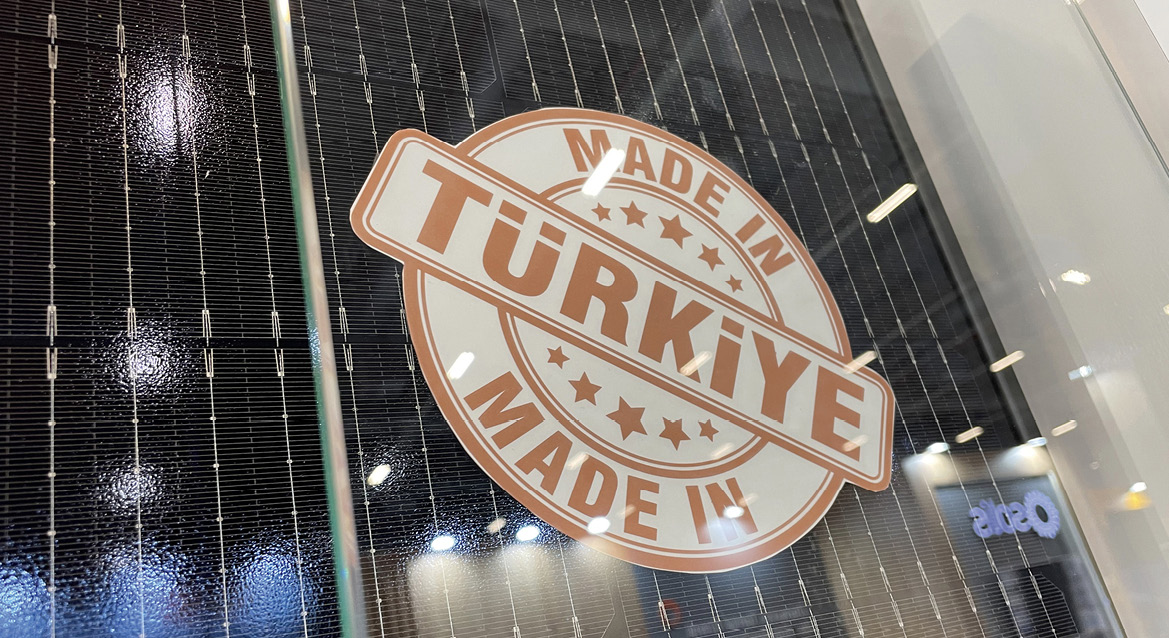
Turkey has emerged as a significant player in the solar energy sector, surpassing leading European nations in solar module production capacity. Recent data from Sinovoltaics reveals that Turkey’s operational solar module manufacturing capability now exceeds that of Italy, Germany, Spain, France, and the Netherlands combined.
Growing Manufacturing Capacity in Turkey
According to Sinovoltaics CEO Dricus de Rooij, Turkey’s current solar module production capacity is approximately 13.2 GW. This figure is distributed among over 20 manufacturers, with the major contributors being Kalyon PV/Hanwha Q Cells at 1.9 GW, CW Enerji with 1.8 GW, Kıvanç Enerji and Schmid-Pekintaş, each contributing 1.2 GW. It is worth noting that the total module manufacturing capacity across all European countries is underwhelming at 9.7 GW, highlighting Turkey’s prominent position in the solar manufacturing landscape.
Turkey’s solar industry benefits from a robust domestic photovoltaic (PV) demand of about 4 GW annually, which primarily fuels export activities. Many manufacturers are focusing on international markets, particularly the United States. Dricus de Rooij explained that the interest in exporting to the U.S. is heightened due to favorable trade policies that currently disadvantage competitors from China and Southeast Asia.
Advantages in the U.S. Market
U.S. trade regulations impose heavy tariffs on Chinese solar products, while countries in Southeast Asia face their own challenges with anti-dumping duties. In sharp contrast, Turkey’s products do not incur these costly tariffs, making them a desirable choice for American buyers. As a result, companies like HT Solar, Smart Solar Technologies, and Kalyon PV have begun exporting to the U.S. and European markets.
However, it’s essential to consider that Turkey’s cell production capacity is somewhat limited. The majority is produced by only two manufacturers, Kalyon PV/Hanwha Q Cells and HT Solar, meaning the country faces constraints on fully Turkish-made module supplies regardless of demand levels. De Rooij cautioned that accurately reporting export volumes is challenging due to a lack of comprehensive data, as free-zone and company-level exports are difficult to track.
Challenges and Future Potential
While Turkey’s achievements in module manufacturing are commendable, there are challenges to address. An oversupply of modules on the global market means that many manufacturers are operating below their rated capacity. This scenario signifies that there is also underutilization within Turkey’s solar module manufacturing operations. The tracker revealed that Turkey has around 2.5 GW of existing cell manufacturing capacity, concentrated between Kalyon PV/Hanwha Q Cells (2.1 GW) and HT Solar (0.4 GW), with several projects slated for completion between 2027 and 2030.
Furthermore, Turkey currently produces approximately 1.2 GW of wafer capacity, exclusively attributed to CW Enerji, which aims to expand this to 5 GW by 2030. However, similar to cell production, other tracked wafer projects are not yet operational, which raises questions about the future scalability of Turkey’s solar manufacturing sector.
In summary, Turkey’s ascent in the solar module manufacturing industry positions it as a central player in the European landscape, leveraging favorable trade conditions with the U.S. while facing challenges around capacity limitations and global market dynamics. The ongoing evolution of trade policies may influence the pace at which Turkey can capitalize on its manufacturing capabilities, positioning the nation as a critical hub for solar energy production in the years to come.