
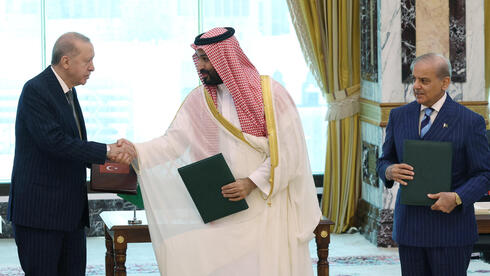
The recent signing of the Mecca Joint Defense Agreement by Saudi Arabia, Turkey, and Pakistan has sparked significant debate regarding its implications for regional security dynamics. This trilateral pact is seen as a potential foundation for broader cooperation among Muslim-majority nations. However, questions arise about its long-term effectiveness and expansion beyond the three founding members.
Understanding the Mecca Agreement
The agreement is framed as a defensive alliance, with Turkish and Pakistani officials emphasizing that it is not aimed at any specific nation. Turkish President Recep Tayyip Erdoğan has encouraged other countries seeking regional stability to join, portraying the existing trio as the backbone of a more extensive security structure. However, crucial aspects remain unclear, such as the exact military commitments involved and how member states would respond to an attack.
Researcher Mohammad Ali Zafar sees greater strategic significance in the agreement beyond merely duplicating NATO’s structure. He notes a growing momentum for a NATO-like alliance among Muslim states, especially in the wake of shifting U.S. security commitments in the region. For countries in the Middle East and South Asia, there is a pressing need for collaborative security arrangements, particularly as the U.S. focus appears to be diminishing, leaving these nations to rely more heavily on one another.
Potential Expansions and Complications
Interestingly, the first potential candidate for expansion is not a Middle Eastern power but South Asian nation Bangladesh. Officials have indicated an interest in the pact, highlighting its potential to extend the alliance’s reach into the Indian Ocean. However, concerns linger about the implications of Bangladesh’s inclusion, especially considering its relationship with Pakistan. Would this introduce further competition within the group?
Analysts like Zafar suggest that while Bangladesh could serve as a valuable partner, the country’s recent turmoil may postpone any immediate decision to join. Moreover, the prospect of Iranian membership complicates the situation significantly. Although reports suggest that Iran has been invited to consider joining, Iranian officials publicly deny receiving any official invitation, casting uncertainty over Tehran’s future role in the pact.
The Iranian Dimension
Iran’s accession to this alliance would differ sharply from the relatively stable inclusion of Bangladesh. The three founding states have repeatedly assured that the agreement is not an anti-Iran initiative, even as existing geopolitical tensions have echoed that sentiment. Iranian analysts argue that joining the Mecca Agreement may be a strategic miscalculation for Tehran, potentially positioning Iran as a target rather than a participant.
Debate persists regarding the actual benefits of Iranian membership versus the risks it entails. The potential inclusion of Iran could fundamentally reshape the dynamics of the pact, transforming it from a tool for containing Iranian influence into a broader security arrangement. However, existing members would be hesitant without robust assurances from Tehran that its participation would not compromise the alliance’s stability.
In closing, while the Mecca Pact’s primary aim is defense and mutual cooperation, its future effectiveness hinges on how well it can manage expansion without complicating the competing interests of member states. The agreement marks an evolving landscape of regional alliances, and its true test may lie not in external threats but in navigating internal dynamics and expanding membership without losing its founding intent. As this architectural framework continues to develop, its implications for Middle Eastern and South Asian relations will undoubtedly be closely scrutinized.