
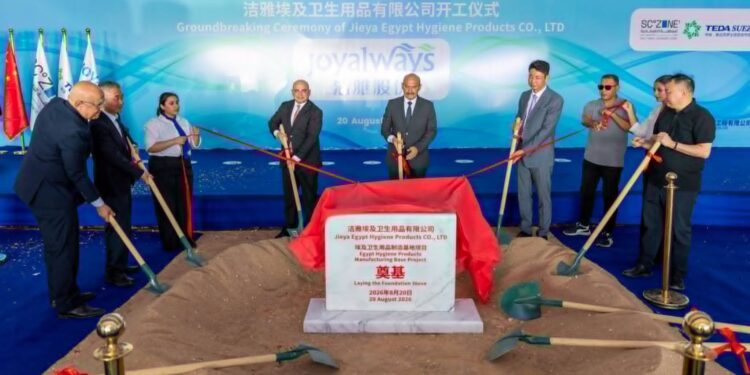
A significant investment is underway in Egypt as Chinese firm Jieya Egypt plans to establish a state-of-the-art manufacturing complex for disposable hygiene products. With an investment of $67 million, the project is set to take place in the Sokhna Integrated Zone, a critical component of the Suez Canal Economic Zone (SCZONE). This initiative marks a substantial step towards bolstering Egypt’s manufacturing capabilities and attracting foreign investment.
Project Overview and Economic Impact
The ambitious manufacturing complex will span 160,000 square meters and is expected to create approximately 450 direct jobs, according to recent reports from Egypt’s Cabinet Media Center. Once operational, the facility will have a remarkable annual production capacity of 8.1 billion units of single-use hygiene products. This will play a pivotal role in enhancing Egypt’s domestic production capabilities in this essential sector, ultimately contributing to economic growth and job creation.
The complex will be established within the newly expanded section of TEDA Egypt, with production anticipated to commence within the next two years. This timeline underscores the efficient planning and infrastructure that SCZONE provides to facilitate such significant investments. The project not only emphasizes the importance of domestic manufacturing but also represents an important collaboration between Egypt and China, two nations keen on strengthening their economic ties.
Strategic Alignment with National Goals
This initiative aligns seamlessly with Egypt’s broader economic strategy, which focuses on localizing value-added industries, transferring technology, and enhancing integrated supply chains across key industrial sectors. The establishment of Jieya Egypt’s complex is poised to bolster local production of essential hygiene items, effectively reducing the need for imports. This move is crucial for building a self-sufficient economy while simultaneously creating employment opportunities.
By increasing local capabilities in hygiene product manufacturing, the complex aims to position Egypt as a regional manufacturing and export hub. The facility is expected to support import substitution—an economic tactic aimed at reducing dependency on foreign goods. This enhances Egypt’s potential to not only meet its domestic needs but also to serve neighboring markets, reinforcing its role as an industrial player in the region.
Strengthening Egypt-China Relations
The investment from Jieya Egypt serves as a testament to the strengthening economic and industrial cooperation between Egypt and China. This collaboration is indicative of a broader trend where SCZONE actively seeks specialized foreign investments, hoping to expand its industrial base. By leveraging international partnerships, Egypt can cultivate a more diverse economy that thrives on manufacturing and exports.
In summary, the establishment of Jieya Egypt’s integrated manufacturing complex represents a significant milestone for both nations. With plans set in motion to begin production in the near future, this venture promises to enhance Egypt’s manufacturing landscape, create jobs, and support national economic initiatives. The project will not only foster domestic production but will also pave the way for further collaborations, ensuring a prosperous and resilient economic future for Egypt.