
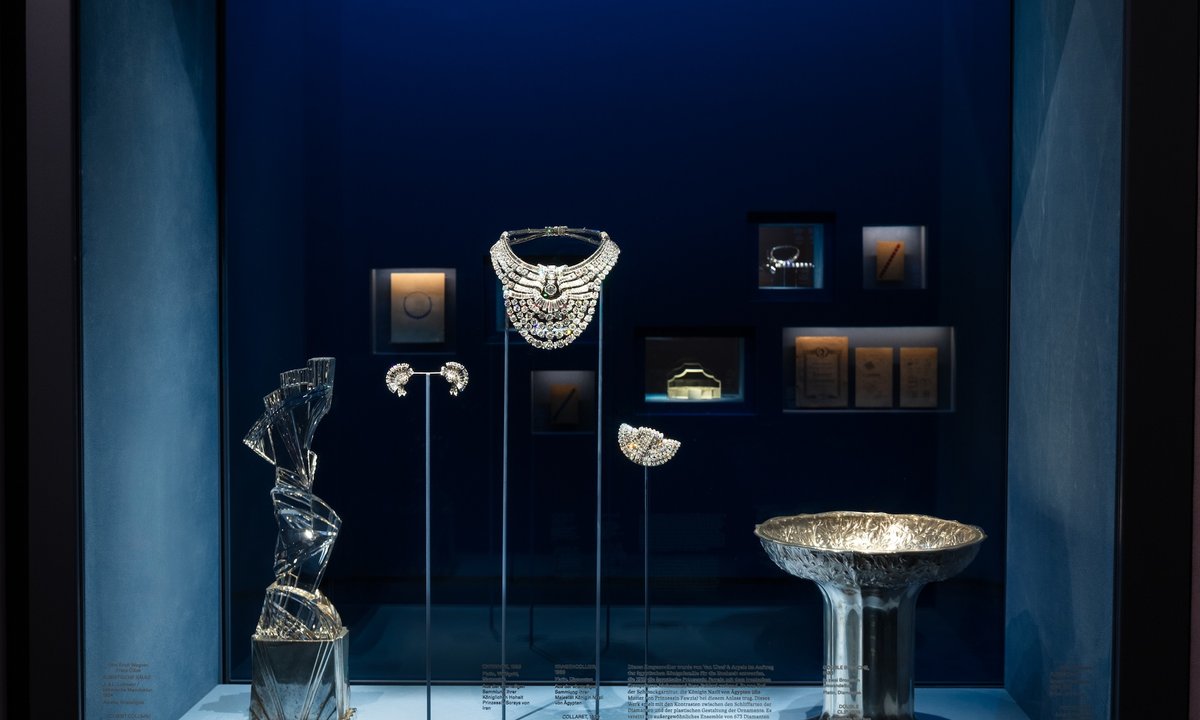
An international search is currently in progress for two individuals who are suspected of stealing a historically significant diamond necklace that once belonged to Queen Nazli of Egypt. This brazen act occurred at the Museum of Applied Arts (MAK) in Vienna on August 27.
Theheft Incident and Immediate Aftermath
The daylight robbery unfolded as the assailants purchased tickets to enter the museum. Once inside, they smashed a display case housing the necklace with a hammer and swiftly exited into the streets. Austrian authorities are currently analyzing clear security footage of the incident, while Interpol has classified the necklace as part of its stolen artwork database, following reports from local authorities. The museum’s exhibit, showcasing the necklace along with other artifacts, was momentarily closed but reopened the next day.
A Jewel with a Rich History
Commissioned in 1938 by Queen Nazli, this exquisite Art Deco necklace features 673 baguette-cut and brilliant-cut diamonds, set in pure platinum. The necklace was elegantly worn with a matching tiara at her daughter Princess Fawzia’s wedding to the future Shah of Iran in 1939. The necklace is currently considered one of the finest pieces by the esteemed jeweler Van Cleef & Arpels. Queen Nazli faced significant life changes when she lost her royal status in 1950 due to family disputes, which eventually led her to move to Beverly Hills where she struggled financially.
In 1975, she auctioned the necklace and her diamond tiara at Sotheby’s. The necklace fetched a substantial $140,000 at that time. Its value skyrocketed, as it sold again in 2015 for an astonishing $4.3 million at another Sotheby’s auction, reflecting its historical significance and artistry.
Security Challenges for Museums
The recent theft has raised concerns about the security of high-value items in museums. Lilli Hollein, the general director of MAK, expressed her distress over the incident, highlighting that this theft is part of a troubling trend of violent museum heists reported across Europe. According to a recent Europol report, the rise in museum thefts often targets items of significant worth, such as precious metals and culturally important artifacts.
High-profile museum heists in countries like France, the UK, and Germany have seen the loss of valuable objects, including crown jewels and ancient coins. The report mentions that robbers prefer items that can be easily sold off or broken down for their metal and stones, making them less traceable compared to unique artworks, which are often easier to recognize as stolen.
Family Reaction and Cultural Impact
Following the theft, Fawzia Farouk, the great-granddaughter of Queen Nazli, publicly conveyed her sorrow through a Facebook post. She emphasized the importance of the necklace not only to her family but also as a part of Egypt’s cultural heritage. She described it as an irreplaceable artifact that symbolizes an era marked by elegance and skill.
Fawzia expressed her hope for the necklace’s recovery so that its legacy could be preserved. Her heartfelt words underline the emotional and cultural significance attached to this historical piece, which transcends mere monetary value and evokes a rich tapestry of history, artistry, and heritage.