
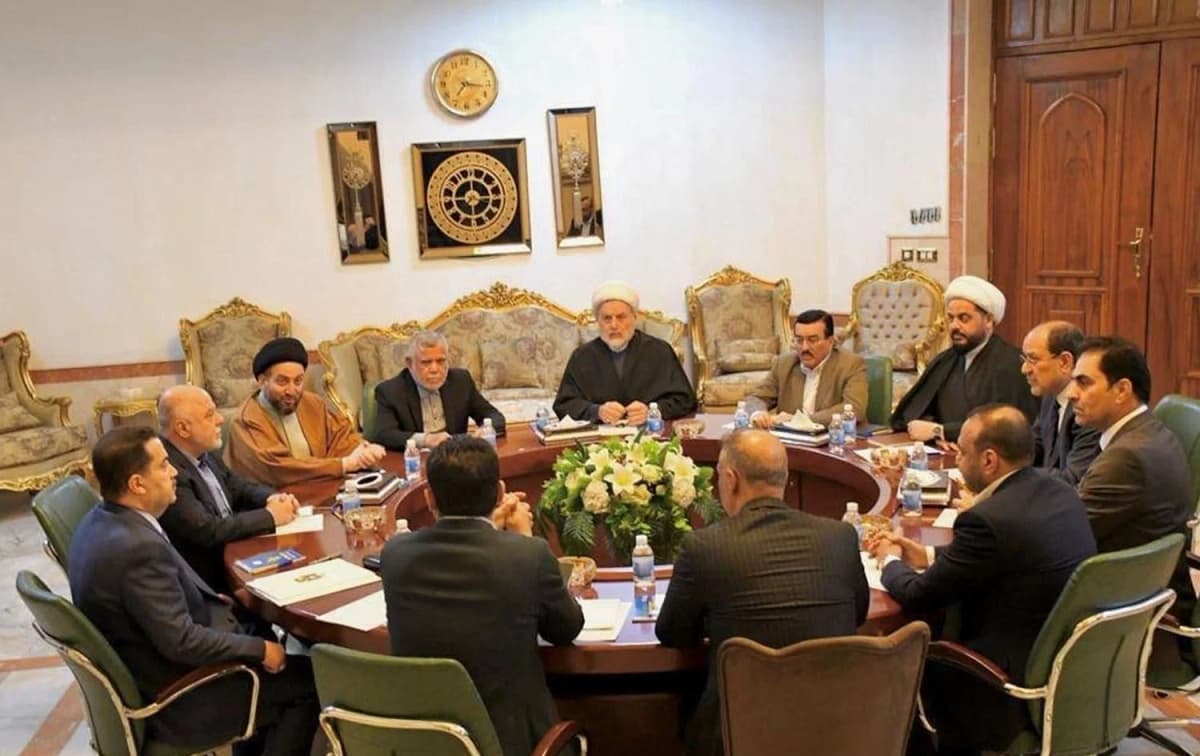
In a significant development within Iraq’s political landscape, the Coordination Framework—a key Shiite political alliance—has implemented a comprehensive strategy to bolster Prime Minister Ali al-Zaidi’s efforts aimed at unifying weapons under the governance of the state. This initiative comes amid ongoing dialogues with Iran-affiliated factions that have historically resisted disarmament.
Government’s Commitment to Arms Control
Faiq Zidan, head of Iraq’s Supreme Judicial Council, articulated the government’s renewed focus on controlling arms through a recently developed plan. In a meeting with Steve Fagin, the U.S. Chargé d’Affaires in Iraq, Zidan emphasized the judiciary’s commitment to supporting the government’s agenda for consolidating weapons under state authority. This promise reflects an ongoing commitment to fostering stable international relations and adhering to constitutional guidelines within Iraq.
The strategy is positioned to improve governance while contributing to Iraq’s international standing. A specially appointed committee has been tasked with formulating and announcing the arms consolidation plan once it is finalized. The framework seeks to align military control with national laws, ultimately aiming to curtail unauthorized militancy.
Prime Minister’s Initiatives for State Security
In his inaugural address to parliament, Prime Minister al-Zaidi pledged to initiate security reforms which focus on restricting arms access to state-sanctioned bodies. He has since ordered the establishment of a committee to manage the dismantling of armed factions associated with the Popular Mobilization Forces (PMF). This is particularly meaningful in a country where various factions, some backed by foreign influences, wield considerable armed power.
The PMF, created in 2014 following a call from religious authorities to combat ISIS, consists of numerous predominantly Shiite groups. While many members have expressed willingness to comply with the government’s disarmament directive, challenges remain. Certain factions cite the presence of foreign military forces, including those from the U.S.-led coalition, as a rationale for maintaining their armed capabilities.
Internal Politics and Negotiation Dynamics
Aqeel al-Rudaini, spokesperson for the Victory Alliance, noted that the committee developing the arms control strategy is directly engaged in negotiations with armed groups. The aim is to facilitate the transition of weaponary management to the PMF, ensuring that decisions related to national security rest exclusively with elected officials. This endeavor is not merely bureaucratic; it addresses critical questions of authority over military force in a state often under external influence.
Several groups, such as Harakat Hezbollah al-Nujaba and Kata’ib Hezbollah, have reportedly hesitated to fully disarm, complicating the government’s objectives. The negotiations now focus on the conditions required to transfer their arms to the PMF, highlighting an ongoing struggle for power and legitimacy within Iraq’s complex political ecosystem.
In summary, as Iraq navigates its intricate web of alliances and disputes, the proposed arms consolidation plan serves as a potential catalyst for reshaping the balance of military power. The effective integration of disparate armed groups into a unified command structure could ultimately stabilize the region, allowing Iraq to reaffirm its sovereignty and governance to its populace and the broader international community.