
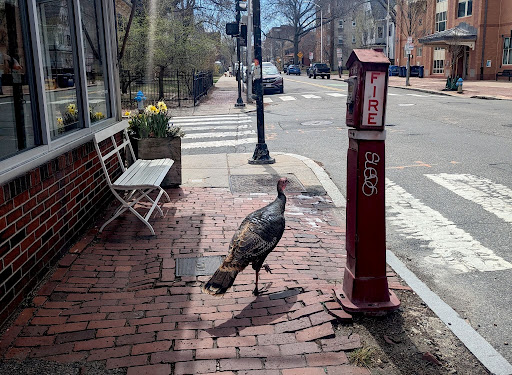
Jeff Fossett’s journey into the world of wild turkeys began when he moved to Cambridge almost ten years ago. Living on Ware Street, he was unexpectedly greeted by these fascinating birds at his apartment window. Initially a curious neighbor, Jeff’s interactions with turkeys soon turned into an exploration of their lives, igniting his interest in their behaviors and routes.
Observing the Daily Lives of Turkeys
In the mornings, as he stepped outside, Jeff discovered turkeys wandering through the streets. They became his unexpected neighbors, prompting him to wonder: what do they do when I’m not around? To satisfy his curiosity, he began tracking their movements. His explorations led him to Quincy Street, where he witnessed the turkeys navigating the Carpenter Center for the Visual Arts. It was there that he was captivated by their ability to fly branch to branch, ascending up to 40 feet to roost in a nearby maple tree.
Fossett documented his findings through an innovative online project named “Turkeys in Public Space,” which became a web application that invites users to contribute photos and stories about local turkeys. This collaborative platform launched in the spring and features a user-generated feed that celebrates these intriguing avian residents of Cambridge.
The Rise of the Turkey Community
Fossett has also published a zine to complement the digital project, showcasing curated photos from the app. While the first edition highlights user-submitted images, the upcoming second issue will introduce illustrations, poems, and opportunities for community interaction. One exciting idea he plans to implement is a hand-drawn turkey competition, encouraging locals to engage creatively.
The turkeys in Cambridge have become more than just a sight to behold; they embody a rich narrative of community. Fossett’s platform, which allows for the sharing of experiences, has seen weekly contributions, further fostering a sense of connection among residents. Remarkably, during one of his outdoor photo sessions, he overheard someone recommend his site, demonstrating its organic growth via word of mouth.
The Historical Context of Turkeys in New England
Historically, New England’s turkey population faced drastic declines due to deforestation and hunting after European settlers arrived in the 17th century. However, conservation efforts in the 20th century enabled a remarkable comeback; from merely 37 wild turkeys in the 1970s to a thriving population of 30,000 today. Interestingly, there is no outright ban on turkey hunting, with approximately 15,000 licensed hunters permitted to hunt during designated seasons—though such activities are curtailed in Cambridge due to local regulations.
As the community embraces their local turkeys, individuals share myriad tales of encounters with these bold creatures. Fossett believes everyone has a turkey story, which is why his platform welcomes both photographs and anecdotes. By documenting these interactions, he hopes to encourage a deeper understanding of how urban life intersects with nature.
Turkeys as Urban Symbols
Fossett’s fascination with turkeys extends beyond their mere presence in the city; he’s intrigued by what they symbolize within the urban landscape. He describes turkeys as “vanguards” of the non-human communities coexisting alongside humanity, making residents rethink how they share their space. These assertive birds navigate the city with confidence, often standing their ground in the road or city parks, prompting people to consider their role in the shared environment.
In Cambridge, turkeys are not just wildlife; they are part of the unique fabric of city life, offering residents an opportunity to connect with the natural world in a meaningful way. Fossett notes, “If it was ‘worms in public space,’ it might be harder to get people interested.” The vibrancy and character that turkeys add to urban life encourage residents to respect and coexist with their feathered neighbors, underscoring the enriching presence of wildlife in our daily lives.