
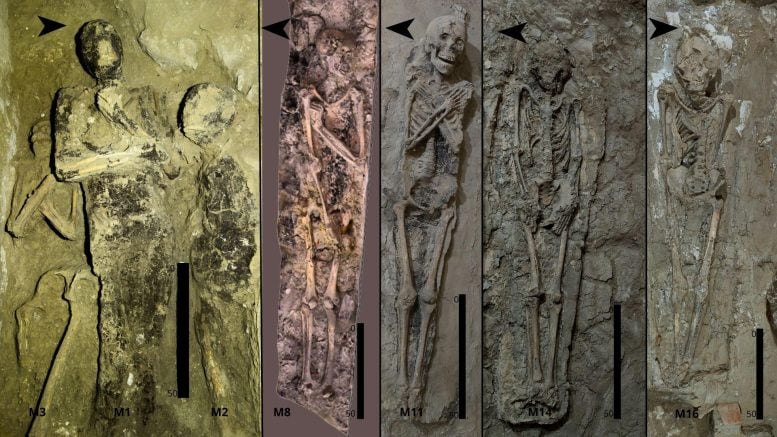
The evolution of burial practices in ancient Egypt reveals much about the society’s beliefs and rituals surrounding death. A recent examination of Theban Tomb 209 has illuminated the significant shift from individual interments to the stacking of mummies, suggesting a transformation in the cultural and symbolic meanings behind these burial methods.
The Stacked Burials of Theban Tomb 209
Located in the Theban Necropolis, opposite Luxor, Tomb 209 features a remarkable arrangement where four mummies and a dog are interred atop one another. Researchers from Spain, who investigated the third chamber of this ancient site, concluded that the increasing density of bodies indicates not only a practical need for space but also a deliberate alteration in funerary customs. Their findings, published in Frontiers in Environmental Archaeology, underscore how new interments retained connections to their predecessors, emphasizing continuity amidst change.
The occupants, dating back to the Ptolemaic era (305 to 30 BCE), exhibited close ties even after death. The positioning of the mummified dog atop a man and woman introduces intriguing questions regarding the relationship dynamics amongst these individuals and their beliefs about the afterlife. The dog’s placement might hint at its role as a psychopomp—a guide for souls venturing into the next world.
Tracing Historical Transitions in Burial Practices
TT 209 is part of an expansive burial complex that includes over 400 tombs, dating back to the Twenty-fifth Dynasty (754 to 656 BCE), and extended usage into the Ptolemaic period. The researchers employed excavation techniques, detailed photography, and meticulous documentation of the mummies’ arrangements to map out the evolution of burial practices in this chamber. In total, they unearthed 16 mummified remains, alongside various grave goods, revealing the diverse practices of interment—ranging from individual to mass deposits.
Notably, the researchers discovered a coherent spatial logic in these burials rather than chaotic accumulation. Each new burial was influenced by existing bodies, suggesting a reflection of historical relationships and cultural memories. The study also highlighted significant shifts in how the dead were interred; earlier elite burials involved lavish coffins and artifacts, whereas later practices adopted a more communal approach with bodies meticulously carefully stacked rather than laid to rest in individual coffins.
Changing Rituals and Cultural Implications
The examination of burial objects also hints at broader social changes. The earliest remains were often adorned with costly items, in stark contrast to the layered mummies found in later deposits, which lacked the luxury of containers and traditional practices. Instead, these later interred individuals were often found without coffins, indicating a shift toward different rituals that continued to evolve over time.
From the late Twenty-fifth Dynasty through the Persian period, the arrangement of bodies changed markedly. Researchers noted a transition from widely spaced individual burials to vertical superimpositions where bodies were layered. Within the chamber, the positioning of arms also varied significantly, indicating differing funerary customs and beliefs, with many later remains adopting the Osirian position, a posture linked to resurrection and rebirth.
Challenges in Interpreting Burial Evidence
Despite the insights gained into these evolving burial practices, researchers face challenges in interpreting the evidence due to centuries of disturbances. Flooding and periods of fire have impacted the integrity of the tomb, complicating efforts to reconstruct the chronological order of interments and the motivations behind them. The resultant debris often obscures previous archaeological readings, making it tough to draw clear conclusions.
In conclusion, the research conducted on Theban Tomb 209 offers valuable insights into ancient Egyptian funerary practices, demonstrating how burial customs transformed over time. These findings serve to paint a more comprehensive picture of societal behaviors surrounding death and resurrection, highlighting a fascinating interplay of memory, ritual, and cultural continuity in the face of change.