
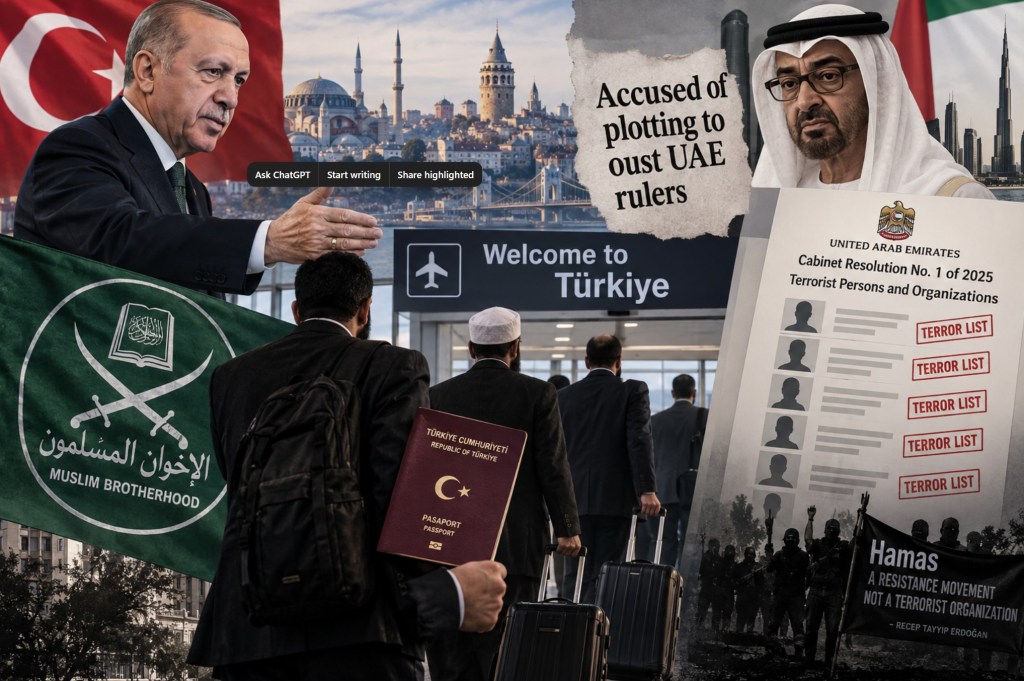
President Recep Tayyip Erdogan’s administration has been a refuge for members of the Muslim Brotherhood, a group that the United Arab Emirates (UAE) views as a threat to its governance. Despite improving relations between Turkey and the UAE, the Turkish government has continued to grant residency, and in some instances, citizenship, to individuals linked to this network. This article explores the implications of Turkey’s support for these figures and how it reflects Erdogan’s ideological stance.
Turkey as a Sanctuary for Brotherhood Affiliates
Recent disclosures have revealed that Turkey has become a primary haven for members associated with the Muslim Brotherhood, especially following a significant crackdown by Emirati authorities that began in 2012. After the UAE intensified its efforts to dismantle Brotherhood ties, many individuals found asylum in Turkey. United Nations communications point out that Turkey has allowed these figures—some of whom are under arrest warrants or have been previously convicted in the UAE—to establish themselves and their activities on its soil without restrictions.
The UN documentation is particularly revealing, showcasing how Turkey is now a hub for Brotherhood-affiliated movements, especially after the Arab Spring upheavals. Individuals initially settled in the West have also migrated to Turkey, likely due to the country allowing them to carry on their activities more freely than in other nations.
Erdogan’s Relationship with Hamas and Political Islam
Erdogan’s ideological alignment with Hamas, which is also rooted in the Muslim Brotherhood, further underscores Turkey’s role as a safe haven for these groups. Erdogan has publicly distanced himself from labeling Hamas as a terrorist organization, instead referring to it as a “resistance group.” This stance has been reinforced by official statements from the Turkish government, which frequently refers to Hamas as part of the “Palestinian Resistance Movement.”
Moreover, the Erdogan administration is not just providing shelter; it’s also offering political protection. Many involved in this network have gained access to Turkey’s financial and corporate sectors, enabling them to mobilize resources and continue their operations. As citizenship is granted, these individuals often adopt Turkish names, complicating tracking efforts by foreign authorities.
UAE’s Crackdown and Turkey’s Response
The UAE’s investigations into the Brotherhood date back to March 2012, when authorities captured many members of the Reform and Social Guidance Association, perceived as the UAE’s local Muslim Brotherhood faction. The government’s accusations claimed that these individuals were working covertly to undermine the state and its leadership. They were alleged to be seeking financial and organizational support from various international groups to bolster their efforts.
Despite these serious allegations, Turkey has turned a blind eye to the UAE’s concerns, even after the Emirates formalized its terrorism list in January 2025, including individuals who had found refuge in Turkey. Turkish authorities have not taken action to extradite these individuals, thereby allowing them to remain protected within its borders while the UAE continues its pursuit of what it classifies as a transnational network aiming for power.
A Continued Rift Despite Diplomacy
The tension between Turkey and the UAE illustrates a significant regional divide, one that persists despite attempts at diplomatic reconciliation. While Turkey’s leadership has fostered relationships with Islamist elements to extend its influence beyond its borders, the UAE views these affiliations as a direct threat to its authoritarian regime.
Although the rhetoric has softened since Erdogan and Emirati President Mohammed bin Zayed began to engage diplomatically, the underlying policy approach remains unchanged. Turkey continues to be a refuge for individuals that the UAE deems dangerous, showcasing the complexities and contradictions of international relations in the region. With its ongoing asylum policies, Turkey is not just acting as a sanctuary; it is actively participating in a geopolitical chess game that undermines Emirati security efforts while reinforcing Erdogan’s ideological commitments.