
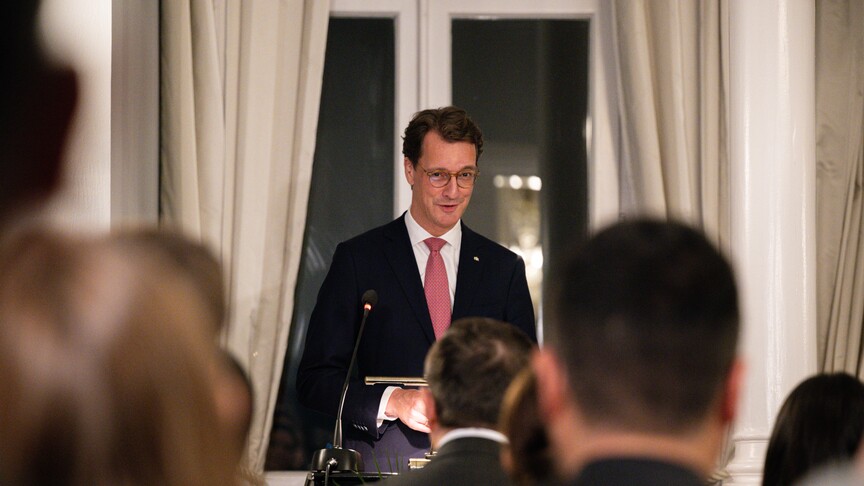
Germany’s North Rhine-Westphalia state is taking significant steps to enhance its long-standing economic partnership with Türkiye. On September 30, 2026, Prime Minister Hendrik Wust outlined plans to deepen these relations at the Türkiye-North Rhine-Westphalia Business Forum in Istanbul. This strategic initiative is crucial, especially amid challenges such as rising international trade obstacles and ongoing pressure on global supply chains.
Strengthening Economic Cooperation
During his address, Wust emphasized the historical movement of people, ideas, and investments between Germany and Türkiye. He acknowledged that, currently, the necessity for dependable connections is greater than ever. By promoting these ties, Wust believes that both regions can further their economic collaboration. To facilitate this relationship, his administration has introduced a fast-track visa process specifically for Turkish business professionals, which will ease access and promote in-person engagement.
Wust also pointed out the importance of updating the European Customs Union, originally established over three decades ago. He stressed the need for revisions to EU industrial policy to align with the evolving landscape of global supply chains. He referred to Türkiye as an essential component of the European value chain and recognized its prominence in foreign direct investment. Notably, he described how one-third of Turkish-owned enterprises in Germany are located within North Rhine-Westphalia, totaling approximately 1,300 businesses.
Energy and Sustainability as Strategic Priorities
The prime minister also highlighted Türkiye’s growing influence in the renewable energy sector, specifically its substantial onshore wind market. This emerging sector, along with investment in power generation and transmission infrastructures, is critical for the energy-dependent industries in North Rhine-Westphalia. Wust underscored that energy security and cost efficiency are vital aspects for the region’s heavy industries, further solidifying Türkiye’s strategic positioning within the partnership.
Memorandums of understanding were signed at the forum to lay the groundwork for future collaboration. These agreements aim not only to boost economic interactions but also to strengthen geopolitical relations, offering a framework for various sectors to develop.
Commitment to Partnership and Economic Integration
Serap Guler, a representative from the German Federal Foreign Office, reiterated Germany’s dedication to enhancing economic ties with Türkiye. She underscored the fact that roughly 8,600 German businesses operate within Türkiye, providing over 100,000 direct jobs. Guler pointed out the adverse effects of geopolitical tensions and supply chain vulnerabilities on competitiveness, stressing that both countries must focus on implementing the agreements forged during their earlier strategic dialogue.
To unlock the economic potential of over 540 million people across the EU and Türkiye, Guler emphasized the necessity of modernizing the Customs Union. She advocated for the removal of both tariff and non-tariff trade barriers, as well as the need to adhere to rule-of-law frameworks that ensure Türkiye’s compliance with agreements benefiting all EU member states.
Furthermore, Guler mentioned Germany’s strong support in Brussels for a “Made with Europe” initiative under the EU Industrial Accelerator Act, which aims to include key partners like Türkiye. Through these efforts, both nations aspire to foster a more integrated and robust economic environment for mutual growth and stability.