
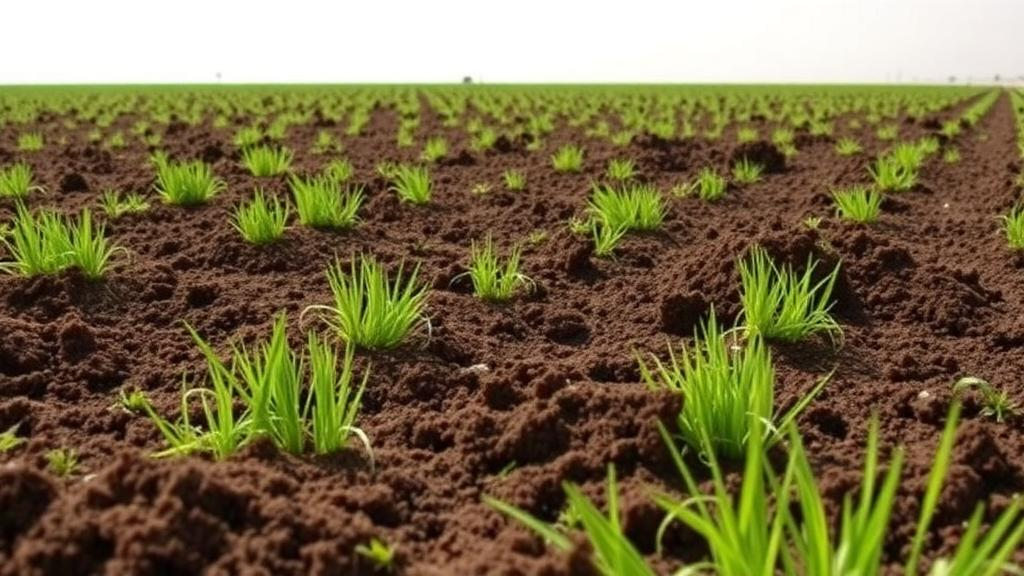
Farmers on Egypt’s Mediterranean coast are grappling with a significant challenge: managing saline conditions in their fields. The groundwater they rely on for irrigation is naturally brackish, and their soils are gradually accumulating salt. However, recent research conducted during the 2023 growing season at Wadi El Raml reveals a promising strategy to mitigate the effects of soil salinity. The study demonstrates that the method of seed placement can dramatically influence crop yield, with single-seed dibbling showing significant advantages over traditional planting techniques.
Impact of Sowing Techniques on Crop Yields
Researchers from Egypt’s Desert Research Center and the Egyptian Center of Excellence for Saline Agriculture found that dibbling, a method that involves placing seeds individually into small holes, outperformed both broadcasting and row planting. Specifically, when utilizing this approach, pearl millet produced a fresh forage yield that was 46.46% higher, and sorghum yielded 22.27% more compared to traditional broadcasting, where seeds are scattered on the surface. The study reported total forage yields of approximately 170 megagrams per hectare for millet and 130 megagrams per hectare for sorghum, all while using the same crop varieties and irrigation practices as the control methods.
The reasoning behind this increased yield lies in the mechanics of soil physics. Dibbling creates concentrated zones of moisture that aid in more effective water infiltration. This localized water movement pushes soluble salts deeper into the soil and away from the root zone, reducing their negative impact on plant growth. By contrast, broadcasting tends to saturate the soil surface, promoting the upward movement of salt due to evaporation. Soil tests confirmed these findings; the dibbling technique resulted in lower soil electrical conductivity—an indicator of salinity—compared to both broadcasting and row planting methods.
The Role of Irrigation Levels
The researchers also examined the effects of different irrigation levels, specifically comparing 100% and 110% of crop evapotranspiration. Interestingly, while the irrigation level alone did not show a significant effect on the measured parameters, its interaction with the dibbling method was meaningful. The additional water volume at the higher irrigation level primarily benefited the dibbling method, as it further promoted leaching of sodium and chloride ions beneath the root zone. This interaction not only reduced soil salinity but also led to lower soil pH levels in the dibbled plots.
Furthermore, the sodium adsorption ratio, which assesses the risk of sodicity in the soil, revealed that dibbling coupled with higher irrigation resulted in significantly lower ratios, suggesting improved soil structure and permeability. This finding is particularly vital as sodicity can hinder agricultural productivity, impacting long-term crop viability.
Choosing the Right Crop Under Saline Conditions
Among the crops studied, pearl millet clearly demonstrated superior performance under saline stress. Although both pearl millet and sorghum are considered moderately salt-tolerant, millet was able to maintain productivity in salinity levels well above those that negatively affected sorghum. The physiological traits of millet, such as its capability to produce osmolytes and maintain favorable ion ratios, contribute to its resilience. Its ability to thrive in challenging conditions makes it a superior choice for salt-affected regions.
The research culminates in the development of a Soil Salinity Vulnerability Index, which quantifies the salinity risks posed to crops. By employing a weighted composite of various soil quality indicators, this index provides farmers and agricultural professionals a clear and actionable way to evaluate soil health and management options. The analysis showed that the method of sowing, rather than the choice of crop, was the most significant factor influencing soil salinity.
As this study underscores, innovative sowing methods like dibbling can not only enhance forage yield but also serve as a feasible approach to lessening the adverse effects of soil salinity. Given the pressing issue of salt-affected land—accounting for a significant portion of Egypt’s agricultural area—this research provides a practical, low-cost solution. By implementing these findings, farmers can optimize their water use efficiency and slowly reclaim their saline soils, all while contributing to food sustainability in a world facing increasing agricultural demands.