
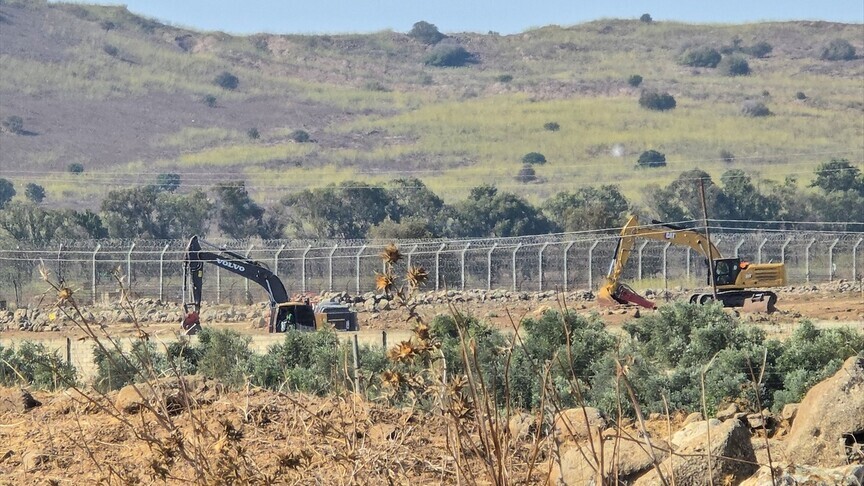
Israeli excavation activities resumed on Sunday in the vicinity of Al-Asha village in Syria’s southern Quneitra region as part of a project referred to as the “Sufa Line” or “Sufa 53,” according to reports from Syria Alikhbaria TV. This development has raised considerable concerns among local residents who are already grappling with the repercussions of military infrastructure expansion.
Understanding Sufa 53
Construction on Sufa 53 commenced in mid-2022, starting near Hadr in northern Quneitra. The project has since extended southward, affecting areas around Jubata al-Khashab, Al-Hamidiyah, Qahtaniyah, Bir Ajam, and Bariqa, ultimately reaching Al-Asha. This initiative involves the establishment of a military road approximately eight meters wide, along with deep trenches, earthen berms towering around five meters high, and various military observation points. Israel argues that these defensive structures are intended to mitigate potential threats from armed groups backed by Iran.
Following the collapse of the Bashar al-Assad government in December 2024, construction efforts accelerated, signifying an increasing Israeli military presence in areas adjacent to the separation line within southern Syria. Reports indicate that Israeli troops have advanced between 300 and 1,000 meters into Syrian territory in certain locations as the project progressed.
Devastating Impact on Agriculture
The implications of the Sufa 53 project have been particularly dire for the agricultural communities in the region. Local authorities have estimated that roughly 12,000 dunams (1,200 hectares) of land in northern and central Quneitra have been adversely affected due to the construction activities. In Jubata al-Khashab specifically, around 7,000 dunams (700 hectares) of farmland have been lost, with an additional 6,000 dunams (600 hectares) from Al-Hamidiyah and Al-Hurriyah being appropriated for the project.
These encroachments have led to significant damage to grazing lands, trees, and wild vegetation, all of which are vital to the livelihoods of local families. Media director for Quneitra, Mohammad al-Saeed, has stated that the Sufa 53 initiative has resulted in extensive harm across the province, further compounded by limited access to affected areas. Mohammad Mazen Maryoud, the mayor of Jubata al-Khashab, highlighted how the trenches have disrupted the natural flow of rainwater, resulting in soil erosion that directly impacts agricultural productivity and livestock.
International Response and Local Sentiment
In the wake of these developments, residents have voiced their grievances, pointing out that the construction work coincides with frequent Israeli operations, including raids, detentions, and increased checkpoints that restrict access to agricultural land. The ramifications have been multifaceted, affecting not just immediate access to land but also the broader agricultural ecosystem upon which families depend for their income.
Syria’s Foreign Ministry responded strongly, condemning the renewed activity on Sufa 53 as a “blatant violation” of the 1974 disengagement agreement and an infringement on international resolutions. The ministry has asserted that ongoing Israeli incursions pose a direct threat to regional security and undermines international law, reaffirming Syria’s claim to sovereignty over its territory. The ministry has called upon the international community to protect Syria’s territorial integrity and to take action against the ongoing violations by Israel.
The ongoing excavation work reflects a broader context of conflict in the region, where local populations find themselves at the intersection of military strategy and agricultural dependence. As these developments unfold, the impact on livelihoods and regional stability remains a critical concern for both locals and the international community.