
Citigroup Inc. is making significant strides by introducing its Citi Token Services to Japan and the United Arab Emirates (UAE). This expansion is part of its broader initiative to enhance its digital payments infrastructure in vital financial centers. With a growing demand among businesses for expedited and adaptable liquidity management options, this move could play a crucial role in bolstering Citigroup’s service offerings.
The Essence of Citi Token Services
Citi Token Services is founded on a private and permissioned blockchain, allowing near-instantaneous fund transfers within Citigroup’s extensive network. This innovative platform addresses the limitations of conventional banking, such as cut-off times, holidays, and geographical time zones, enabling smoother cross-border liquidity management. Such capabilities will bolster Citigroup’s transaction banking and improve client relations, making it easier for businesses to navigate global markets.
As of now, Citi Token Services is operational in seven markets, including the U.S., Ireland, Hong Kong, Singapore, and the UK. The newest additions, Japan and UAE, are particularly noteworthy as they will facilitate USD transactions in Japan and both USD and euro transactions in the UAE. This functionality allows the platform to manage billions in transactions and supports collateral management, positioning it as an essential tool for clients’ treasury operations and expanding its reach in payments and liquidity management.
Advancing the Tokenization Strategy
The recent expansion follows a broader rollout of Citi Token Services, which began commercially in 2024 after an initial pilot test between Singapore and New York. In 2025, the platform incorporated 24/7 U.S. dollar Clearing capabilities and expanded to support euro transactions in Dublin. By adding Japan and the UAE, Citigroup strengthens its presence in global financial centers, thus fulfilling its vision of integrating traditional financial structures with emerging digital mechanisms.
This initiative is more than just enhancing payment capabilities; it also fosters a deeper engagement with corporate clients and encourages increased cross-border transactions. This move aligns with Citigroup’s strategic goals outlined during its 2026 Investor Day, where tokenization and next-gen platforms were identified as pivotal drivers for long-term growth. With anticipated revenue growth in the low to mid-single-digit range for its Services segment in 2027-2028, the wider adoption of Citi Token Services may solidify Citigroup’s competitive stance in global transaction banking.
Competitor Landscape and Broader Trends
Citigroup is not alone in its push toward digital payment enhancements. Other major banks, such as HSBC and JPMorgan Chase, are actively advancing their capabilities for cross-border transactions and liquidity management. For instance, HSBC launched its Tokenized Deposit Service in the UAE following its rollout in the U.S., allowing eligible clients to conduct fund transfers around the clock. This move is expected to further bolster HSBC’s digital payment operations.
Similarly, JPMorgan has made strides by collaborating with Mitsubishi Corporation to operationalize its Kinexys blockchain platform for global payments. Having processed over $3 trillion in transactions, this development underscores JPMorgan’s commitment to faster cross-border transfers and improved liquidity management.
Citigroup’s Financial Outlook
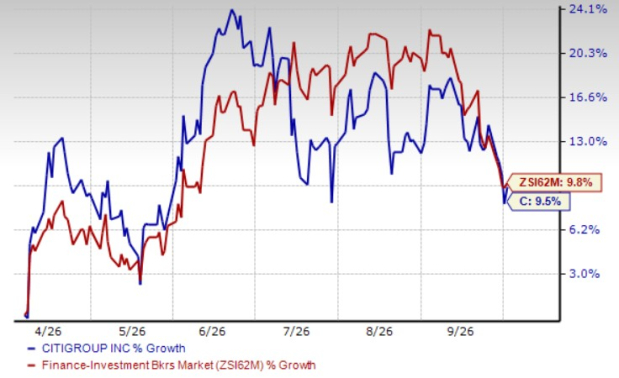
In terms of performance, Citigroup shares experienced a 9.5% increase over the past six months, which is comparable to the industry average growth of 9.8%. Valuation-wise, Citigroup trades at a forward price-to-earnings (P/E) ratio of 10.25, significantly below the industry average of 12.73.
Looking ahead, the Zacks Consensus Estimate indicates that Citigroup’s earnings are projected to increase by 40.4% in 2026 and 15.8% in 2027, although these estimates have faced recent downward revisions. Currently, Citigroup holds a Zacks Rank of #3 (Hold), reflecting cautious sentiments in the market but also the potential for long-term growth as its digital services continue to evolve.
By bolstering its digital payment network and expanding its tokenization efforts, Citigroup is strategically positioning itself to capture a larger share of the transaction banking market and foster increased client engagement in the global financial landscape.