
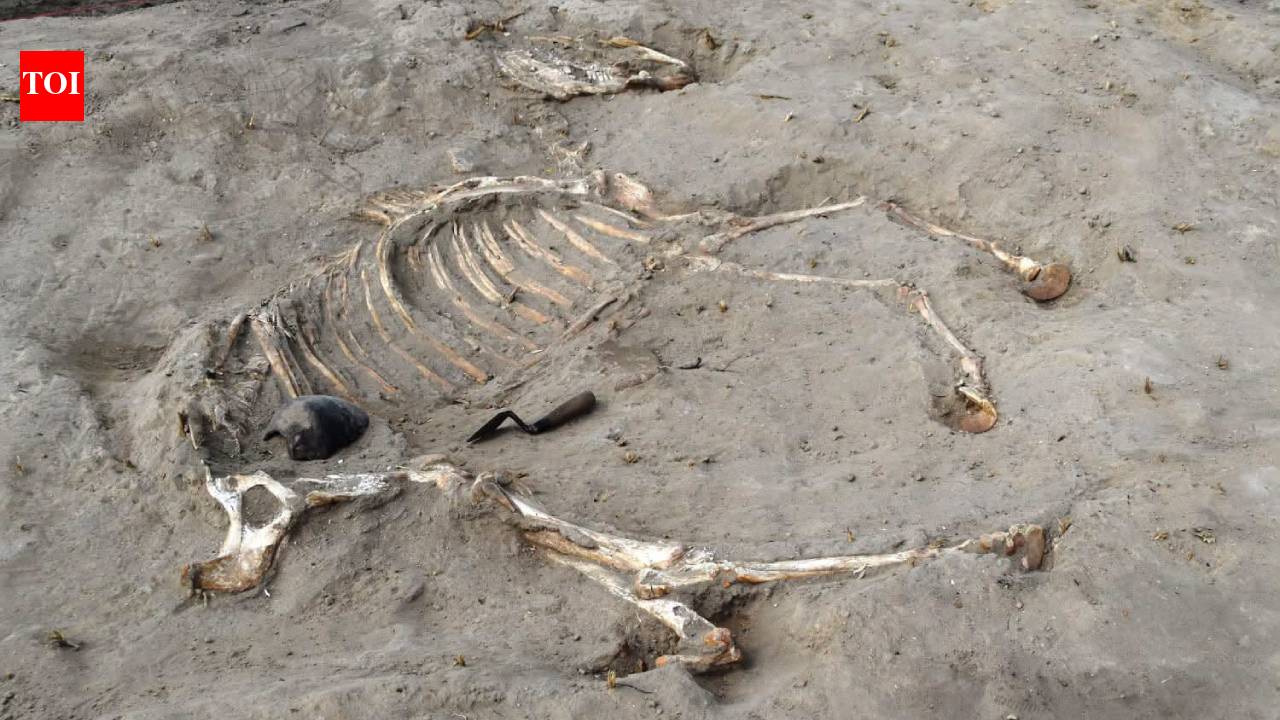
Archaeologists in Egypt have made a remarkable finding: the remains of a horse that dates back approximately 3,000 years. This discovery was made within the ancient military fortress of Abqaa’, located in the western Nile Delta. This revelation provides valuable insights into the significance of horses in the context of ancient Egyptian warfare and culture.
Significance of the Horse Discovery
The horse was unearthed at the Abqaa’ archaeological site, which traces its origins to Egypt’s New Kingdom period, around 1550 to 1070 B.C. This military fortress was constructed to defend the western frontiers of Egypt against invading Libyan groups. According to Egypt’s Ministry of Tourism and Antiquities, the horse is described as a young, medium-sized male. Archaeologists also found pieces of its harness, suggesting its involvement in chariot racing or military functions.
The careful burial of the horse points toward a deliberate act rather than neglect or abandonment. Experts believe that such a burial might have been ceremonial, indicating the animal’s high value to ancient Egyptians. Lonneke Delpeut, a researcher specializing in ancient Egyptian horses, notes that complete skeletal remains from this era are rare, making this discovery particularly significant. While some may label this horse as a “war horse,” the terminology lacks a clear definition in ancient Egyptian contexts. Nevertheless, evidence strongly suggests it was indeed utilized for chariot warfare.
The Role of the Abqaa’ Fortress
The findings at the Abqaa’ sites shine a light on its strategic importance during the New Kingdom of Egypt. Built as part of a network of defensive installations, this fortress aimed to protect the nation from various threats, particularly from Libya. One notable aspect of the excavation includes a tablet depicting a Libyan prisoner from the Meshwesh tribe, a faction with which the Egyptians often clashed.
This tablet reveals the circumstances surrounding the conflict, as it shows the prisoner restrained, symbolizing his submission. This insight contributes to a broader understanding of military life and the complexities of border defense during this era.
Connections to Pharaohs Ramesses II and Merneptah
Adding another layer of significance to the discovery, archaeologists uncovered inscriptions linked to two celebrated Pharaohs of the New Kingdom: Ramesses II and his successor Merneptah. One hieroglyphic tablet contains the name of Ramesses II, who ruled from around 1279 to 1213 B.C., while the other references Merneptah, who reigned from 1213 to 1203 B.C. Notably, the inscription draws a parallel between Merneptah’s strength and that of Seth, the deity associated with the desert and storms.
These findings reinforce the role of the Abqaa’ fortress as a hub of military strategy, positioned not only to protect borders but also to project power beyond them during a turbulent period in Egypt’s history.
Future Research Opportunities
Experts believe that the horse remains may offer even deeper insights into ancient Egyptian warfare and society. Carolyn Willekes, a specialist in ancient horses, notes that well-preserved skeletal remains provide critical data about the horse’s life and overall health. The intentional burial could reveal how ancient Egyptians regarded these animals, while the harness fittings found nearby may lend further clarity on the horse’s use.
Researchers anticipate that scientific analysis of the horse’s skeleton could unearth additional details regarding its age, health, and working conditions. The excavation, conducted by Egypt’s Ministry of Tourism and Antiquities, exemplifies the rare alignment of history, archaeology, and practical military insights, promising to enrich our understanding of ancient Egyptian civilization.