
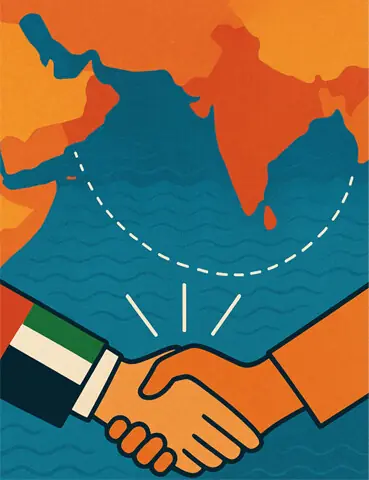
Recent reports indicate a significant strategic partnership between India and the United Arab Emirates (UAE), underscoring a larger shift in security dynamics across the Gulf and the Indian Ocean. This emerging relationship manifests not as a formal alliance, but rather as a versatile network of cooperation driven by economic ties, maritime security apprehensions, and a preference for adaptive strategies.
The UAE’s Diversified Foreign Policy
The UAE’s growing ties with India can be traced back to a shift in foreign policy adopted after 2015, characterized by diversification. The UAE aims to strengthen relationships with a variety of global powers, including the United States, Israel, India, and major Asian economies, while simultaneously reducing reliance on any single security ally. This strategic pivot has been spurred by ongoing regional instability, escalating tensions with Iran, and evolving Arab political landscapes. Consequently, the UAE has favored a dispersed security strategy over traditional alliances to bolster its position in the region.
India’s Strategic Vision in the Gulf
For India, the Gulf region represents more than just a primary energy source; it is increasingly viewed as an extension of its own maritime security zone. India’s efforts to enhance defense ties with the UAE are aimed at safeguarding vital shipping routes through the Strait of Hormuz, amplifying situational awareness regarding maritime activities in the Arabian Sea, fostering defense industry collaboration, and establishing India as a key security partner in the region. Additionally, these endeavors are linked to India’s broader strategy to counterbalance China’s expanding naval footprint across the Indian Ocean.
Layers of India-UAE Defense Cooperation
The India-UAE defense framework is best conceptualized as a layered cooperation rather than a conventional alliance. This partnership encompasses various aspects, such as maritime coordination, defense technology, intelligence sharing, and joint military exercises aimed at enhancing operational compatibility. Notably, this security facet is integrated within a larger economic framework that includes trade, logistics, and direct investments, providing the relationship with both depth and durability.
Challenges for Pakistan in the Evolving Landscape
This emerging alignment presents gradual yet profound challenges for Pakistan. The competition for influence in Gulf capitals is intensifying, as India’s economic heft increasingly translates into strategic Advantages. Meanwhile, Pakistan’s access to Gulf diplomatic support over sensitive political issues is narrowing, with Gulf nations opting to keep their bilateral relations distinct from disputes involving third-party nations.
Investment flows from Gulf countries are shifting more towards India’s thriving economy, thereby diminishing Pakistan’s relative standing. While Pakistan maintains significant relations with the UAE, these interactions are increasingly governed by pragmatic considerations rather than strategic imperatives. Domains such as labor migration, remittances, and occasional financial assistance form the backbone of this relationship, even as the strategic alignment has waned compared to previous decades.
Thus, the challenges faced by Pakistan are structural and cannot be resolved through diplomacy alone. A comprehensive strategy is needed that entails economic stabilization, diversification of Gulf partnerships beyond the UAE, and renewed investment in maritime security and logistics in the Arabian Sea. Establishing Pakistan as a credible connectivity hub linking China, Central Asia, and Gulf economies is equally vital.
In summary, it is becoming increasingly clear that economic strength, technological capabilities, and maritime connectivity are essential drivers of regional influence. Pakistan’s path forward involves engaging with these evolving dynamics on its own terms, rather than relying on outdated frameworks that no longer accurately reflect the regional landscape.