
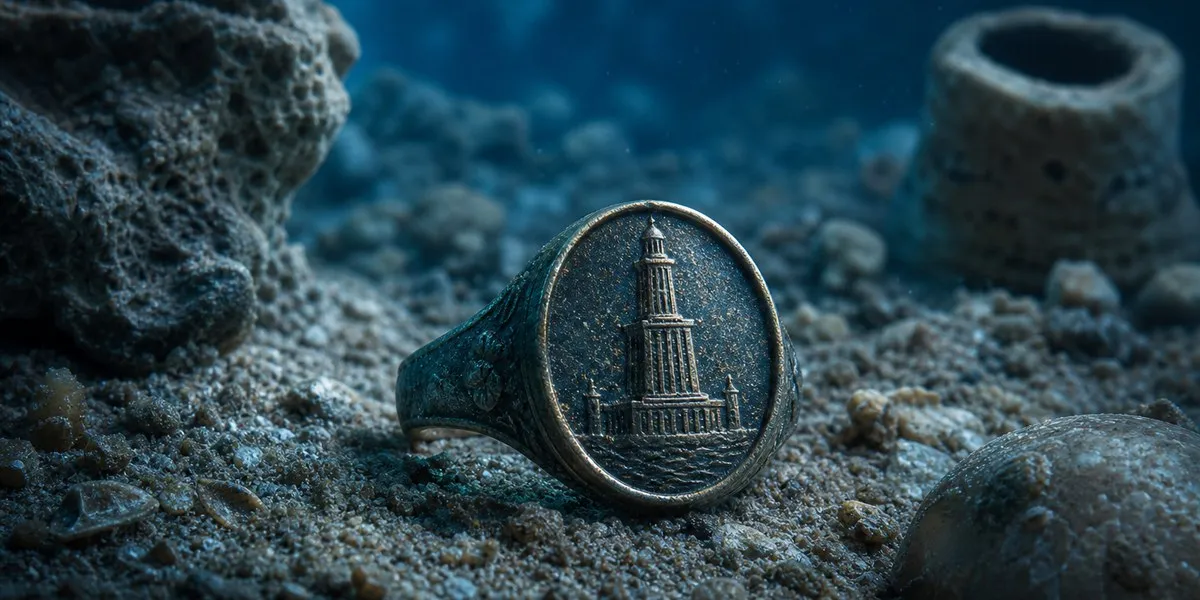
A remarkable discovery has emerged from the depths of the Mediterranean Sea near Alexandria, Egypt: a bronze signet ring believed to showcase the iconic Lighthouse of Alexandria. This finding was made by a collaborative team from the European Institute for Underwater Archaeology and Egypt’s Ministry of Tourism and Antiquities, during their explorations of a palace located on the submerged island of Antirhodos.
Significance of the Engraved Lighthouse
This bronze ring marks the first instance of a signet ring featuring the Lighthouse of Alexandria. The intricate design mirrors likenesses of the lighthouse found on second-century coins. Although some of the engraving has eroded over time, Doris Behrens-Abouseif, an Art History and Archaeology professor emerita at the University of London, suggests that it likely represents the lighthouse accurately. Researcher Andrew Chugg has identified an interesting asymmetrical detail at the top of the engraving, which he interprets as a plume of smoke from an oil lamp positioned atop the statue resembling the structure.
Furthermore, Professor emerita Margaret Miles has posited that the ring could have belonged to a merchant in Alexandria where the lighthouse symbolized the city’s significance. Its discovery offers valuable insight into the relationship between the merchants and their connection to Alexandria’s most renowned architectural marvel.
Historical Context of Antirhodos
The submerged island of Antirhodos was once a powerful center, favored by the Ptolemaic dynasty that ruled from 304 to 30 BC. Franck Goddio, president of the European Institute for Underwater Archaeology, emphasized the palace’s historical importance. Signet rings from this era served a practical purpose, creating impressions on materials like clay and wax, thereby functioning as tools for administration. The newfound ring suggests potential administrative activities related to the lighthouse, highlighting the island’s significance in local governance and trade.
The Lighthouse of Alexandria, constructed on the nearby island of Pharos around 280 BC, was a marvel of engineering rising over 100 meters. Ancient writers, including Pliny the Elder, celebrated it as one of the wonders of the ancient world. The structure was operational until the Middle Ages, when a series of earthquakes and natural erosion culminated in its submersion beneath the waves.
Implications of the Discovery
The discovery of this signet ring not only enhances our understanding of the artifacts associated with Alexandria but also underscores the rich tapestry of life in the ancient city. The ring serves as a tangible connection to commerce, governance, and the maritime culture that characterized Alexandria. As underwater archaeology continues to unveil these historical treasures, we gain deeper insights into the lives of those who inhabited this storied region.
In this ever-evolving narrative of history, each artifact provides a thread that weaves together the past and present. Scholars and enthusiasts alike await further explorations, which promise to enrich our understanding of ancient civilizations. As underwater archaeology flourishes, the submerged secrets of Alexandria and its environs shall continue to reveal their stories, forever deepening our appreciation for this remarkable part of human history.