
The United Arab Emirates (UAE) is taking significant strides in space exploration with plans for its second-ever interplanetary mission. Set to commence in March 2028, this ambitious project, known as the Emirates Mission to the Asteroid Belt (EMA), aims to investigate seven asteroids located between Mars and Jupiter. The mission will conclude with a landing on the intriguing asteroid 269 Justitia, distinguished by its reddish hue.
Mission Launch and Preparations
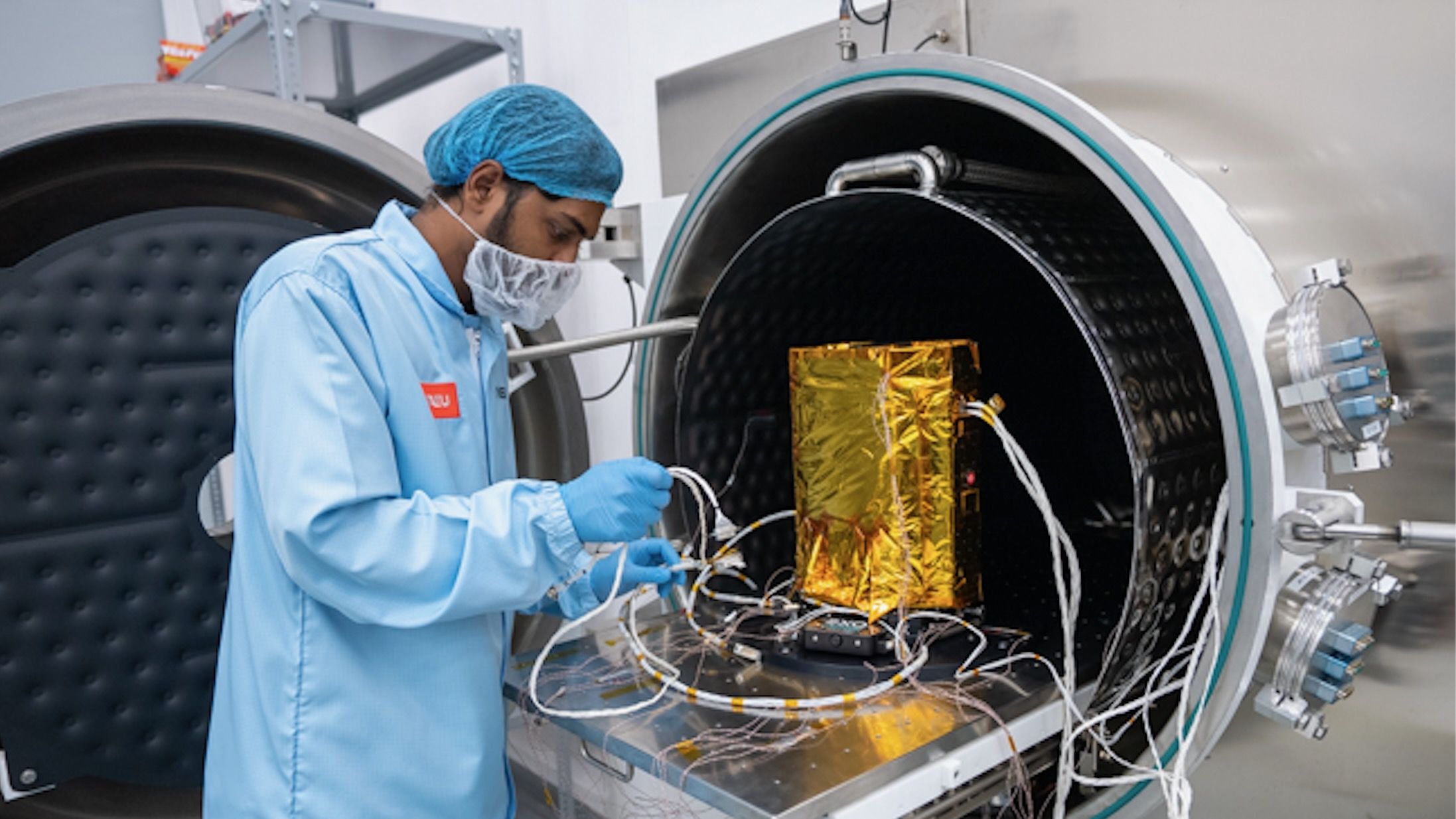
During a press event in Abu Dhabi on October 1, 2023, officials provided updates, showcasing a half-scale model of the homegrown lander that will be integrated into the primary spacecraft, the MBR Explorer. This spacecraft is named after Sheikh Mohammed bin Rashid al-Maktoum, the current prime minister of the UAE. The lander is currently housed within a vacuum chamber in the UAE capital, pending its eventual transport to Colorado for further integration with the MBR Explorer. The mission represents a sequel to the UAE’s successful Hope Mars mission, which has been exploring the Red Planet since 2021.
If everything unfolds according to the timeline, the MBR Explorer will embark on its journey from Japan in March 2028. The mission signifies a leap in the UAE Space Agency’s ambitions, highlighting its growing capabilities in space exploration.
A Deep Dive into the Asteroid Belt
The EMA will perform high-speed flybys of six asteroids before finally orbiting 269 Justitia. Covering approximately 3 billion miles (or 5 billion kilometers), the mission will utilize gravity assists from Venus and Earth to accelerate toward its targets. The spacecraft will first encounter asteroids 10253 Westerwald, 623 Chimaera, and 13294 Rockox, followed by further gravitational assists from Mars to reach its final three targets: 88055 Ghaf, 23871 Ousha, and 59980 Moza.
In 2036, the MBR Explorer will arrive at 269 Justitia, a 30-mile-wide celestial body with a striking crimson color. Scientists theorize that this unusual hue is similar to icy objects found in the Kuiper Belt, suggesting that it may have originated from the outer solar system and later migrated inward. This theory positions the asteroid as a prime candidate for studying the early solar system, particularly in understanding the distribution of water and organic materials as planets formed.
Technical Challenges and Objectives
Once the spacecraft reaches 269 Justitia, it will spend approximately seven months studying the asteroid from orbit. The descent of the lander will occur at a calculated speed, wherein it will likely impact the asteroid’s surface rather than land gently. Although the team does not anticipate the probe surviving this impact, it has been designed to collect valuable data. The high-speed approach is expected to create a small crater, potentially exposing subsurface materials that have remained undisturbed.
The challenge of ensuring successful mission execution within a limited timeframe poses additional pressure. The team has only a narrow three-week launch window in early March 2028. Once deployed, the probe will operate autonomously for its eight-year journey, making decisions on data capture without commands from Earth.
Future Prospects and Scientific Gains
Beyond the immediate scientific outcomes, the EMA reflects the UAE’s broader ambitions to enhance its sovereign space capabilities and stimulate its domestic space economy. Established in 2014, the UAE Space Agency has expanded its undertakings within just a few years, transitioning from satellite missions to deeper explorations of Mars and, soon, to the asteroids.
The EMA mission crew comprises around 50 local engineers and scientists, many of whom began their careers in the previous Hope Mars mission. As the UAE aims to rank among the world’s top ten space economies by 2031, the insights gained from the EMA mission could have far-reaching implications, not only for the UAE but for global scientific understanding of our solar system.
The journey of the EMA encapsulates more than mere exploration; it signifies the UAE’s commitment to advancing its space initiatives, pushing the boundaries of where humanity can reach, and setting the stage for future missions that continue to unravel the mysteries of the cosmos.