
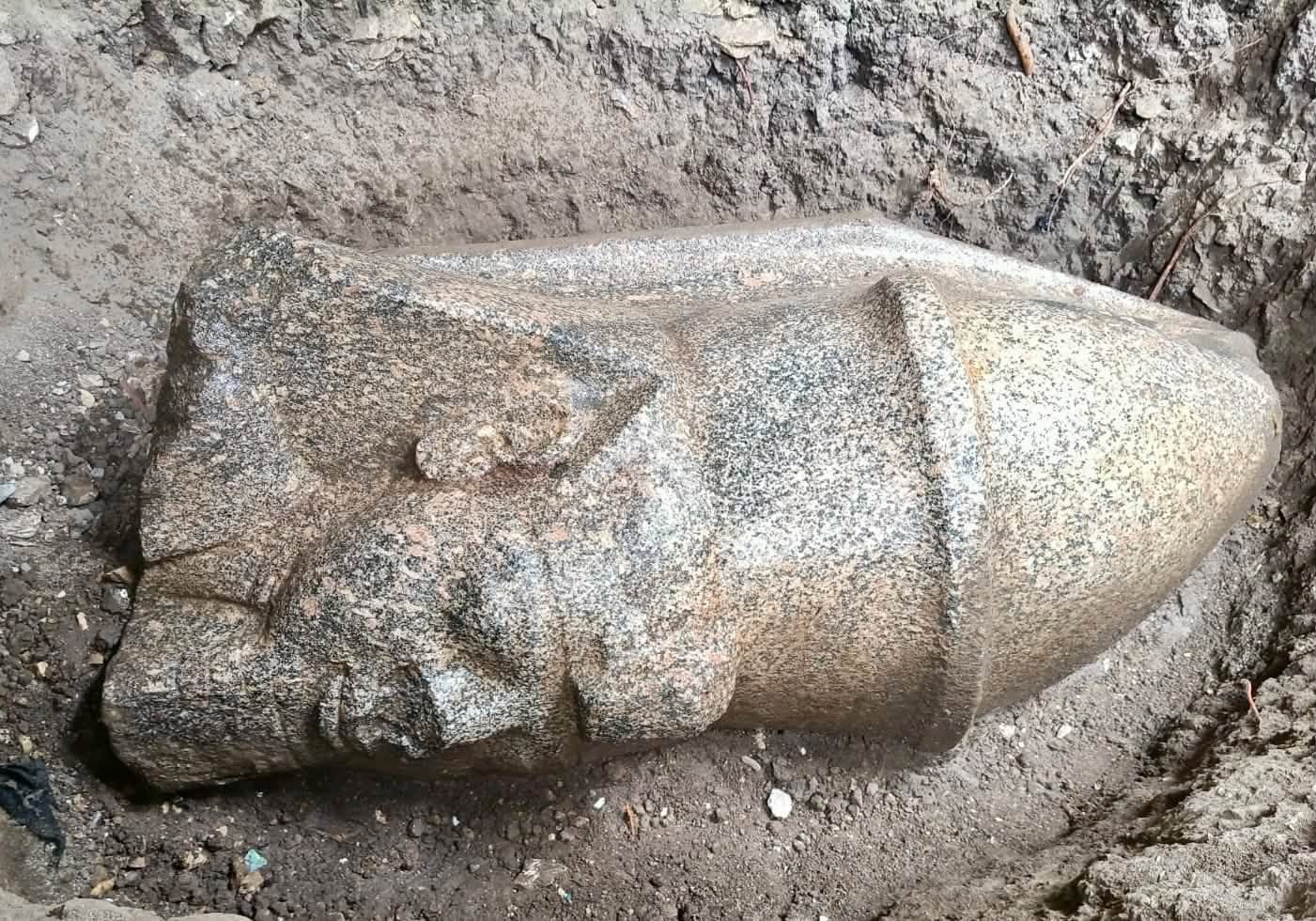
Archaeological efforts in Egypt have yielded remarkable discoveries, uncovering colossal royal statues, notably one attributed to King Ramesses II. These findings, situated in Behebat al-Hijara, Gharbia Governorate, are not only significant for their historical context but also for the insights they provide into ancient Egyptian artistry and culture.
Massive Statue of Ramesses II Unveiled
The excavation team, operating under the auspices of the Supreme Council of Antiquities, revealed a giant head from a statue of Ramesses II, measuring about 5.2 feet tall. The figure showcases the pharaoh adorned with the double crown, emblematic of the unity of Upper and Lower Egypt. Hisham El-Lithi, the secretary-general of the Council, elaborated on the statue’s estimated height, suggesting that it could have originally stood at a monumental 28 feet tall when fully intact.
Additionally, fragments of the statue’s back pillar were found, displaying an inscription of Ramesses II’s Horus name, “Har Ka Nekht Mari Maat.” This detail offers a glimpse into the pharaoh’s divine lineage and authority. Ramesses II, reigning during the 13th century B.C. under the 19th Dynasty, is often regarded as one of Egypt’s most illustrious rulers, known for his extensive temple construction and extraordinary sculptures.
Insights from Additional Discoveries
Alongside the colossal head, a secondary statue was discovered, measuring roughly 7.9 feet long. While its legs and base were absent, researchers noted that its head remains intact, boasting similarities to the first statue’s features. Although the statue’s identity hasn’t been fully confirmed, there is speculation that it too may depict Ramesses II.
In close proximity, another significant find was a pink granite block inscribed with hieroglyphics. This 4.3-foot-long artifact bears two royal titles associated with Ramesses II: “Nesu Bety,” translating to King of Upper and Lower Egypt, and “Sa Ra,” meaning Son of Ra. The presence of such inscriptions on the granite block reflects the pharaoh’s official titles and underscores the significance of his reign in ancient Egyptian society.
Ongoing Research Near the Temple of Isis
The archaeological initiative commenced after a local resident reported finding an inscribed stone, prompting an inspection by authorities. Minister of Tourism and Antiquities, Sherif Fathi, commended the individual for their diligence in reporting the initial discovery. As excavations continue, El-Lithi emphasized the importance of determining the relationships between the newly uncovered statues and the broader archaeological context of the area.
Behebat al-Hijara is historically recognized for its proximity to the Temple of Isis, a vital site of worship in ancient Egypt. The ongoing research aims to provide clarity about the original locations of these statues and their architectural relevance. With each layer of discovery, the excavation site reveals deeper narratives pertaining to ancient Egyptian civilization, enriching our understanding of its history, art, and religious practices.
In conclusion, these remarkable discoveries shed light on not only the grandeur of Ramesses II’s reign but also the intricate craftsmanship of ancient Egyptian artists. As excavation efforts persist, the findings will likely continue to unveil additional insights into the architectural and cultural heritage of this extraordinary civilization.