
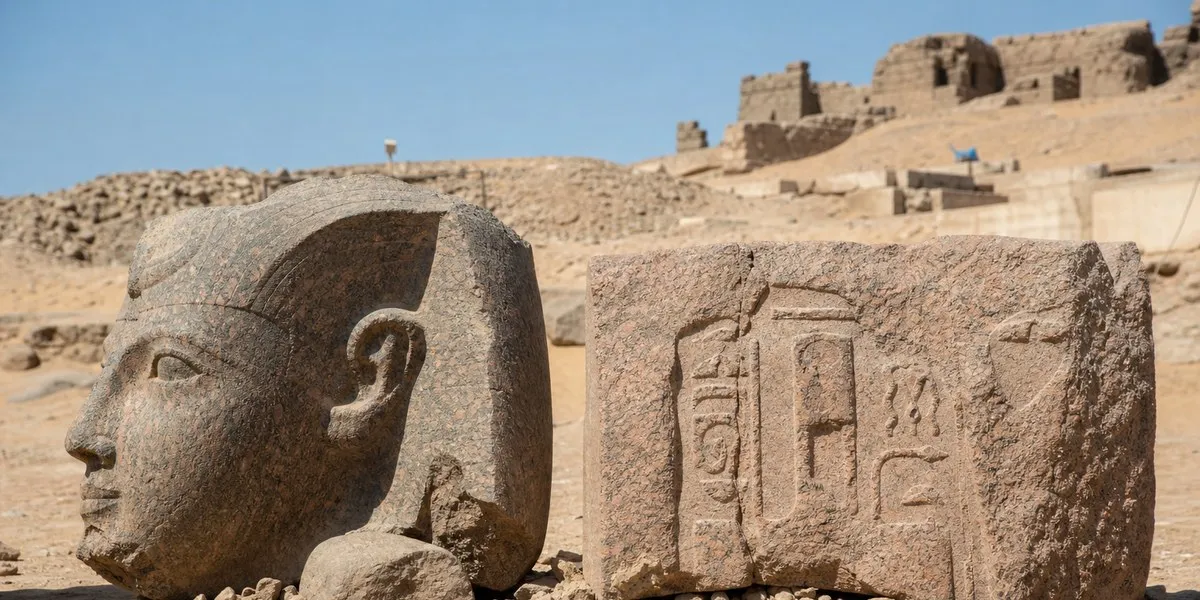
In the village of Behbeit el-Hagar, located in northern Egypt, an accidental yet remarkable archaeological find has occurred. Farmer Khaled el-Shahat Khalil stumbled upon remnants of two monumental statues while cultivating his field. Initial analyses suggest these may represent Pharaoh Ramses II. This discovery has attracted the attention of Egypt’s Ministry of Tourism and Antiquities, as reported by The Jerusalem Post.
Excavation and its Significance
Upon discovering the fragments, Khalil promptly alerted the authorities. In response, a specialized team was dispatched for rescue excavations in the locality. Behbeit el-Hagar is not just any village; it harbors the remnants of an ancient temple dedicated to the goddess Isis, known as the Iseum. This location is rich in historical significance, making any new findings even more intriguing.
Details of the First Fragment
The first piece unearthed features a head measuring approximately 1.6 meters in height, depicting the pharaoh adorned with the pschent, the iconic double crown representing the unification of Upper and Lower Egypt. Close by, the statue’s rear was discovered, marked by an inscription that includes Ramses II’s Horus name—”Hor Ka Nakht Meri Maat,” translating to “Mighty Bull, Beloved of Maat.” Hisham el-Leithy, the secretary-general of Egypt’s Supreme Council of Antiquities, asserts that the original statue’s total height could have reached around 8.5 meters, showcasing the grandeur associated with Ramses II.
The Second Fragment and Additional Discoveries
The second fragment relates to Ramses II as well, standing at 2.4 meters tall and exhibiting well-preserved facial features. While it lacks legs and a base, the upper portion of the traditional nemes headdress is evidently absent. What amplifies this find is the accompanying block of pink granite discovered alongside the fragments. This block features several hieroglyphic inscriptions, including titles such as “Nesu-Bity,” which translates to “king of Upper and Lower Egypt,” and “Sa Ra,” meaning “son of Ra.” These inscriptions further contribute to our understanding of Ramses II’s legacy and the royal honors bestowed upon him.
A Recognition Ceremony and Future Prospects
In light of this significant discovery, Egyptian Minister of Tourism and Antiquities, Sherif Fathy, honored Khalil and his wife with a certificate of appreciation for reporting their findings. This acknowledgment underscores the importance of local involvement in archaeological discoveries and helps foster a sense of pride in Egypt’s ancient heritage. The fragments not only hold historical value but also offer a unique opportunity for further studies that could illuminate more aspects of ancient Egyptian civilization.
This recent discovery at Behbeit el-Hagar may reshape our understanding of the era’s monumental architecture and artistry. As research continues, it underscores the potential that still lies beneath the soil of Egypt, inviting historians and archaeologists alike to delve deeper into the nation’s rich past. The ongoing excavations and their findings are a reminder of the complexities of Egypt’s historical narrative and the unending quest for knowledge and heritage preservation.