
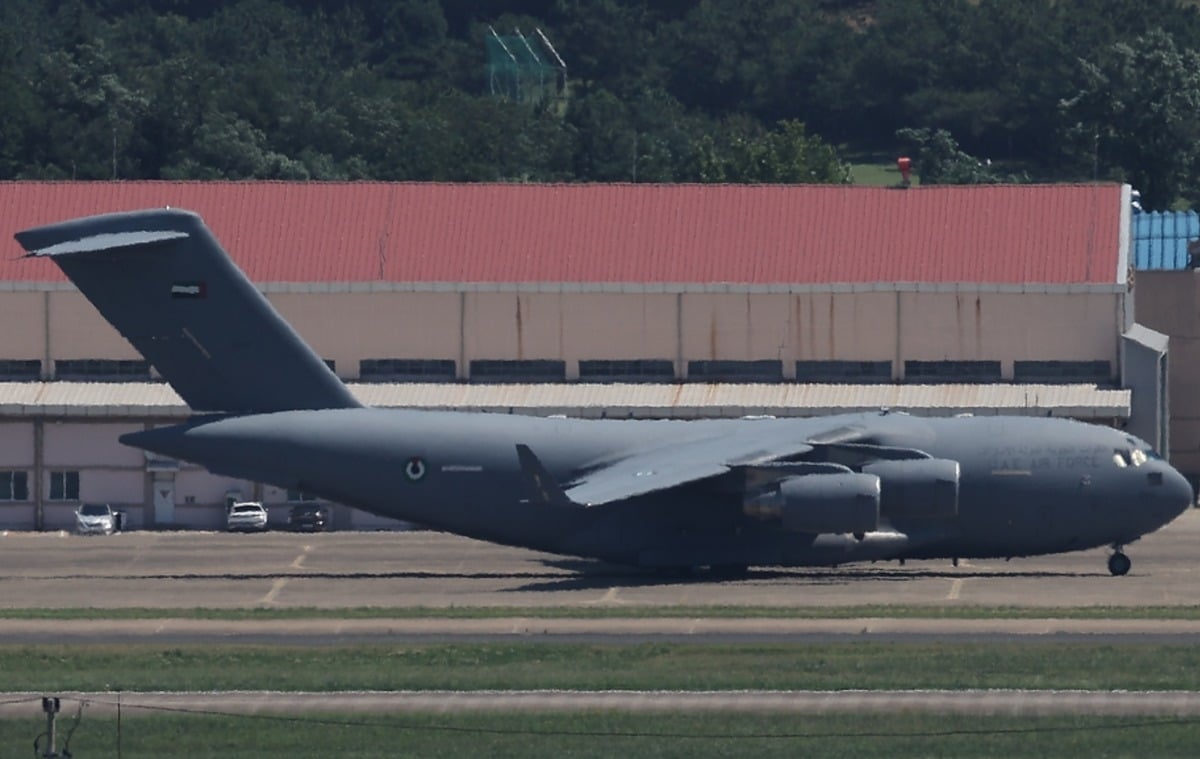
The United Arab Emirates (UAE) has recently taken significant steps to bolster its air defense capabilities amid ongoing regional tensions. In a strategic move, the UAE dispatched eight C-17 military transport aircraft to South Korea for the urgent airlift of a Cheongung-II air defense battery, alongside interceptor missiles. This operation allowed the UAE to bypass the critical Strait of Hormuz, which has been effectively blocked, thereby ensuring a secure route for the necessary military hardware.
Logistical Challenges and Military Readiness
South Korean military sources confirmed that this operation began at Daegu Air Force Base, where at least one C-17 was observed loading the defense systems. The rapid deployment saw multiple aircraft arriving sequentially to expedite the transport of the military equipment, effectively pushing the delivery timeline forward by about a month from the original contract. Generally, such heavy military equipment would be transported by sea, but the blockade has made that option infeasible. Each C-17 can carry over 170,000 pounds of cargo, indicating that several flights are necessary to transport an entire Cheongung-II battery and its components.
The urgency behind this operation is highlighted by the recent spate of missile and drone attacks linked to Iranian forces across the Gulf. The two existing Cheongung-II batteries stationed in the UAE have seen action, working in tandem with U.S. Patriot systems and Israeli Arrow interceptors. Reports indicate these batteries successfully launched over 60 interceptor missiles, achieving an impressive success rate of around 96%. This live combat performance has significantly influenced Abu Dhabi’s approach, leading to a reassessment of the timeline for delivering the remaining units of its air defense contract.
Previous Airlift Operations and Strategic Implications
This week’s airlift is not the first of its kind for the UAE. In March, a C-17 was used to transport interceptor missiles from South Korean military reserves to replenish stocks compromised during earlier Iranian attacks. However, this current operation is of a much larger scale, involving both an entire battery and additional rounds, highlighting a growing urgency in the UAE’s defense posture.
The Cheongung-II, or KM-SAM Block II, is a sophisticated medium-range surface-to-air missile system developed by South Korea. Each battery comprises multiple launcher vehicles, a multifunction radar system, and an engagement control station, designed to intercept various aerial threats. Its role in Abu Dhabi’s defense aligns it closely with similar systems like the U.S. Patriot PAC-2, although it comes at a significantly lower cost per battery. This airlift represents the third battery under a larger $3.5 billion contract signed by the UAE in early 2022, which marked a milestone in South Korean defense exports.
Global Interest and Future Prospects
The procurement of the Cheongung-II system has caught the attention of neighboring countries, with Saudi Arabia and Iraq also signing contracts for the missile system in 2024. This demand, coupled with the system’s strong performance in combat, has led to increased inquiries from additional nations, indicating a growing global interest. South Korean officials have acknowledged that the real-world effectiveness of the Cheongung-II during live conflicts offers a compelling selling point to potential buyers, as defense systems that demonstrate reliability in active scenarios hold more appeal than those validated only through testing.
Ultimately, the proactive measures taken by the UAE—by investing in a complex airlift operation—underscore the seriousness with which Abu Dhabi assesses its current security situation. The logistical challenge of moving a battery across blockaded waters has been overcome through concerted airlift efforts, allowing for rapid deployment and operational readiness. This strategic commitment should send a clear signal regarding the UAE’s posture towards regional threats while reinforcing confidence in the Cheongung-II’s capabilities.