
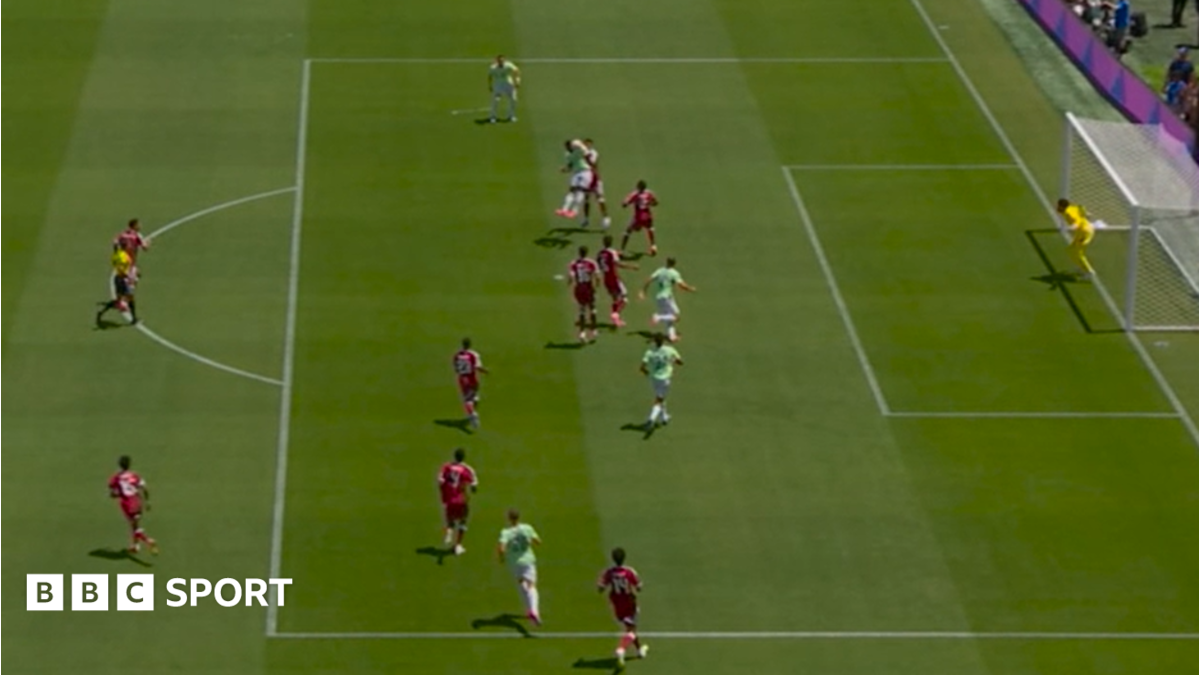
The question of whether Remo Freuler was offside before being fouled by Qatar’s goalkeeper Mahmoud Abunada remains a topic of debate following the World Cup Group B match that ended in a 1-1 draw. The incident led to a penalty kick that was successfully converted by Breel Embolo. As the tournament unfolded, FIFA had high hopes for its new semi-automated offside technology, which was designed to improve the accuracy of decisions in crucial moments.
FIFA’s Ambitions and Technology
Before the World Cup commenced, FIFA introduced an innovative semi-automated offside system to enhance decision-making accuracy. The organization invested considerable resources to create realistic avatars of each player participating in the tournament. This initiative was intended to offer the most precise interpretations of offside situations ever witnessed in football. However, despite these advancements, there seems to be an absence of conclusive evidence proving Freuler’s onside status during this contentious moment in the match.
Notably, pundits like Gary Neville have expressed skepticism about the decision. On ITV, he remarked, “We all think it here [that it was offside]. Everybody at home thinks it.” This indicates that there is widespread confusion and uncertainty surrounding the application of the offside rule during the game. Neville further stated that FIFA, as the host broadcaster, possesses the capability to present evidence from their new technology but has yet to do so, generating doubts that FIFA may be concealing information about the incident.
Impact of Delays on Perceptions
The delay in revealing crucial information can contribute to public doubt, creating a vacuum that often leads to conspiracy theories. Many fans may assume that FIFA’s silence indicates a potential issue or oversight on their part. The anticipation surrounding the use of animated avatars to clarify offside decisions raised expectations, but it is clear that not all situations are being addressed equally. For instance, FIFA disseminated animated graphics during other matches, even when VAR was not consulted, highlighting the inconsistency in communication.
There was a notable example earlier during the tournament involving Tani Oluwaseyi, who was flagged offside before being challenged by the Bosnia-Herzegovina goalkeeper. FIFA provided animation in this case, demonstrating their commitment to utilizing technology for clarity. In contrast, the ambiguity surrounding Freuler’s case has left many fans questioning the effectiveness of the semi-automated offside system and its reliability in crucial situations.
Quick Response to Offside Calls
One of the key features of FIFA’s semi-automated offside system is its ability to alert officials quickly when a player is deemed offside by more than 10 cm. This innovation aims to reduce delays in flagging offside scenarios, creating a more fluid match experience. Quick processing means that obvious offside calls can be made swiftly, mitigating the frustrations often associated with delayed VAR decisions. However, Freuler’s situation appears to have been more nuanced, lying at the edge of the 10 cm threshold, which further complicates matters.
Ultimately, while FIFA has improved the speed of offside decisions, the ambiguity surrounding Freuler’s situation leaves room for doubts and discussions. For fans and analysts alike, the effectiveness of this new technology hinges on transparency and the timely dissemination of information. Whether the technology can deliver the clarity it promises during critical moments remains to be seen as the tournament progresses.