
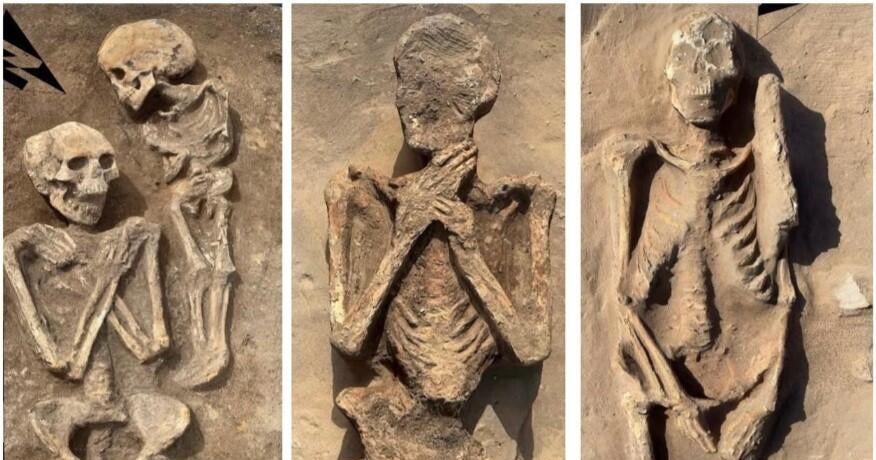
Archaeologists in Egypt have made a groundbreaking discovery at the Tell Kom Aziza site in the Nile Delta, revealing remains and artifacts from a Greco-Roman cemetery over 2,300 years old. This finding not only highlights the evolution of burial practices across centuries but also underscores the significance of this historical location.
Insights into Ancient Burial Practices
Excavations at Tell Kom Aziza, located in Egypt’s Beheira province near the Mediterranean coast, have unearthed remains and various artifacts dating back from approximately 332 B.C. to 395 A.D. The site showcases a wide array of burial customs, indicating a transition from a settlement hub to an extensive cemetery over time. Nevine El-Aref, media adviser to the Minister of Tourism and Antiquities, emphasized that this discovery is vital for understanding the historical importance of the area, revealing a unique transformation of cultural practices.
The burial styles found at the site range widely; archaeologists discovered everything from simple pit burials to graves constructed with mud bricks, and even elaborate painted plaster coffins. Significant variations in interment methods were identified, suggesting diverse social statuses and rituals. According to Dr. Hisham El-Leithy, Secretary General of the Supreme Council of Antiquities, graves included both individual and collective burials aligned along different axes.
Symbolic Hand Positions and Ritual Significance
Interestingly, the positioning of the arms of the deceased varied significantly. Some were interred with their hands crossed over the pelvic area, while others were arranged in the “Osirian pose,” characterized by arms crossed over the chest. This diversity in burial practice might indicate differences in societal roles or variations in funerary traditions, as pointed out by Khaled Abdel Ghany Farhat, the head of the excavation team.
Among the notable findings were two complete skeletal remains of wild boars, a rarity in ancient Egyptian burial sites. These animals were often linked with Seth (or Set), a deity associated with chaos and conflict in ancient mythology. Mohamed Abdel Badi, Head of the Egyptian Antiquities Sector, noted that while it’s unclear whether these animal remains signal intentional burials or serve another purpose, their presence in this context suggests a deeper cultural and religious significance.
Unearthing Pottery and Everyday Items
The site also produced pottery fragments dated back to the Egyptian Old Kingdom (2686-2181 B.C.), extending to the Greco-Roman period which followed thousands of years later. The recovery of domestic items, including amphorae, burial jars, and bread-making tools, suggests that the Tell Kom Aziza area was a hub of continuous human activity for centuries.
These discoveries shine a light on the enduring importance of the site, with evidence of its use spanning millennia. El-Aref stated that excavation efforts are still in progress, aiming to unveil more about the ancient civilization that inhabited this area. The ongoing research will contribute to a more profound understanding of human activity patterns and the historical evolution of this significant location.
In summary, the Tell Kom Aziza site offers invaluable insight into a complex network of burial practices that evolved over centuries. This ongoing excavation not only enhances our understanding of ancient Egyptian society but also highlights the importance of archaeological research in piecing together the past. As excavations continue, there is great anticipation for what more this significant site may reveal about ancient Egyptian culture.