
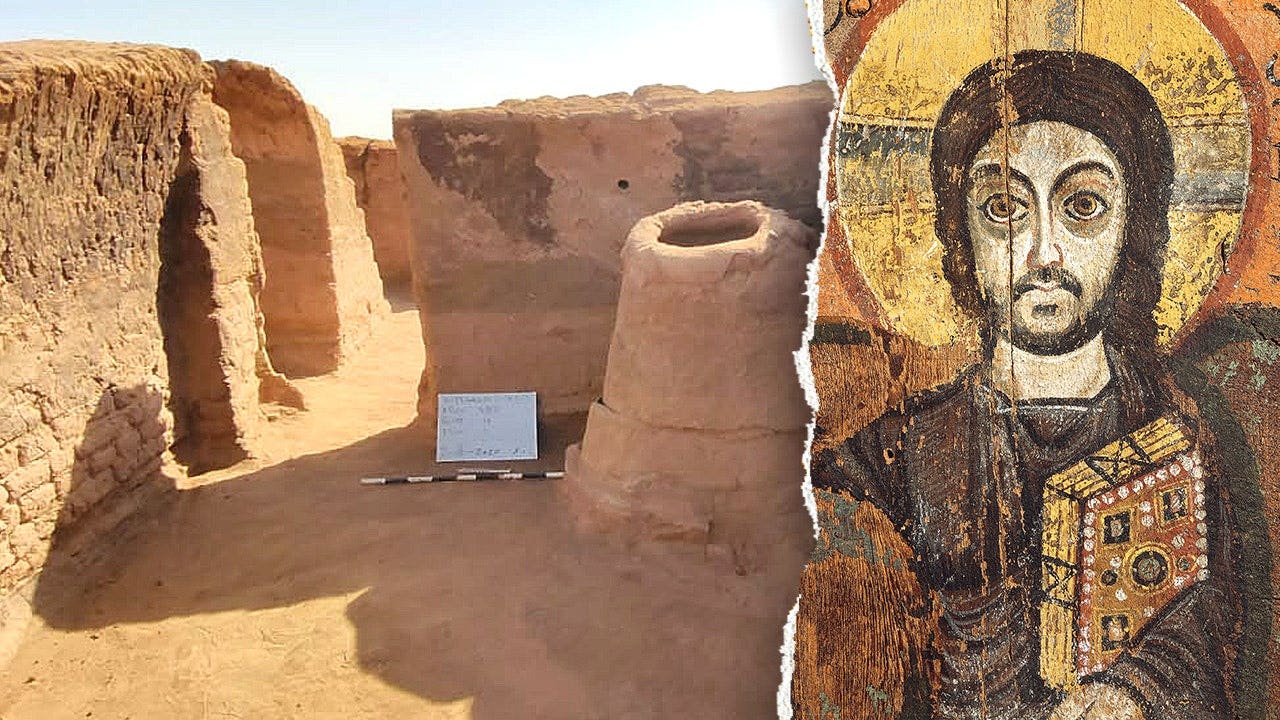
Archaeologists in Egypt have made an astonishing discovery: an ancient Christian city dating back to the early years of the faith. This significant find includes a well-preserved church and the residence of a deacon. The announcement was made by Egypt’s Ministry of Tourism and Antiquities on July 3, revealing crucial insights into the early Christian era in this historically rich region.
Uncovering a Byzantine-Era Settlement
The excavation took place at the Ain al-Sabil archaeological site located in the Dakhla Oasis, approximately 185 miles west of Luxor. The Ministry officials described this Byzantine-era city as remarkably “complete.” Photographs from the excavation highlight mudbrick rooms, intricate passageways, and domed ovens believed to have been used for baking bread. All structures discovered were constructed with mud bricks, indicating a cohesive building practice that has endured through the centuries.
Among the found structures is a basilica church dating to the mid-fourth century A.D., as well as two watchtowers on the city’s periphery. Additionally, researchers uncovered a fortress featuring strong defensive walls, along with clusters of homes that showcase large halls and vaulted ceilings. One particularly noteworthy structure is the residence of Tisos, a church deacon from the later part of the fourth century A.D. There is also a house identified as Tapibos that likely served as a house church prior to the construction of the basilica.
A Well-Planned Urban Layout
Diaa Zahran, who leads the Islamic, Coptic, and Jewish Antiquities Sector at the Supreme Council of Antiquities, emphasized that the city exhibits a meticulously planned urban layout. Notably, it features main streets running from north to south, interspersed with east-west streets, which create open squares and communal plazas. At the center stands the basilica church, strategically situated to oversee the principal street.
The excavations also yielded a plethora of everyday artifacts, including household pottery, oil storage bottles, lamps, and grinding stones. A particularly interesting find was a treasure trove of coins, with several well-preserved bronze coins depicting Byzantine emperors and incorporating both Latin inscriptions and Christian symbols. Some gold coins even date back to the reign of Emperor Constantius II, who ruled between 337 and 361 A.D.
An Archive of Daily Life and Historical Significance
One of the most remarkable discoveries was an archive of written documents comprising around 200 ostraca—pieces of pottery or limestone inscribed in Coptic and Greek. Mahdi, the director of excavations for the Islamic and Coptic Antiquities Sector, revealed that these texts record transactions, correspondence, and various aspects of daily life. This unique archive provides invaluable insights into the living conditions and societal structure of early Christian communities.
Egypt holds a pivotal position as one of the cradles of early Christianity and has seen numerous significant archaeological finds in recent years. Just this spring, officials announced the discovery of an ancient monastery in Wadi El-Natrun that dates back to the nascent stages of Christianity. Earlier in the year, excavations also unveiled a Christian monastic complex in Upper Egypt, shedding light on the lives of monks before the Arab conquest.
This recent discovery not only enriches our understanding of early Christian history in Egypt but also highlights the ongoing archaeological work that continues to uncover the layers of historical significance embedded within the nation’s landscape. As researchers delve deeper into this ancient city, further revelations may emerge that will enhance our comprehension of the early Christian community’s life and culture.