
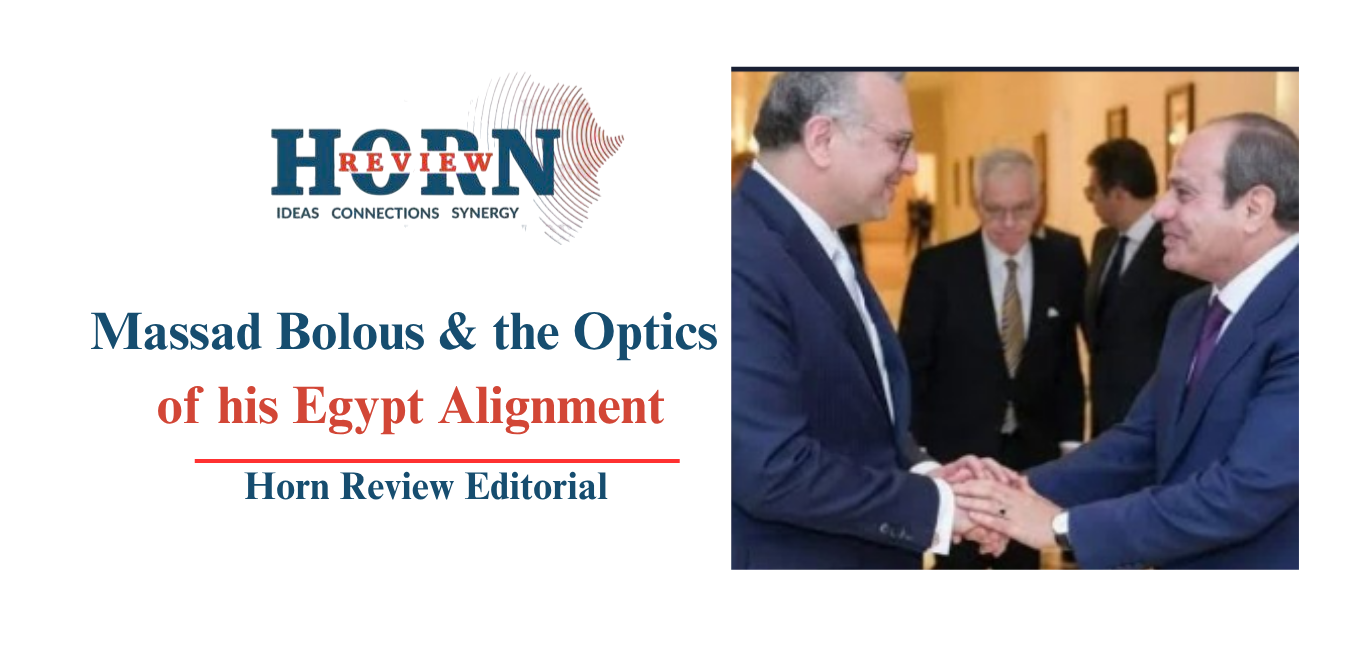
In contemporary diplomacy, alignment is often suggested rather than explicitly stated. It takes form through the dynamics of meetings, agendas, silence, and selective urgency. Imagery is not trivial; it is integral to policy-making. The arrangement of meetings, seating order, and the visual representation of alliances often convey messages more effectively than official announcements. Particularly noteworthy is the diplomatic behavior of Massad Boulos, a Senior Advisor for Arab and African Affairs in the Trump administration. His recent trip to Cairo merits examination, not for its overt declarations but for its underlying implications. His public denials of an anti-Ethiopian stance contrast sharply with a diplomatic path that appears to endorse such a perception, whether intentionally or not.
The Impact of Cairo Engagements
Boulos’s interactions in Cairo, particularly with the foreign ministers of Egypt, Somalia, and Eritrea, underscore how diplomatic appearances can obscure the distinction between neutrality and alignment. By participating in a prominent sequence of meetings, Boulos may inadvertently project an alliance that marginalizes Ethiopia. This initiative strengthens Egypt’s role as a central player in the Horn of Africa and subtly shifts U.S. engagement from a balancing act to one that could potentially disadvantage Ethiopia in discussions key to its strategic interests.
While Boulos officially refutes claims that the U.S. is forming frameworks with Eritrea or Egypt against Ethiopia, the real evaluation of diplomacy comes from tangible actions. Recently, Boulos has championed re-engagement with Eritrea, proposing normalized relations and the potential lifting of sanctions. These discussions are not conducted in a vacuum; they are centrally coordinated in Cairo, where Egypt has long held a vested interest in regional dynamics, often at odds with Ethiopia’s aspirations.
The Repercussions of Diplomatic Choices
The strategic interplay among Egypt, Eritrea, and Somalia since 2024 reveals a collective intent to counter Ethiopia’s influence. By engaging with one of these states through another, Boulos complicates perceptions of U.S. neutrality in the region. The vital question here is whether his actions, regardless of intention, produce consequences synonymous with support for an anti-Ethiopian coalition. Three key facets that emerge warrant discussion.
First, the sequence of diplomatic engagements reconfigures the hierarchy of the U.S. strategy in the Horn of Africa. This includes potentially normalizing relations with Eritrea, a nation that has historically posed challenges to Ethiopia. Such moves introduce disparities that could position Ethiopia’s security concerns as secondary. In a geopolitical landscape where stability hinges on mutual respect for all players, sidelining a key actor like Ethiopia could render any framework inherently weak.
Second, the geography of Boulos’s diplomatic engagements is critical. Egypt’s longstanding disputes with Ethiopia over Nile waters make it a partial actor rather than a neutral mediator. By centering U.S. diplomacy in Cairo-led consultations, Boulos risks entwining U.S. efforts with Egyptian agendas, fostering a bias against Ethiopia.
Third, the conspicuous absence of Ethiopia in regional discussions raises red flags. Ethiopia is integral to the region’s demographic and security landscape. Engaging states that oppose Ethiopia while relegating it to a reactive role not only distorts regional perceptions but also undermines the natural order of power dynamics within the Horn.
The Dilemma of Intent vs. Perception
Proponents of Boulos’s approach might argue that the U.S. focus is on broader geopolitical concerns, like safeguarding Red Sea shipping routes and counterbalancing Iranian influence. While these are valid issues, they do not diminish the regional fallout from such engagements. Actions taken in one geopolitical sphere inevitably influence another, creating a complex intertwining of interests.
This leads to the crux of the matter: the disparity between intent and effect. While evidence may not suggest a calculated effort by Boulos to foster an anti-Ethiopian coalition, his diplomatic engagements and public statements create an apparent imbalance. This situation raises essential questions about his overall approach, which often seemingly accentuates Egypt’s interests at the expense of Ethiopia’s security concerns.
In summary, the challenge lies in whether the United States fully understands the ramifications of its diplomatic choices in the Horn of Africa. With Ethiopia remaining a cornerstone for regional stability, policies that overlook its central role could lead to significant miscalculations. In diplomacy, perception is reality, and signs of bias towards Egypt in Boulos’s actions are increasingly difficult to dismiss, ultimately shaping the strategic landscape in ways that could have far-reaching effects.