
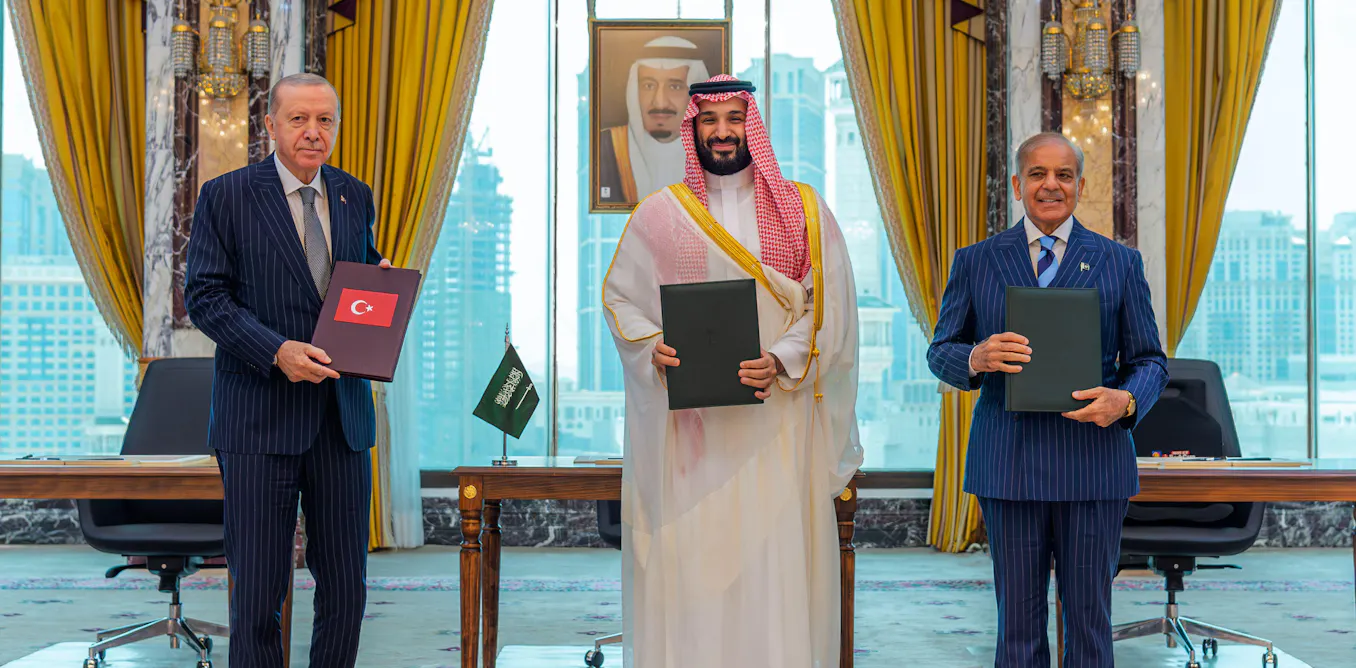
The recent establishment of a mutual defense pact among Saudi Arabia, Turkey, and Pakistan on August 7 has spurred widespread commentary. This agreement, often subjected to the label “Islamic NATO,” fundamentally changes the security dynamics in the region. Its core principle asserts that an armed attack against any of the signatory nations will be viewed as an assault on all three. This alliance has drawn reactions from various quarters, with Israel categorizing it as an anti-Israel coalition.
Reassessing the NATO Comparison
The comparison to NATO might be misleading. The real implication of this pact is less about an anti-Israel stance and more about the evolving perceptions of American reliability among its allies. The treaty is likely intended for a more critical audience in Washington than in Tehran or Tel Aviv. This arrangement signifies a new paradigm where trusted alliances are now being reconsidered based on past American actions—or inaction.
On paper, the trio combines significant military assets: Turkey possesses NATO’s second-largest standing army and a cutting-edge drone industry; Saudi Arabia contributes substantial financial resources; and Pakistan adds a well-trained military alongside the Muslim world’s only nuclear capability. Analysts argue that the combined strengths of these nations—Turkey’s technological prowess, Pakistan’s manpower, and Saudi Arabia’s financial muscle—make this alliance potentially effective in a way that individually, they could not achieve.
The Historical Context
The necessity for this pact did not emerge in isolation. It extends from a previous Saudi-Pakistani agreement made in September 2025, right after significant Israeli military actions against Hamas. The urgency was compounded by recent conflicts, notably the US-Israeli military campaign against Iran. As the Gulf region faces growing hostile acts, particularly from Iran, questions about the reliability of American military support resurfaced. For many years, Gulf states have operated under the protective umbrella of the U.S. However, instances of insufficient responses to Iranian aggression have led to doubts about this longstanding arrangement.
The Mecca agreement serves as an insurance policy for governments that no longer want to rely solely on a single ally for their security. However, it is essential to understand that while this pact diversifies their strategic options, it does not equate to a severing of ties with the U.S., which remains crucial for their defense strategy. Officials have emphasized that this agreement complements existing alliances rather than replacing them.
Geopolitical Implications for the U.S.
The geopolitical ramifications for the United States are profound. Attempts to have Saudi Arabia normalize relations with Israel, through the Abraham Accords, face hurdles with Riyadh’s new commitments to Turkey and Pakistan—two nations that maintain adversarial positions toward Israel. Consequently, the pact could complicate any future diplomatic efforts aimed at achieving peace or stabilization in the region.
It is worth noting that the pact does not explicitly state military obligations, raising questions about its operational effectiveness. Historical precedents show that past agreements between these nations did not lead to significant military cooperation, raising skepticism about this new treaty’s practical implications.
Despite its challenges, the Mecca pact solidifies Pakistan’s status as a regional security provider, shifting Islamabad’s role from a mere beneficiary of Gulf support to a key participant in regional defense strategies. However, this expansion brings its own set of risks, as being part of a collective defense arrangement may pull Pakistan into conflicts it would otherwise avoid.
The Future of Middle Eastern Security
Iran has dismissed this pact as mere “borrowed security,” though it’s essential to recognize that regional dynamics are shifting toward a self-reliant security architecture. This new configuration may not be interpreted as an anti-American bloc, but rather as a necessary step for allies who can no longer presume that their traditional benefactor will always provide the necessary support.
The Mecca pact indicates a significant change in how security in the Middle East will be structured moving forward. As this transition unfolds, the U.S. faces a pivotal choice: to view this as a strategic setback to address, or as a foreshadowing of an evolving landscape where allies increasingly seek alternative partnerships. The decisions that follow will undoubtedly influence the ever-complex balance of power in the Middle East as nations reassess their security strategies.