
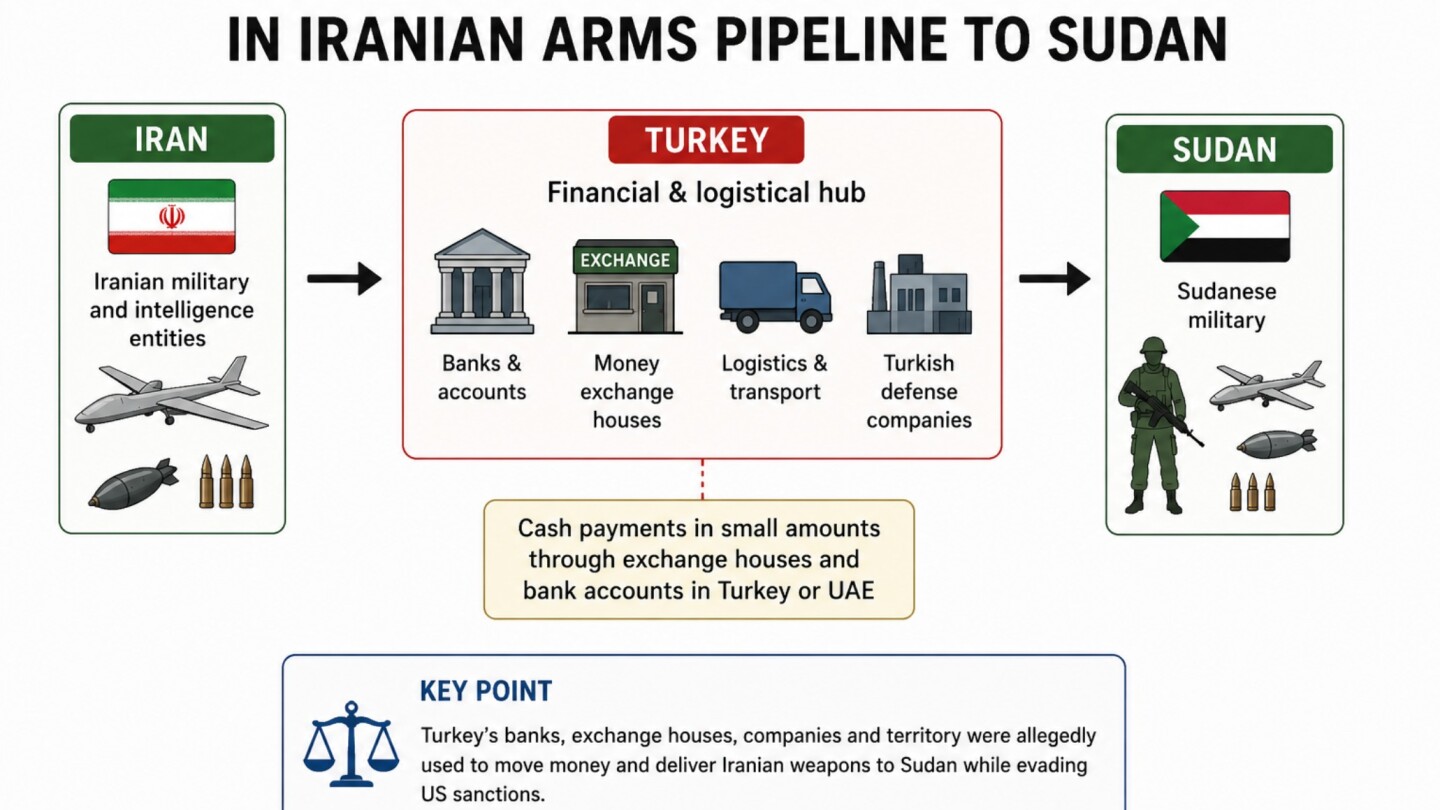
A recent US federal indictment has uncovered Turkey’s pivotal role as a financial and logistical center within an extensive Iranian arms trafficking network. This network has reportedly supplied drones, ammunition, and components for explosives to the military in Sudan. The case illustrates the existing ties between Turkish and Iranian defense contractors, revealing Turkey’s strategic location as a means to bypass international sanctions and facilitate arms transfers.
Details of the Indictment
Filed in the US District Court for California, the indictment accuses Iranian national Shamim Mafi, also known as Raheleh Mafi, of conspiring to breach US sanctions laws. The evidence is drawn from a comprehensive 33-page document detailing Mafi’s actions, particularly her role in brokering substantial arms deals involving Iran’s Islamic Revolutionary Guard Corps (IRGC), Iran’s Ministry of Defense, and Sudanese military organizations. The indictment emphasizes Turkey as a key operational hub utilized by the accused to manage transactions, facilitate payments, and effectively maneuver Iranian military exports.
The indictment also highlights how various banks and corporate entities in Turkey were exploited to transfer funds from Sudan to individuals and organizations linked to the Iranian regime. This revelation draws attention to ongoing concerns expressed by the Financial Action Task Force (FATF) regarding Turkey’s failure to combat terrorism financing and permit illicit money transfers through its financial system. Turkey was placed on FATF’s “grey list” in 2021 for these deficiencies, and although it was removed in 2024 after implementing certain reforms, the indictment suggests that significant vulnerabilities in the financial and regulatory frameworks persist.
Connection Between Iran and Turkey
Mafi, an Iranian national who moved to Turkey in 2013, utilized the country as a long-term operational base for cultivating business relationships and intelligence networks. Her background reveals connections to Iran’s Ministry of Intelligence, indicating her integration within Iranian military procurement activities. Mafi allegedly re-established herself in the US as a lawful permanent resident while maintaining frequent travel across various nations, including Iran and Turkey. This raises questions about her extensive involvement in Iran’s military-related transactions.
Further complicating this web of connections is evidence that Mafi’s former husband worked for Iran’s Ministry of Intelligence, strengthening her ties within Iran’s political landscape. The indictment suggests that Mafi was directly instructed by Iranian officials to create a business in the U.S. to facilitate operations aimed at resolving issues faced by Iranian Americans, with funding sourced from the Ministry of Intelligence. Investigators have identified numerous communications between her and Iranian operatives, showcasing her ongoing involvement in covert activities.
Turkey’s Financial Role in Arms Trafficking
Turkey’s informal money exchange sector has been flagged for its lack of oversight and susceptibility to money laundering. The indictment’s details point to a structured effort to utilize cash transfer systems in Turkey, minimizing the risk of detection by international financial institutions. For instance, Mafi instructed her Sudanese contacts to perform transactions in small amounts via Turkish money exchange houses rather than using formal banking channels.
As investigators dug deeper, they discovered that certain Turkish companies had facilitated the delivery of arms, including ammunition and drones, bound for Sudan’s military during its ongoing civil conflict. The documents confirm suspicions that Iranian defense contractors were effectively using Turkish financial networks to navigate sanctions while conducting arms exports. Notably, an amendment to a drone contract indicated that payments were planned through accounts in Turkey or the UAE, further entrenching Turkey’s role as a critical connector in these illicit operations.
The implications of this indictment extend beyond the immediate parties involved. Given Turkey’s dual role as a NATO member and a nation increasingly intertwined with Iran’s military ambitions, the findings suggest systemic issues within its regulatory environment that allow for the proliferation of arms trafficking. With US and European investigators now focused on Turkish entities linked to this network, a reevaluation of Turkey’s commercial practices is imminent, particularly as international scrutiny on sanction violations intensifies.
In conclusion, this indictment not only unveils the complex interplay between Turkey and Iran’s arms trafficking operations but also raises urgent concerns regarding Turkey’s compliance with international financial regulations. As efforts to curb Iranian weapons proliferation gain momentum, the role of Turkish financial channels as facilitators of illicit activities remains a pivotal issue in global security dialogues.