
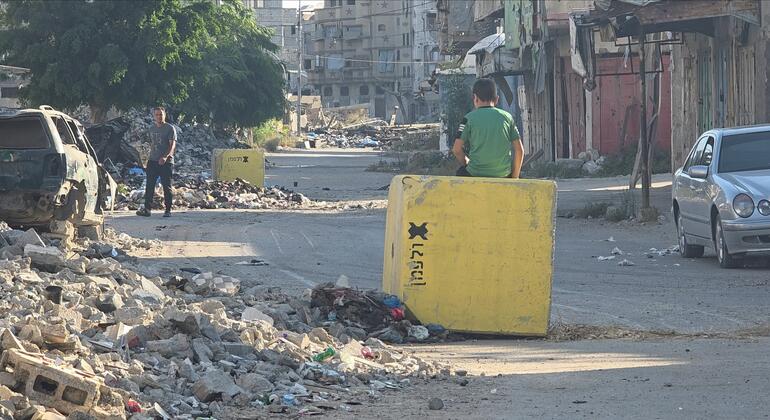
Following the announcement of the Israel-Hamas ceasefire in October 2025, a new boundary known as the “yellow line” was established, effectively dividing Gaza into two regions. The majority of the Palestinian population is now confined to the western section, while the eastern area falls under Israeli military oversight.
Initially, this yellow line allocated approximately 47% of Gaza’s land to the Palestinian community. However, reports from the United Nations Office for the Coordination of Humanitarian Affairs (OCHA) indicate that Israeli forces have gradually encroached on this allowance, reducing the land designated for Palestinian inhabitants. Currently, less than 40% of Gaza’s territory remains accessible to Palestinians, leading to widespread displacement for families residing close to the line.
Ongoing Displacement Challenges
For residents like Ibtisam Malika from the Zeitoun neighborhood, the situation has resulted in a relentless cycle of moving, returning, and relocating yet again. “Every two to three months, we find ourselves forced to change our homes and leave behind our possessions,” she lamented. The emotional and physical exhaustion of such instability is palpable. “We’ve lost half of our children in the conflict, and now, barely anything remains of our family,” she shared.
According to the UN, around 2.1 million individuals, which practically constitutes the entire population of Gaza, are currently displaced but remain within the confines of the yellow line. Many families have chosen to stay in areas close to this boundary, such as the Al-Tuffah and Al-Zaytoun neighborhoods in eastern Gaza City, simply because they have no alternative places to go. These residents live in a state of heightened anxiety, constantly aware that a shift in the security situation could force them to flee at any moment.
“We often find ourselves asking, ‘Where do we go?’ This question has become a part of our daily lives,” shared Safaa Mushtaha, a resident of Al-Tuffah. “We have adjusted to living near the yellow line, but the constant fear and uncertainty have become intolerable.”
Critical Humanitarian Needs
The humanitarian situation in Gaza has reached alarming levels, with the United Nations reporting increased difficulty in finding secure locations for displaced individuals. Much of the land suitable for such camps lies within areas that are restricted or deemed unsafe. The latest assessments indicate that approximately 1.98 million people, or about 94% of Gaza’s population, are in urgent need of assistance regarding shelter and basic necessities. Despite living in challenging conditions, 84% of families endure inadequate living arrangements like unsheltered tents that fail to provide sufficient protection from the elements.
Daily Life Amid Uncertainty
Living close to the yellow line has drastically altered the daily lives of many. “We are at a loss for what to do or where to go. We lack basic shelter and resources,” expressed Ola Ishtiwi, highlighting the grim reality faced by her family. Ahmed Arhim, another local from the Zeitoun neighborhood, noted, “The sounds of gunfire and drones haunt us, making it nearly impossible to sleep, particularly for the children.” As a result, children are often traumatized, experiencing fear that leads to sleepless nights and anxiety.
These testimonies are particularly significant considering the ongoing reports from UN agencies that indicate continued Israeli military operations despite last year’s ceasefire. As of October 10, 2025, local authorities have recorded 1,334 fatalities and 4,429 injuries linked to ongoing conflict, according to OCHA’s latest humanitarian updates. The UN Human Rights Office has expressed urgent calls to end the violence, stating, “The bloodshed in Gaza must stop.” This ongoing crisis only emphasizes the dire need for lasting peace and humanitarian interventions in Gaza.