
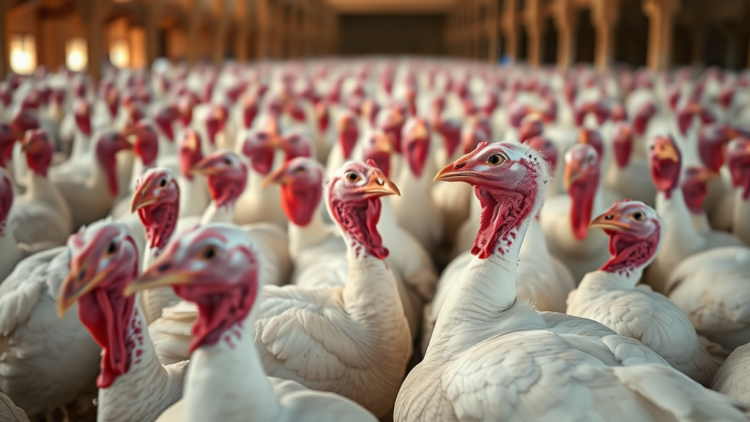
In the bustling space of a commercial turkey barn, distinguishing between individual birds proves to be a challenge. With thousands of white-feathered turkeys milling about, both humans and conventional computer vision systems frequently struggle to identify specific animals. However, modern precision livestock farming requires the ability to monitor individual turkeys, as drops in their activity can signal health issues or stress. A recent study by Debayan Sen and Theo Lutz, published in Smart Agricultural Technology, addresses this challenge with a surprisingly effective solution: a compact artificial intelligence model tailored specifically for turkeys.
The Importance of Re-identification in Livestock Farming
Re-identification is a crucial component of behavior analysis in precision livestock farming. While object detection systems can effectively outline every turkey in a video frame, the real challenge lies in tracking the same bird across multiple frames, especially in crowded settings. Conventional algorithms, such as DeepSORT, rely on motion predictions combined with appearance embeddings—a unique numerical identifier for each animal. However, the default appearance model, which was trained on humans, struggles with turkeys since their uniform shape and color provide minimal distinguishing characteristics. This discrepancy illustrates the need for models specifically designed for poultry.
Creating a Tailored Model for Turkeys
In light of these challenges, Sen and Lutz hypothesized that a smaller, specialized embedding, trained on turkey-specific data, could enhance identification accuracy. They developed a Siamese convolutional neural network with only 714,000 parameters, significantly smaller than the pedestrian model which features around 2.8 million parameters. This network uses a unique architecture, refined through a process that ensured each design choice led to measurable improvements in accuracy and stability in tracking individual turkeys.
Three key design elements emerged during their development process. Introducing pre-activation ordering in their residual blocks improved gradient flow, while squeeze-and-excitation channel attention helped the system focus on the nuanced features that actually differentiate one turkey from another. Additionally, the network’s channel count was adjusted to enhance its capability in the deepest stages, ensuring accurate identification where it mattered most.
Training Methodology and Results
The training phase of this model combined two strategic objectives: a batch-hard triplet loss, designed to bring images of the same turkey closer together while distancing images of different turkeys, and an auxiliary identity-classification loss that aids in regularization on the limited training set. The dataset used encompassed 106 unique turkey identities and incorporated realistic operational conditions, ensuring that the model could handle previously unseen birds.
The findings were noteworthy. The domain-specific embedding outperformed the generic model across all metrics of discrimination. This involved significant improvements, reducing the overlap in similarity distributions between different turkeys and enhancing the clarity of individual identities. Such advancements suggest that better separation in the model’s capability translates directly to more reliable identity tracking, which is essential for real-time monitoring of livestock health.
Implications and Future Outlook
Beyond just performance metrics, the study highlights the advantages of a lightweight model. The custom neural network consumes less memory and operates more quickly without sacrificing performance, which is essential given the resource constraints in many agricultural settings. Furthermore, through interpretability analyses, it was observed that the model emphasizes crucial attributes of the turkeys, thereby improving accuracy.
While the results are promising, the study acknowledges inherent limitations. Identity fragmentation remains a challenge, and further research is essential for larger-scale validation across various barns and flock settings. Nonetheless, this work demonstrates that models specifically designed for animal tracking can achieve superior results over generic counterparts, ultimately enhancing precision livestock farming practices and animal welfare monitoring.