
Thank you for subscribing! If you enjoy my content and haven’t considered supporting me yet, please think about it. Your contribution helps me cover the data costs for my posts, which I fund myself. It allows you to reach out directly with questions or comments. I truly appreciate your support!
The Impact of the East-West Pipeline Attack on Oil Prices
Oil prices surged recently following news of an attack on the East-West pipeline, which has been crucial for Saudi Arabia’s oil exports despite earlier closures of the Strait of Hormuz. This article explores the implications of this incident and reasons behind the inflated oil prices. I draw extensively from Samir Madani of TankerTrackers, who has consistently provided valuable insights into tanker activities and oil infrastructure throughout this period of conflict.
Understanding the Nature of the Attack
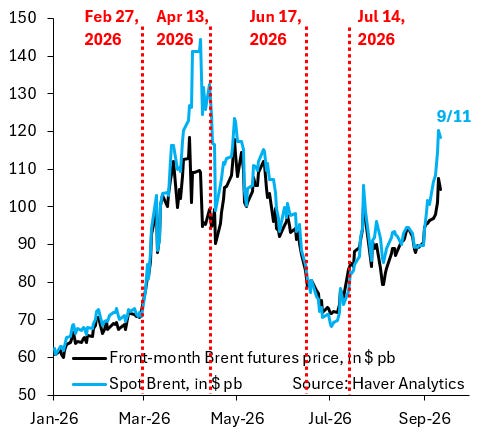
It’s essential to clarify that the recent attack wasn’t executed by the Houthis; instead, it was a drone assault originating from Iraq. This distinction is significant, as it implicates Iran as a key orchestrator rather than a proxy. While there have been issues with Houthi activities causing reductions in oil exports from Yanbu — the Saudi terminal at the end of the East-West pipeline — these disruptions had already been factored into market prices that stabilized around $90 per barrel for Brent oil.
Analyzing the Price Surge
The sharp increase in oil prices appears to be an overreaction by the market. Yanbu maintains storage facilities that can be utilized to sustain oil exports while repair work on the pipeline is conducted. Therefore, the incident does not represent a substantial threat to global oil supply. Recent market movements indicate a notable divergence between spot prices and futures prices for Brent crude, suggesting panic buying in response to the situation. Historically, such disconnections tend to correct themselves swiftly, hinting that the current premium for Brent may not hold.
The Real Value of Brent Crude
When analyzing what should be priced into Brent crude, it’s important to consider a range of scenarios. The worst-case analysis suggests that if Yanbu were to become entirely inactive, the oil market could see a drop of up to 4 million barrels per day. However, this is a hypothetical that exaggerates the situation, as expert estimates indicate repairs will likely be completed within a week. Consequently, current prices may be approximately $10 higher than justifiable given the foreseeable supply situation.
Iran’s Decreasing Influence in the Region
While the pipeline attack may seem serious, the overarching takeaway is that the actual disruption to the oil supply chain is minimal. A more pressing concern for Iran is its diminishing control over the Strait, as evidenced by data reflecting an increase in oil exports from U.S. allies in the Gulf. Since the reintroduction of U.S. sanctions against Iran, Iranian oil exports have plummeted to zero, indicating a strategic shift in regional control. The increase in oil output from Gulf ports suggests that the market is stabilizing rather than deteriorating, dismissing alarmist perspectives driven by recent events.
In conclusion, the market’s reaction to the East-West pipeline attack was largely disproportionate to its actual implications for global oil supply. Though initial confusion may have fueled the response, indications are that the situation is manageable and supply shocks are receding as Iran’s grip on the Strait weakens. Thus, maintaining a measured view of the market will be crucial as conditions evolve.