
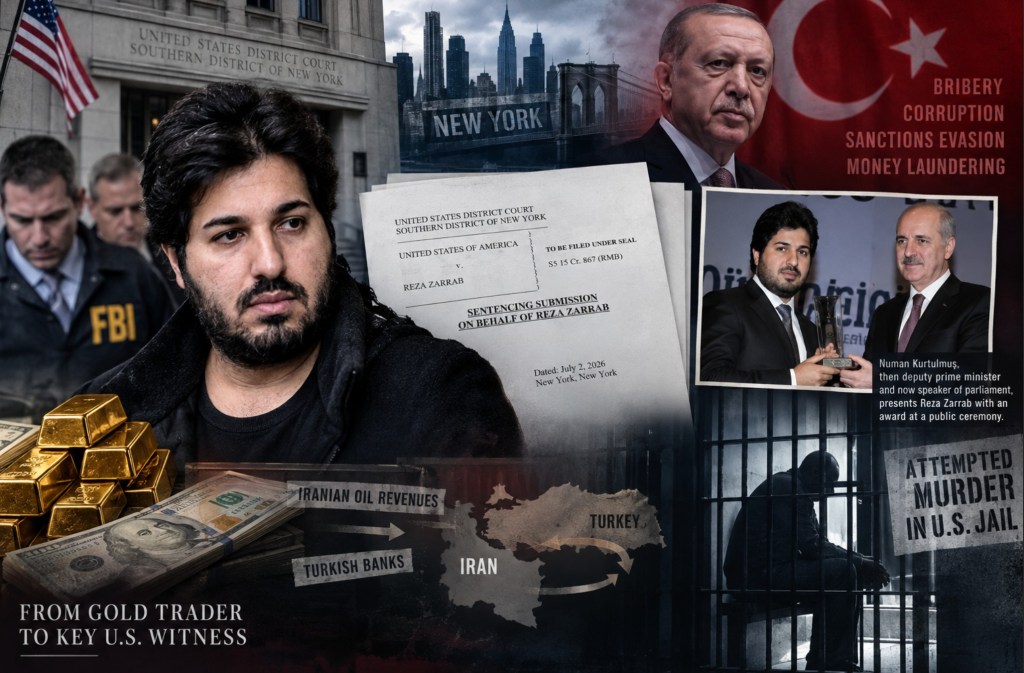
The case of Reza Zarrab, an Iranian-Turkish gold trader, has unveiled shocking claims against the Turkish government regarding attempts to silence him amidst a complex sanctions-evasion scandal. A recent federal court memorandum highlights allegations that the Turkish authorities plotted to murder Zarrab while he was in U.S. federal detention, as he cooperated with prosecutors investigating widespread violations of sanctions against Iran involving high-ranking Turkish officials, including President Recep Tayyip Erdoğan.
Allegations of a Murder Plot
The memorandum, submitted on July 8, 2026, details that Zarrab was actively collaborating with U.S. authorities while confined at the Metropolitan Detention Center. Despite measures aimed at concealing his cooperation, rumor spread among inmates regarding his alignment with the prosecution. This led to a harrowing incident in November 2017, where an inmate allegedly hired to kill Zarrab confronted him with a knife, threatening his life should he continue to assist the U.S. prosecutors. The source of the threat remains undisclosed but is described in the memorandum as an extreme act on the part of Turkey to retaliate against Zarrab’s cooperation.
Retaliation Tactics by Turkish Authorities
The alleged assassination attempt was only a part of a broader strategy to undermine Zarrab’s testimony against significant political figures involved in the corruption scandal. His defense team claims that around the time of his testimony at Mehmet Hakan Atilla’s trial, several of Zarrab’s employees were arrested in Turkey, likely as an intimidation tactic to pressure Zarrab into silence. Furthermore, Turkish authorities conducted midnight raids to intimidate Zarrab’s associates days prior to his pivotal testimony, which ultimately exposed extensive corruption in government-sanctioned operations facilitating Iranian access to restricted funds.
Zarrab’s courtroom accounts proved crucial, as they detailed intricate mechanisms by which Turkish institutions facilitated Iranian financial transactions despite U.S. sanctions. Following his cooperation, Turkish authorities reportedly escalated their retaliation, re-arresting previously detained employees and launching what his attorneys deem incoherent legal investigations against him, aimed at punishing him for his actions. As a consequence of these measures, significant assets belonging to Zarrab and his family were seized, creating a harsh financial environment that his lawyers argue went beyond standard enforcement measures.
Long-Term Implications of Zarrab’s Testimony
After a turbulent legal journey, including his arrest in the U.S. in 2016 and subsequent guilty plea for various charges such as money laundering and bank fraud in 2017, Zarrab testified for several days about the extensive sanctions-busting operations involving senior Turkish officials. His revelations have significantly impacted U.S.-Turkey relations, as they demonstrated how high-level corruption allowed Iran to circumvent international sanctions. The U.S. legal actions against Halkbank, the state-run Turkish bank implicated in these operations, continue to create tensions between the two countries.
Zarrab’s ordeal reflects not just a personal struggle but also highlights systemic issues regarding judicial integrity and political influence within Turkey. The Turkish response, which included not only legal actions against him but also threats to his life, underscores the lengths to which the government was willing to go to silence him—a characteristically bold move that has raised questions about the wider implications for whistleblowers and witnesses involved in corruption scandals linked to powerful political figures.
In summation, the allegations against the Turkish government concerning Zarrab’s attempted assassination while in U.S. custody reveal a complex web of corruption, retribution, and power dynamics that extend beyond an individual case, shedding light on the precarious nature of justice in politically charged environments. As Zarrab’s defense team seeks to have him sentenced to time served, this unfolding saga continues to capture international attention and encapsulates the fight against corruption and the safeguarding of judicial accountability.