
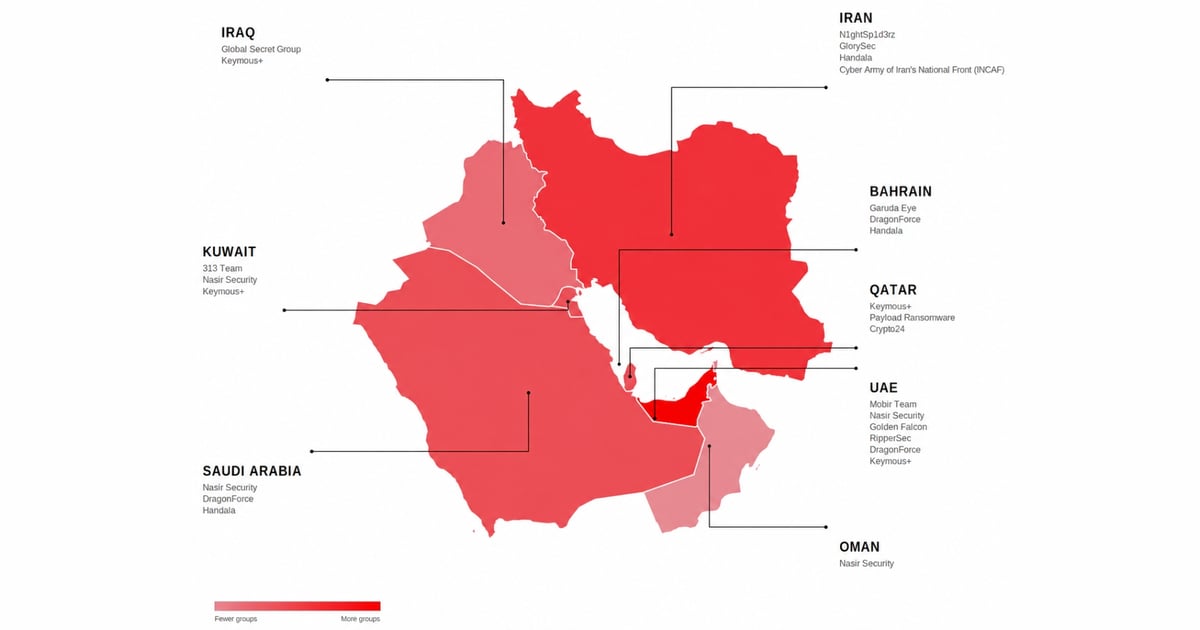
The landscape of cybersecurity in the Middle East is rapidly evolving, marked by an alarming increase in cyberattacks. These threats are often financially motivated, and their rise occurs amidst ongoing military tensions in the region. As nations push towards greater digitalization, the vulnerabilities that come with it become increasingly apparent.
Rise in Cyberattacks in the Middle East
Recent findings from threat intelligence firm Positive Technologies reveal that the United Arab Emirates (UAE), Iran, and Saudi Arabia are the epicenters of cyber incidents, accounting for roughly two-thirds of all attacks analyzed through open-source intelligence. The surge in digital transformation initiatives within these nations has expanded their attack surfaces, making them attractive targets for cybercriminals. Positive Technologies noted that both the UAE and Saudi Arabia are focusing heavily on modernizing their public and private sectors, inadvertently creating larger vulnerabilities for exploitation.
The data also indicates that while politically motivated groups often ramp up their activities during periods of conflict, financially driven cybercriminals are not lagging behind. Darya Lavrova, a lead analyst at Positive Technologies, asserts that these criminals are increasingly targeting critical infrastructure across various sectors. Despite widespread attacks, many incidents go unreported due to concerns surrounding reputational impact, suggesting that the actual threat landscape could be far more severe than indicated.
Types of Cyber Threats and Their Impact
A staggering statistic reveals that organizations in the UAE and Saudi Arabia have been subjected to nearly 2,700 cyberattacks per week. This figure contrasts sharply with the global average of 2,300 weekly attacks for typical organizations, emphasizing the intensity of the threat faced in these countries. The predominant form of attack focuses on exploiting information-disclosure vulnerabilities, impacting 62% of affected entities. Other significant methods include remote code execution and authentication bypass, marking a noteworthy escalation in the types of attacks being launched.
Ransomware, botnets, and information-stealing malware have also noticeably increased in the region compared to global averages. As attacks become more sophisticated, there has been a shift from easily detectable exploits—like Distributed Denial-of-Service (DDoS) attacks—to more covert operations aimed at critical infrastructure. This evolution signifies a worrying trend where cybercriminals focus on stealth and long-term infiltration rather than overt disruption.
Diverse Attack Profiles and Strategic Targeting
As cyber threats intensify, different nations display varied profiles of attackers. The ongoing conflict involving the U.S., Israel, and Iran drives numerous cyber incidents. However, the observed decline in DDoS attacks reflects a potential strategy shift among cybercriminals. Data shows that around 35% of all attacks target the UAE, while Saudi Arabia bears around 15%, indicating that these economies remain prime achievable targets.
Government entities are among the most frequently attacked, accounting for 27% of incidents, while cross-sector threats impact a similar 23%. Vulnerability exploitation has emerged as the most common entry point for cyberattacks, emphasizing the need for robust vulnerability management. It’s also notable that more than half of these incidents—58%—result in significant business disruption.
The Role of AI in Future Threat Proliferation
Artificial Intelligence (AI) is poised to reshape the cybersecurity landscape, particularly in the context of the Middle East. Industry experts warn that autonomous attacks are becoming increasingly viable. Dream Group’s CEO, Shalev Hulio, highlights the rapid evolution of attack capabilities, suggesting that adversaries can exploit vulnerabilities faster than defense mechanisms can respond. The integration of AI into cyber operations can dramatically increase the efficiency and effectiveness of threat actors.
Organizations, both public and private, must urgently reconsider their cybersecurity strategies. Reducing attack surfaces and upgrading outdated infrastructure, including legacy systems and IoT devices, is essential. As Lavrova points out, AI-driven threats will relentlessly probe for weaknesses, making it crucial for organizations to enhance their defenses in this new era of cyber warfare. As cybersecurity becomes a matter of national security, swift adaptation is imperative to mitigate risks associated with these advanced threats.