
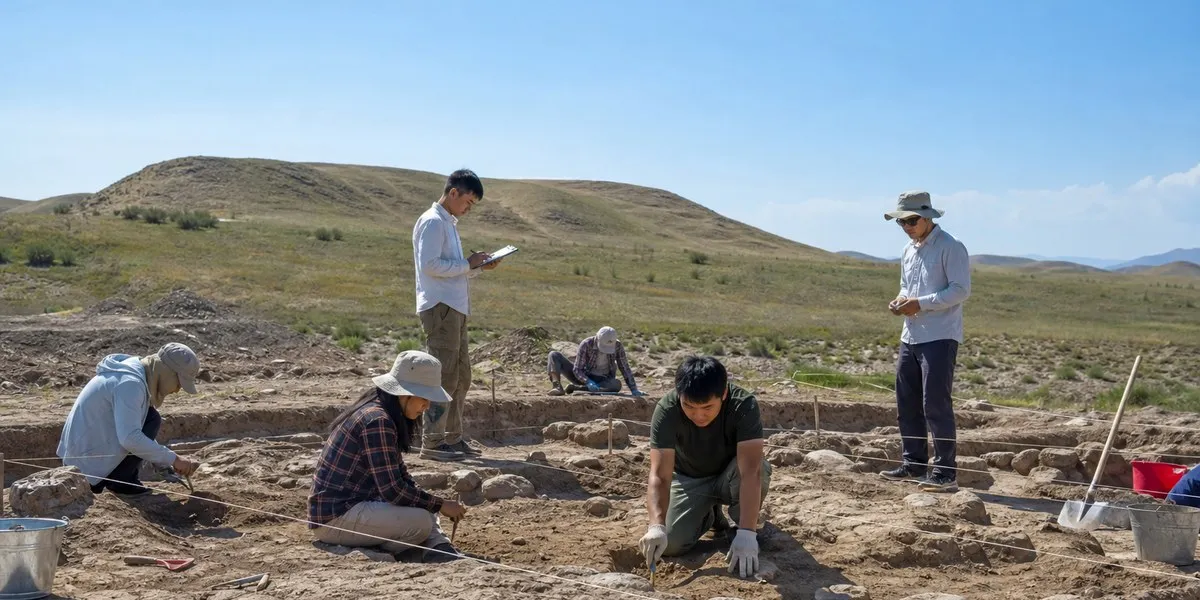
On September 24, China’s National Cultural Heritage Administration announced exciting results from three archaeological collaborations in Egypt, Tunisia, and Kyrgyzstan. These projects uncovered a mysterious sacred lake adjacent to an Egyptian temple, significant archaeological remnants in Tunisia, and numerous ancient urban sites in Kyrgyzstan’s Chu River basin, shedding light on historical aspects of these regions.
New Discoveries at the Luxor Temple
A collaborative effort between Chinese and Egyptian researchers led to the discovery of a sacred lake at the Montusite Temple in Luxor, measuring over 50 square meters. This adds to an earlier find of another sacred lake in the northern area of the temple complex. The two lakes create a distinctive layout, indicating the temple’s importance in ancient religious practices. This revelation enhances our understanding of the temple’s functions and rituals, illustrating its role in the spiritual life of ancient Egyptians.
Insights from Tunisia’s Ben Arous Forest
In Tunisia, the archaeological team, combining Chinese and Tunisian expertise, explored the Ben Arous Forest site. Their efforts unveiled structural remnants, reservoirs, ash pits, and kilns dating back to both the Punic and Roman eras. The excavated area spans approximately 20,000 square meters, revealing sections that included temples, homes, baths, and workshops. This comprehensive excavation not only showcases the daily life of its ancient inhabitants but also highlights significant cultural exchanges that took place during that time. As a part of their initiative, the team established an archaeological park, enhancing the site’s educational value through landscaping and contextual displays.
Kyrgyzstan’s Ancient Urban Landscape
Meanwhile, in Kyrgyzstan’s Chu River basin, the joint research efforts of Chinese and Kyrgyz scholars have borne fruit since their excavations commenced in 2018. The Krasnaya Rechka archaeological site yielded the identification of 24 ancient city sites, which are crucial for understanding the evolution of urban structures and cultural interactions along the historic Silk Road. These findings not only illuminate the complexities of past civilizations but also promote further study into the region’s role in ancient trade networks and social dynamics.
With these groundbreaking archaeological outcomes, the collaborative efforts of researchers from China, Egypt, Tunisia, and Kyrgyzstan contribute significantly to our understanding of historical civilizations. As discoveries continue to emerge from these sites, they hold the potential to shape modern perspectives on cultural heritage and historical narratives, reinforcing the interconnectedness of global ancient societies.