
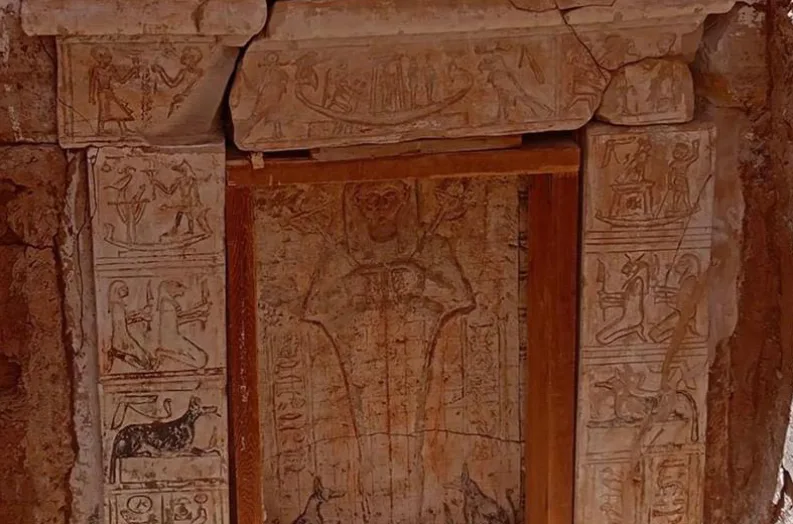
Egyptian archaeologists have made an exciting discovery in the Dakhla Oasis: a Roman-era tomb shaped like a pyramid, adorned with ancient Egyptian funeral imagery and an inscription in Ancient Greek. This unique find highlights the cultural blend of Egyptian, Greek, and Roman traditions during that era, as reported by Ahram Online and UNN.
Tomb Discovery Overview
The recently unearthed tomb is constructed from mud bricks and is located within the Bir al-Shaghala necropolis. Archaeologists speculate that the tomb may have served as a final resting place for a man and his spouse. Among the items recovered, a significant stone funerary stele stands out, containing a poignant 19-line lament written in Ancient Greek. This text is dedicated to a man named Pisecht, who preliminary evaluations suggest may have held a position as a judge. The inscription is estimated to date back to the late 3rd to early 4th century AD.
Afterlife Imagery Inside the Tomb
Access to the tomb is gained via a staircase of fourteen steps leading to a beautifully decorated entrance. This entryway features hieroglyphic funerary spells, a winged solar disk, and striking representations of cobras. Furthermore, archaeologists uncovered an astonishing scene from the “Imi-Duat,” an ancient Egyptian text detailing the journey through the afterlife. This portrayal is noted as a first within the necropolis, signifying its exceptional nature.
Within the tomb, researchers found a hall topped with a vaulted ceiling and two burial chambers, all beneath a pyramid-shaped structure. Additional artifacts include an offering table, ceramic vessels, and a bronze coin depicting the Roman emperor Constantine. These discoveries enhance our understanding of the rich burial customs that blended various cultural elements.
Cultural Significance of the Findings
The excavation reveals the potential for the tomb to have been reused at a later point, underscoring the complex interplay of funerary practices among the Egyptians, Greeks, and Romans in the Dakhla Oasis. The artifacts and inscriptions not only provide insights into individual lives, such as that of Pisecht, but also reflect a broader tapestry of interwoven traditions that shaped how these cultures viewed death and the afterlife.
This exceptional find not only adds to our knowledge of the region’s history but also highlights the significance of archaeological research in uncovering the multifaceted heritage that exists in places like the Dakhla Oasis. As research continues, the site promises to reveal even more fascinating insights into the beliefs and practices surrounding death and the afterlife in antiquity, serving as a vital resource for historians and archaeologists alike.
In conclusion, the discovery of this pyramid-shaped tomb showcases the rich cultural interconnections present during the Roman era in Egypt, offering invaluable glimpses into historical practices and beliefs.