
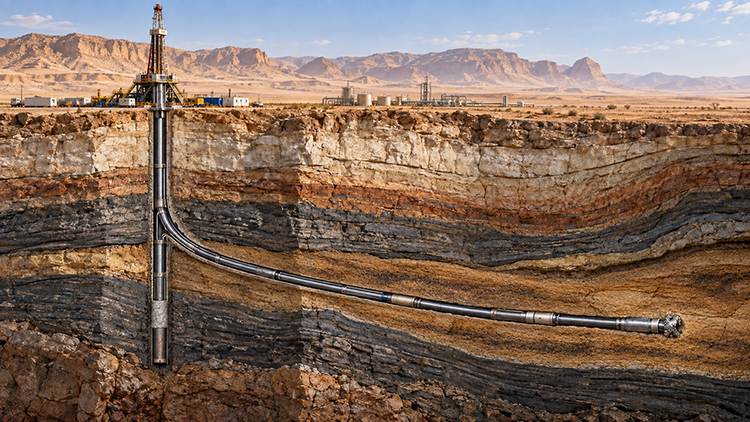
Not every oil well optimally performs on its initial drilling attempt. Often, issues like misalignment or depletion of available hydrocarbons can impede expected production levels. In established fields, operators know that hydrocarbon resources may still exist, but the high costs of drilling new wells pose a significant challenge. This is precisely where sidetrack drilling technology comes into play, offering a feasible alternative to traditional drilling.
Understanding Sidetrack Drilling
Sidetrack drilling offers a second chance for underperforming wells. Instead of beginning anew at the surface, engineers can redirect the drill bit away from the original borehole at a certain depth, creating a new underground pathway. This allows access to areas previously overlooked or to navigate around blockages. As Hesham Al Khateeb, a geo-engineering expert, highlighted, “A sidetrack can reach new geological targets, avoid unusable sections, or rectify poor drilling paths. By utilizing the existing wellbore, it significantly reduces costs and enhances efficiency.” First introduced with directional drilling techniques in the 1920s, sidetrack drilling gained notoriety during the 1934 Conroe oilfield incident in Texas, where it was employed to control a raging gas well fire.
Reviving Older Wells
According to Al Khateeb, sidetrack drilling presents a strategic solution for wells that have been temporarily abandoned or are not meeting production expectations. “Instead of permanent shutdowns, a sidetrack can provide access to untapped reserves when primary reservoirs become exhausted,” he explained. This technology improves extraction efficiency by correcting deviations in wellbores or targeting more permeable zones, ultimately revitalizing aging wells. “Sidetracking can dramatically enhance production rates and extend the operational life of assets, proving economically beneficial for continued field activities,” he noted.
The Economics of Sidetrack Drilling
In offshore regions where operational costs are typically elevated, sidetracking is often a more cost-effective solution than drilling new wells. By extending the existing casing deeper or adding lateral extensions to reach new reserves, operators can leverage already established equipment without incurring additional expenses associated with rig relocations. Al Khateeb estimates that sidetracking can save between 30-60% of total well costs, making it a favorable option, especially in remote or high-cost environments.
Technical Aspects of the Sidetracking Process
The sidetracking process can differ based on individual well requirements, although it generally starts with identifying a suitable depth and direction for the new borehole. Engineers use a whipstock, a downhole tool designed to divert the drilling assembly, set at the designated depth to guide the drilling operation. Specialized milling tools then cut a window through the existing casing to create an exit point for the new wellbore. Modern drilling techniques, including measurement-while-drilling (MWD) systems, provide real-time updates on the well’s trajectory, allowing for precise and controlled directional changes. Ultimately, the new well can be directed to different reservoir targets or previously bypassed sections.
Recent projects, especially in Egypt, demonstrate the value of sidetrack drilling. BP’s Fayoum-4 well in the West Nile Delta exemplifies this, as it achieved an estimated production increase of 80 million cubic feet per day by sidetracking from an existing wellbore. This strategic approach not only optimizes existing resources but also contributes significantly to national energy supply.
In closing, sidetrack drilling, while an established technique, is experiencing a resurgence due to advancements in technology. This approach allows operators to tap into previously unrecoverable reserves, maximizing the economic potential of legacy wells and enhancing overall industry efficiency. By revisiting mature reservoirs, sidetracking serves not just as a remedial measure but as a strategic tool for optimizing oil and gas production.