
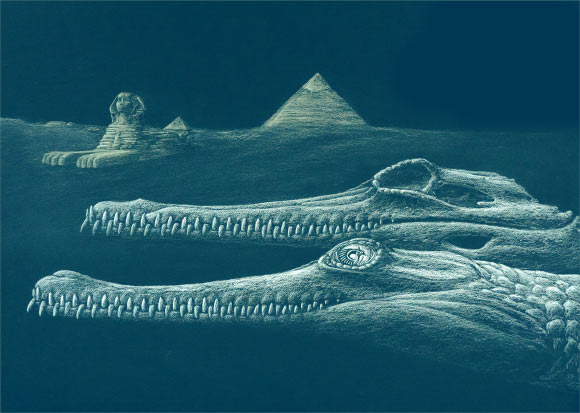
Recent CT scans of a fossil discovered near Cairo have revealed intriguing insights into ancient crocodilian species. Contrary to previous beliefs, this fossil is not closely related to the false gharial, previously thought to be a lineage representative. This significant discovery enhances our understanding of crocodilian evolution and diversity.
The Misleading Classification of Crocodilian Fossils
Historically, the gavialid crocodilian genus, represented today by the endangered false gharial species (Tomistoma schlegelii), was thought to encompass a wider range of fossil species across various epochs. “Fossils previously assigned to this genus hinted at a more diverse and geographically extensive distribution, stretching back to the Eocene in regions like Africa and Europe,” stated Professor Philip Mannion from University College London and his research team.
An example includes Tomistoma cairense, from Egypt’s Middle Eocene, which marked one of the earliest categorized members of this genus. Originally recognized in 1927, this species was documented through several fossil specimens, including a nearly complete skull hosted by the Staatliches Museum für Naturkunde Stuttgart.
Reconstructing Ancient Anatomy Through Modern Technology
Researchers applied advanced micro-CT scanning techniques to delve into the intricacies of the skull of Herugavialis cairensis. This modern method allowed for the precise reconstruction of its internal anatomy and provided essential comparisons with other related groups like the Indian gharial and additional gavialoids. An extensive evolutionary analysis involved assessing 152 species based on 331 distinct anatomical features.
The findings positioned the Egyptian fossil within the gavialoid family tree, but distinctly separated it from the contemporary false gharial lineage. Newly named Herugavialis cairensis, this species belongs to an earlier branch of the gavialine lineage, distinct from today’s gharials. Key characteristics include an elongated, narrow snout that constitutes roughly 64% of the skull’s total length, alongside eye sockets exhibiting raised rims.
The Evolutionary Story of Mediterranean Gavialoids
The research further examines the evolution of gavialoids in the Mediterranean region, indicating that at least six species thrived during the Paleogene period, with an additional six emerging in the Miocene. However, none have been identified in the Oligocene, implying a notable gap in their evolutionary record. It appears that Mediterranean gavialoids experienced significant declines during the Late Miocene, vanishing entirely before the onset of the Pliocene era. The research suggests that this decline could be linked to the Messinian salinity crisis, which dramatically altered the region’s climate and water systems.
Dr. Paul Burke, another researcher from University College London, elaborated on the historical context, stating, “For much of the last 50 million years, the Mediterranean was home to a diverse array of crocodiles, including gavials. However, this diversity wasn’t static; it fluctuated with global climate shifts and sea-level changes. Ultimately, by approximately 6 million years ago, the Mediterranean had dried significantly, leading to the extinction of all crocodilian species in the region.”
The team’s findings were recently published in the journal Royal Society Open Science, contributing valuable knowledge to the ongoing study of ancient crocodilian diversity and evolutionary patterns within the Mediterranean region. This research not only reshapes our understanding of Herugavialis cairensis but also emphasizes the need for continuous exploration and reassessment of existing classifications in paleontology.