
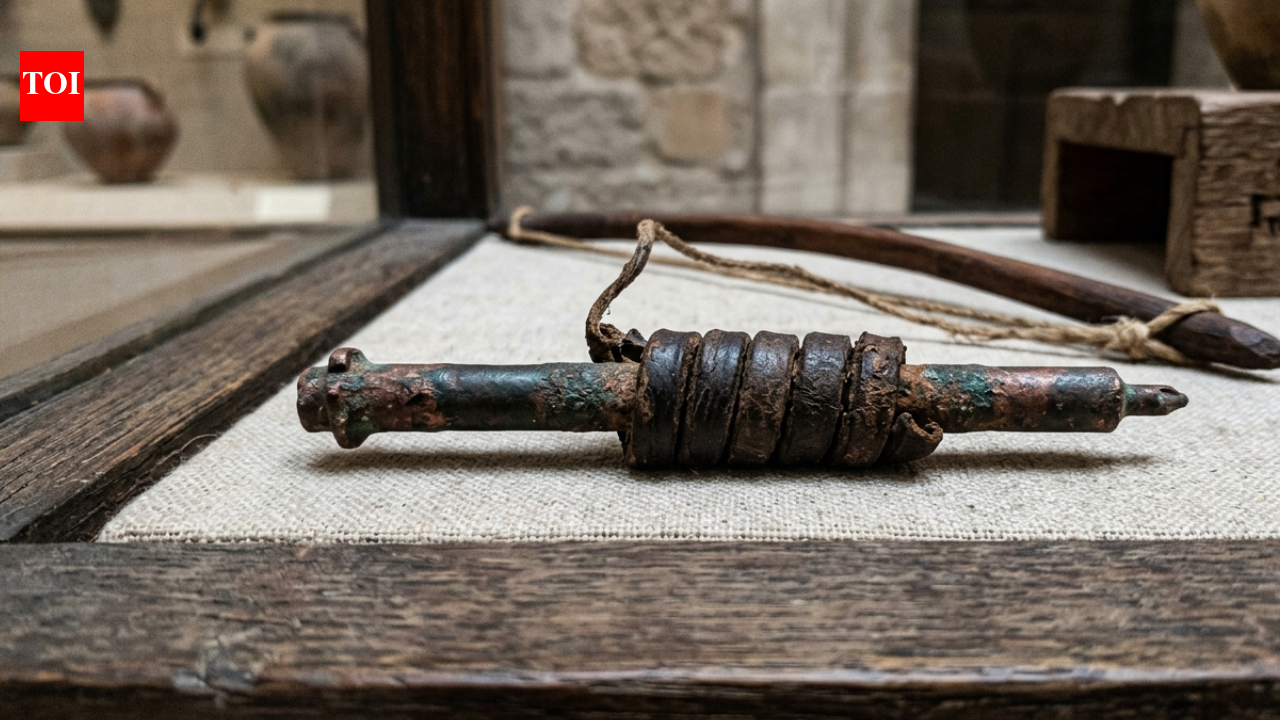
A small copper-alloy artifact found in a Cambridge museum has transformed our understanding of ancient Egyptian technology. Measuring only 63 millimeters and weighing about 1.5 grams, this seemingly modest object has been reinterpreted by researchers, revealing it to be a significant mechanical device dating back approximately 5,300 years. Originally identified as a copper awl, closer examination has identified this object as a rotary drill operated by a bow, shedding light on the advancements in early Egyptian craftsmanship.
Rediscovering the Badari Artifact’s True Nature
Excavated from a cemetery at Badari in Upper Egypt nearly a century ago, this artifact was long overlooked due to its modest size and unassuming description. However, it was during a recent study that archaeologists at Newcastle University uncovered its true purpose. The drill predates the era of the pharaohs and challenges previous timelines of technologically assisted drilling in ancient Egypt. Prior evidence of such tools, illustrated in tomb paintings from the New Kingdom, suggested that this technology was not in use until much later. This new finding pushes back the timeline, showing that Egyptians were experimenting with mechanically assisted tools long before documented history indicated.
The Mechanics of the Bow Drill
The bow drill operates on simple yet effective principles. A cord wraps around a slender shaft that features a pointed tip. When a bow moves back and forth, the cord spins the shaft, allowing it to create holes in various materials like wood, stone, and organic substances. This system significantly reduces the physical effort required compared to using an awl manually. For early artisans, the mechanical advantage of a rotary tool would have made their work more efficient, facilitating the creation of precise holes much quicker.
Unveiling Hidden Clues
The artifact, catalogued as 1924.948 A in the Museum of Archaeology and Anthropology at the University of Cambridge, contains finer details that reinforce its classification as a drill. The metal shows wear patterns that suggest a rotary function rather than the typical use of a simple pointed tool. Moreover, the preserved leather coils, which were found attached to the metal shaft, indicate the means by which the tool was operated. These ancient remnants support the theory that the people of the late fourth millennium BCE were already applying complex mechanical techniques in their daily tasks.
Insights into Ancient Egyptian Metallurgy
The investigation also revealed the unusual composition of the copper-alloy, containing arsenic, nickel, lead, and silver. This combination provokes further questions about the practices of early Egyptian metalworkers and their knowledge of metallurgy. Researchers speculate that the unique alloy might have been a result of deliberate alloying strategies or the influence of trading networks that circulated across the eastern Mediterranean in the fourth millennium BCE. Such findings open up broader discussions regarding the technological exchanges and material cultures of ancient civilizations.
In conclusion, the study of this seemingly inconsequential artifact illustrates the potential of archaeology to reveal hidden layers of history. As more researchers approach old collections with new questions, many other overlooked objects could yield invaluable insights into ancient technologies and practices, changing the narrative of human innovation in different eras. The Badari drill’s journey from a catalogued item in a drawer to a significant piece of evidence highlights the dynamic nature of archaeology—where the past continuously unfolds with new interpretations.