
Egypt is focused on increasing its mining sector’s contribution to the economy, aiming to elevate it from under one percent of GDP to approximately six percent. Achieving this ambitious target hinges on retaining value within the country rather than merely extracting minerals.
The Importance of the Value Chain in Mining
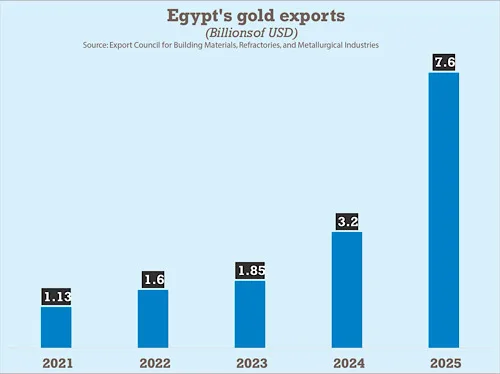
In the realm of economics, a mining operation’s true impact lies within its value chain. The success of Egypt’s mining aspirations will depend on how well this chain can enhance national wealth. Recent data indicates that Egypt’s gold exports surged to $7.6 billion in 2025, doubling from the previous year’s $3.2 billion. Gold has now joined the ranks of vital income streams, sitting alongside the Suez Canal and remittances to bolster foreign currency reserves. However, this boost reflects more about fluctuating gold prices than an increase in mining capacity. Export figures often illustrate gross revenue rather than the actual economic value added by the sector.
Understanding GDP Targets
The official target seeks to expand mining’s share of GDP from below one percent to a striking six percent. Interpreting this statistic as a production goal focuses on raw extraction figures like ounces and tons, but when evaluated as a GDP target, it emphasizes domestic value addition, a more complex challenge. Given an overall economy estimated at approximately $350–400 billion, achieving six percent implies generating $20–25 billion annually in value added. This figure suggests that to reach such heights, total mining output would need to be around $40–50 billion, multiple times current gold exports. However, realizing this target requires coordinated efforts across five key areas.
Five Essential Channels for Growth
The first requirement is significant investment. Exploration is inherently risky, and mine development demands capital, with projects costing hundreds of millions of dollars. A sixfold increase in the mining sector indicates that tens of billions of dollars must be invested over several years, primarily from foreign sources.
The second channel involves production diversification. Gold alone cannot meet the GDP target; minerals like phosphate need to scale up as well. Each of these resources brings its own geological characteristics, customer bases, and logistical requirements.
Next is processing. Raw minerals or concentrates yield only a fraction of the value derived from refined products. By focusing on beneficiation, where ores are transformed into finished goods, Egypt can enhance its job market and establish an industrial base.
The fourth channel is the enhancement of domestic supply chains. Egypt can tap into local services for mining equipment, engineering, and logistics, reducing dependence on foreign imports. Every dollar spent abroad represents potential GDP that is lost to the local economy.
Advancements in Regulatory Framework
Cairo has taken significant steps to improve its regulatory landscape for mining. In May 2026, substantial amendments to the Mineral Resources Law reduced exploratory area rents by up to 60 percent. These reforms also streamlined project approvals to 30 days and permitted multiple minerals to be explored under a single concession. Moreover, the government’s share in joint ventures decreased from 25 percent to 10 percent, making projects more appealing to outside investors.
While these changes effectively address the economic sensitivities of exploration costs and timelines, they do come with trade-offs. The decreased government stake leaves less financial upside for the state during lucrative discoveries. However, increased license applications signal positive interest. The challenge will be whether this interest translates into actual mining developments.
Infrastructure as a Critical Factor
Lastly, the geographical challenges inherent in many of Egypt’s mineral deposits can affect the viability of mining operations. Many resources are located in the Eastern Desert, far from vital industrial centers, making robust infrastructure indispensable. Effective mining requires a reliable supply network that includes roads, electricity, water, and security measures.
In these marginal deposit areas, investing in shared infrastructure can significantly influence the feasibility of projects. If the government invests in essential utilities and logistics, it lowers barriers for multiple projects across a region, potentially spurring a wave of mining investment that far surpasses mere regulatory changes.