
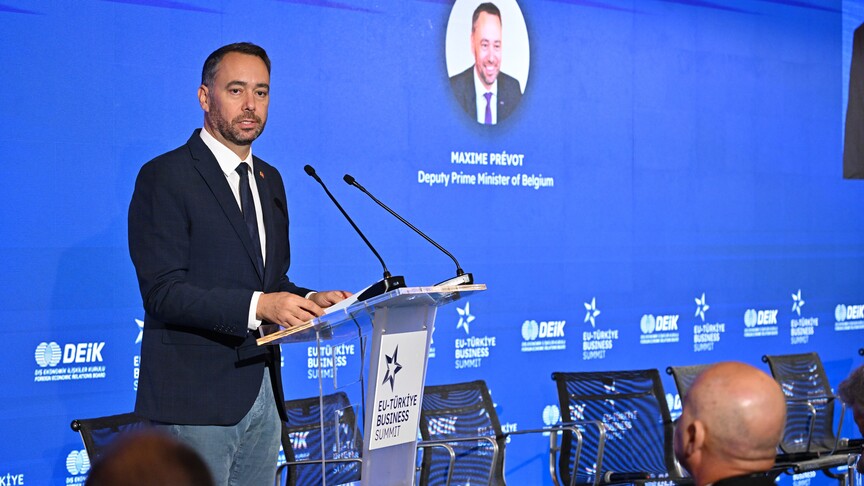
Turkey plays a pivotal role in Europe’s quest to reduce its strategic dependencies, particularly within critical industrial sectors. This was articulated by Belgian Foreign Minister Maxime Prevot during remarks at the EU-Turkey Business Summit held in Brussels.
Shifting Global Dynamics and Economic Vulnerabilities
Prevot addressed the conference by highlighting the evolving global landscape, underscoring how factors like the ongoing conflict in Ukraine and significant disruptions in supply chains have led European nations to a heightened awareness of their economic fragilities. He stated, “Turkey has a crucial role to fulfill, not only as an industrial market but also as a gateway to broader regional markets.” This indicates that Turkey’s industrial capacity and proximity to various neighboring markets are invaluable assets for European nations looking to bolster their supply chain resilience.
The call for European companies to reassess their production and goods storage locations is becoming increasingly urgent. As a result, many European businesses are identifying Turkey as a reliable partner. “We must leverage the advantages of its proximity, especially in sectors where Europe must lessen its strategic dependencies,” Prevot emphasized. This alignment allows for a mutually beneficial relationship that can enhance economic security.
The Importance of Economic Cooperation
Prevot characterized Turkey as a NATO ally, an EU candidate nation, and a vital industrial economy serving as a bridge between Europe, Asia, and the Middle East. He expressed that Turkey’s capabilities could play a significant role in crafting more resilient supply chains within Europe. To this end, the Belgian Foreign Minister called for enhanced economic collaborations between Brussels and Ankara, particularly focusing on sectors like economic security, defense, innovation, clean energy, and digital technologies.
“Our economic relationship should evolve beyond mere transactions of goods. We ought to engage in joint development, production, and investment,” he stated. Such a shift could lead to not only economic growth but also greater strategic alignment between the two regions.
Modernizing Existing Agreements
The discussion also touched upon the necessity of modernizing the EU-Turkey Customs Union. Prevot asserted that while this agreement has benefited both economies over the last three decades, it must be updated to reflect contemporary global economic realities. This modernization can serve as a catalyst for deeper economic ties, allowing for increased trade and investment opportunities.
Prevot also shared insights from a recent Belgian economic mission to Istanbul and Ankara, which attracted over 400 participants and culminated in the signing of 33 agreements across diverse sectors like defense, aerospace, energy, and technology. He described the outcomes of this mission as promising, signifying a strong foundation for future partnerships.
Looking Toward the Future
The second iteration of the EU-Turkey Business Summit aims to gather influential figures from business, government, and civil society to explore how economic interdependence can be transformed into strategic resilience. As Europe navigates its economic future, Turkey stands as an essential ally, fostering closer ties and collaborative ventures that can benefit both parties in the evolving global landscape.