
In a remarkable archaeological find, a local farmer has uncovered significant artifacts from ancient Egypt in the Nile Delta. This discovery sheds light on the region’s rich history and highlights the importance of civic responsibility in preserving cultural heritage.
Discovery of the Stone Head
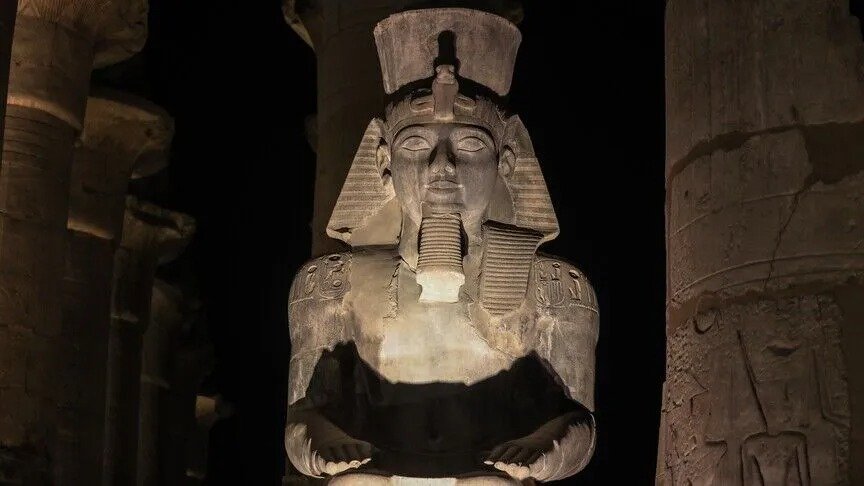
While working on his land in Behbeit el-Hagar village, Khaled El-Shahat Khalil unearthed a remarkable stone. Recognizing that it might hold historical significance, he promptly informed the local antiquities authorities. This action led to further excavations in the area, revealing a striking 1.6-meter-tall stone head of Ramses II. This head features the double crown, a powerful symbol denoting the unification of Upper and Lower Egypt, marking a crucial aspect of the pharaoh’s legacy.
Uncovering Royal Statues
Continuing their exploration, archaeologists discovered much of a second statue that stands at an impressive 2.4 meters. This statue is believed to represent Ramses II as well, adorned with a traditional royal headdress. The head showcases well-preserved facial features, providing invaluable insight into the artistic craftsmanship of ancient Egypt. These findings not only deepen our understanding of Ramses II’s portrayal but also contribute to the overall study of ancient Egyptian sculptures and their cultural significance.
Inscriptions on Pink Granite
In addition to the statues, researchers located a 1.3-meter block of pink granite inscribed with hieroglyphics. These inscriptions include two royal titles attributed to the ancient pharaoh, offering further context to his reign and authority. Such artifacts are vital in decoding the historical narrative of ancient Egypt, allowing historians to piece together the life and times of one of its greatest rulers.
Recognition for Civic Responsibility
Khaled El-Shahat Khalil’s integrity in reporting his discovery earned him commendation from officials. On a recent visit, Tourism and Antiquities Minister Sherif Fathy and Gharbia Governor Alaa Abdel Moaty acknowledged Khalil’s contribution to preserving the cultural heritage of Egypt. In recognition of his civic responsibility, both he and his wife received a certificate of appreciation along with an Umrah pilgrimage to Mecca. This highlights how individual actions can play a significant role in the preservation of archaeological sites.
Khalil’s decision to report the find has proven crucial for archaeologists, ensuring a thorough investigation and preservation of the area’s historical treasures. The incident presents a compelling argument for the need for ongoing community engagement in archaeological efforts.
Behbeit el-Hagar is not only significant for this recent discovery; it is also known for the remains of an ancient temple dedicated to the goddess Isis. This area is an essential part of Egypt’s extensive historical landscape, drawing interest from both tourists and historians alike. As more findings emerge, they continue to enrich our understanding of Egypt’s illustrious past and its civilization’s complex societal structures.
In conclusion, the recent archaeological discoveries in Behbeit el-Hagar highlight the intersection of local engagement and historical preservation. Khalil’s findings serve as a reminder of the valuable role that citizens can play in safeguarding their cultural heritage, illuminating the significance of cooperative efforts in the field of archaeology.