
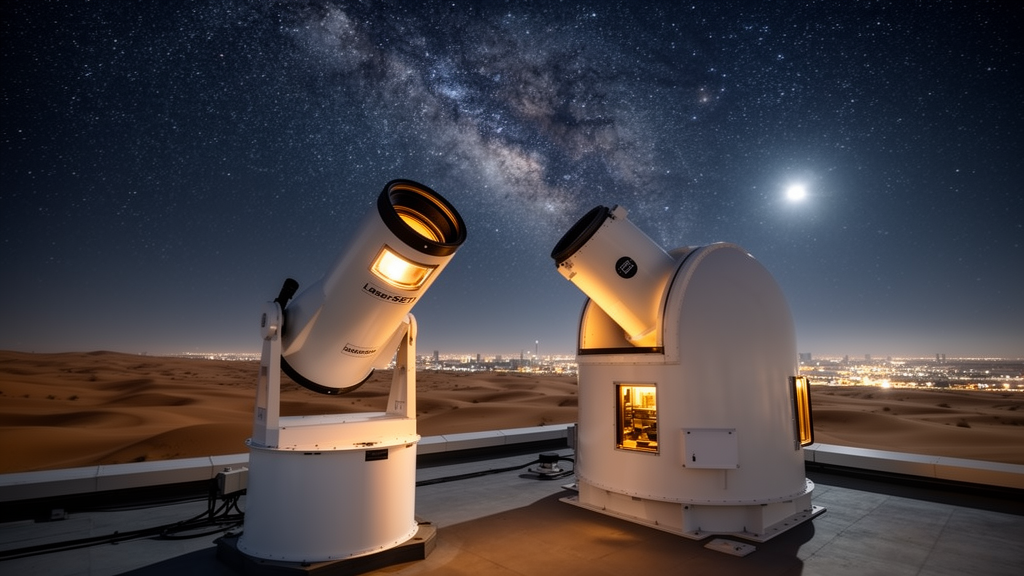
The installation of two LaserSETI stations in AlUla, located in northwest Saudi Arabia, marks a significant leap in astronomical endeavors. Through a collaboration between the SETI Institute and the Royal Commission for AlUla (RCU), this initiative positions AlUla as the first and only observation site in Asia for the LaserSETI network, which now spans five global locations. This new development not only enhances the continuous monitoring of the night sky but also reinforces AlUla’s commitment to advancing scientific research in the field of astronomy.
Innovative Monitoring of the Night Sky
LaserSETI, a project spearheaded by the SETI Institute, aims to monitor extensive portions of the sky, specifically searching for transient optical events or fleeting flashes of light. Unlike traditional telescopes that focus on specific celestial bodies, LaserSETI employs wide-field cameras and diffraction gratings to observe a broad range of the sky simultaneously. This innovative approach allows for the capture of short-lived cosmic occurrences, previously missed by conventional observation methods. By maintaining continuous vigilance, LaserSETI enhances the chances of identifying unusual astronomical phenomena and potential signals from extraterrestrial technologies.
The Importance of Location
The strategic placement of LaserSETI stations around the globe amplifies their observational efficacy. AlUla’s pristine dark skies present optimal conditions for detecting faint optical events, making it an ideal site for such monitoring. Furthermore, by expanding operations into Asia, the LaserSETI network is able to minimize gaps in global coverage that would otherwise occur with a network limited solely to the Americas. This addition not only amplifies observational capabilities but also facilitates the comparison of unusual cosmic events captured from diverse geographic perspectives.
Collaboration and Future Aspirations
The commissioning of these LaserSETI stations in AlUla represents a milestone in the collaboration between the SETI Institute and RCU. As Dr. Franck Marchis, a senior planetary astronomer at the SETI Institute, emphasized, the successful installation of these instruments enhances global observational efforts. Each new site within the network contributes both additional observational time and distinct vantage points for examining noteworthy optical phenomena. This cooperative strategy underscores the essential nature of worldwide collaboration in advancing astronomical research.
Broader Impact on Science and Education
This initiative not only advances scientific inquiry but also serves educational purposes. The partnership between the SETI Institute and RCU encompasses scientific publication opportunities and public engagement strategies, designed to bridge research and community involvement. By connecting AlUla’s exceptional dark skies with a broader global observatory network, new avenues for scientific investigation and international cooperation are established. This endeavor aims to showcase the marvels made possible by preserving dark-sky environments, while also engaging the public in the unfolding narrative of scientific discovery.
In summary, the installation of LaserSETI stations in AlUla is a pioneering effort to enhance the monitoring of brief optical events in the night sky. By leveraging strategic locations and fostering global collaboration, this initiative not only contributes to our understanding of the universe but also strengthens AlUla’s role in astronomy and scientific research. The ongoing dedication to scientific advancement in this region sets the stage for a bright future in both exploration and education in the field of astronomy.